
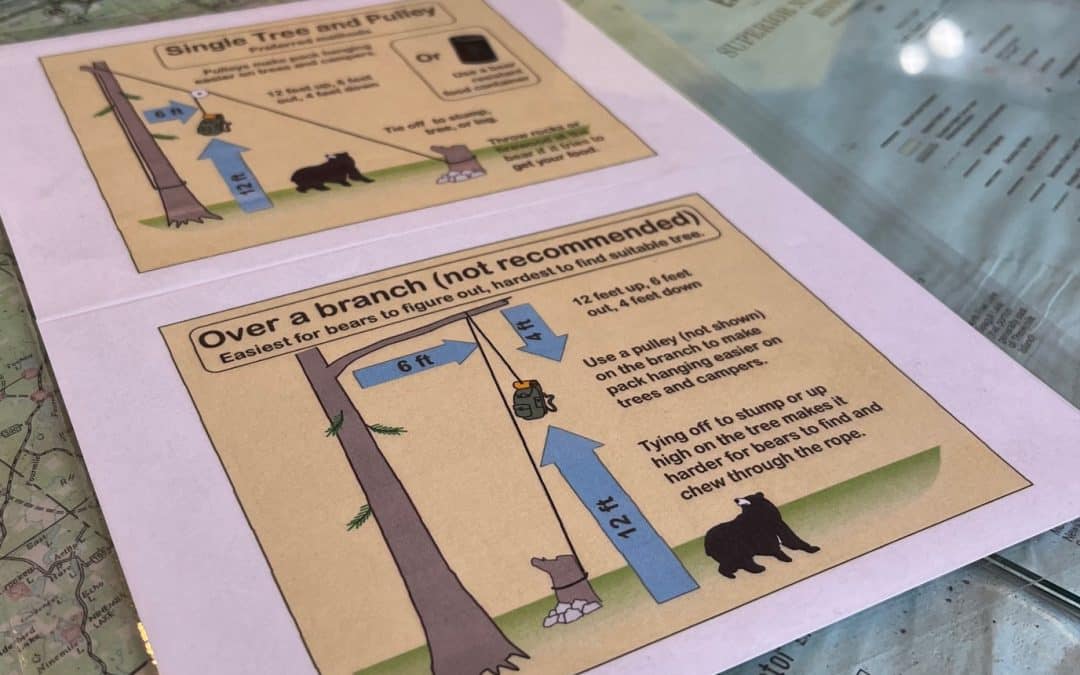

Recommendation for hanging food in the BWCA. Photo by Joe Friedrichs
BWCA Outfitters Say It’s Business as Usual as New Food Storage Rule Takes Effect

By Joe Friedrichs
For some of the outfitters on the edge of the Boundary Waters, it’s a modest change from a recommendation to a rule.
Not a big deal.
“A nothing burger,” as one outfitter described it to me.
I spent several hours May 16 touring the roads of the Tofte and Gunflint districts of Superior National Forest talking with numerous outfitters about a recent change in how visitors to the Boundary Waters Canoe Area Wilderness store and transport their food.
According to a Forest Service Order signed April 19, “In effect March 1-November 30 each year, except while being prepared, consumed, or under on-site visual observance, all food, food containers, scented items (such as soap, lip balm, toothpaste) and refuse shall be suspended at least 12 feet above the surface of the ground and not less than 6 feet horizontally from the trunk of a tree, or stored in an Interagency Grizzly Bear Committee certified bear resistant container.”
The order states that, “Any violation of this prohibition is punishable as a Class B misdemeanor by a fine of not more than $5,000 for individuals and $10,000 for organizations, or by imprisonment for not more than six (6) months, or both.”
In other words, you can be charged with a crime for violating the order.
The Forest Service sent a press release May 6 about the food storage order. Included in the press release is the following statement: “Our goal initially is to highlight the importance of all of us doing our due diligence to keep wildlife from becoming habituated. Except for gross violations or repeated violations, we intend to issue warnings for the first year of the order.”
In subsequent interviews, the Forest Service insists the fine for violating the order is $50. Forest Service officials have been sharing messages in the press in the aftermath of the rollout of policy shift from recommendation to law. As one outfitter shared with me this week, the Forest Service has been doing “damage control” following the response to the policy change.
Cathy Quinn, the Superior National Forest acting wilderness program manager, told WTIP radio in Grand Marais that “despite what a lot of people have focused on, unfortunately, early on in this media campaign about the food storage order, it’s a $50 fine.”
There’s no documentation in the forest order of a $50 fine.
By comparison, the forest order about food storage is like other things of consequence in the BWCA. No cans or bottles. No cutting live vegetation. No launching fireworks into the night sky. Do these things, and you’ll be fined. Violate the food storage order, and… maybe you’ll maybe be fined? It’s a gray area. Subjective. At least for now, according to statements made by the Forest Service following the rollout of the policy change.
It was a rainy Thursday driving up the Sawbill and Gunflint trails this week. A prescribed fire the Forest Service started and lost control of the day before smoldered a few ridgelines to the southwest. With the notion of putting out fires swirling about, I thought about my role in the situation with the food storage order. My story for Paddle and Portage was the first to break the news in the press of the forest order. I’ve talked with Superior National Forest spokesperson Joy VanDrie multiple times about the situation since my story was published May 4. The headline, I’ve told VanDrie, could have been less inflammatory. I fully acknowledge it could have been better. I’ve expressed similar sentiments to Quinn. I also told Forest Supervisor Tom Hall the notion of enacting the order to reduce bear-human conflicts makes sense.
Outfitters from the Tofte and Gunflint districts all agreed that taking steps to reduce bear-human encounters in the BWCA is a good idea. The outfitters said time and time again when I spoke with them that canoeists are showing up since the news broke of the food storage order prepared and ready to hang their food or keep it in one of the approved containers. Everyone is being compliant. It’s not a big deal. That was the theme. An outfitter agreed that my story, not necessarily the forest order, had caused quite a stir on social media. The outfitter explained that her business fielded some phone calls once the story spread on various BWCA social media sites. One caller, she explained, said they’d never heard of Paddle and Portage. They questioned if we were a satire site, similar to The Onion. On the surface, it seems a reasonable assumption.
“What kind of story would say you could end up in jail or be fined if you don’t store your food properly in the Boundary Waters?” became the running narrative.
The thing is, the reporting not only in my story, but in those from the Duluth News Tribune, Star Tribune, and Minnesota Public Radio, all make mention of the possible $5,000 fine and the possibility of jail time. Why? Because it’s in the order from the Forest Service.
Canoeists who paddle the BWCA in early or mid-May are often experienced wilderness travelers. These are often anglers, people who’ve done multiple trips to the BWCA, solo paddlers, and others beyond the novice stage. It’s therefore to be expected that these early-season paddlers will be prepared to deal with the forest order requiring them to hang their food or store it in a specialized container. What about the July and August paddlers? Will the novice wilderness traveler be prepared to hang food from a tree at a campsite in the BWCA? What if the trees in camp aren’t suited for hanging food? What does the inexperienced canoe camper do then?
Time will answer these questions. Time and progress. The two things that change everything.
Meanwhile, the “nothing burger” of changing the food storage recommendations to law is in place. For at least the next two years, a subjective determination can be made by wilderness rangers regarding if you’ll be charged with a Class B misdemeanor or not when it comes to how you travel with and store your food in the wilderness.
Learn more about food storage in the BWCA in this video from the Forest Service.
Other Recent Articles

A Visit to Sigurd Olson’s Listening Point as Senate Nears Vote to Reverse Mining Ban
Photo from inside Sigurd Olson's house in Ely, now the headquarters for the Listening Point Foundation. Photo by Joe FriedrichsA bill that was introduced by a Minnesota Congressman to overturn a 20-year mining ban near the Boundary Waters is heading to the Senate...
Talking Boundary Waters Politics with Candidate for Minnesota Legislature
Joe Friedrichs (left) talks with Minnesota District 3A Candidate Aaron Kania during the Ely Winter Festival. P&P photoFresh off his retirement from the U.S. Forest Service, Aaron Kania announced in January 2026 his candidacy for the Minnesota House of...
Chicago Man Recounts Experience Breaking Through Ice Near BWCA’s Stairway Portage
Ice hole on the Duncan narrows. Photo by George PastorinoDUNCAN LAKE – George Pastorino knew the sound. The ice was giving way underneath him and soon at least part of his body would be in the water. A casual snowshoe trek Wednesday, Feb. 4 in the Boundary Waters...