
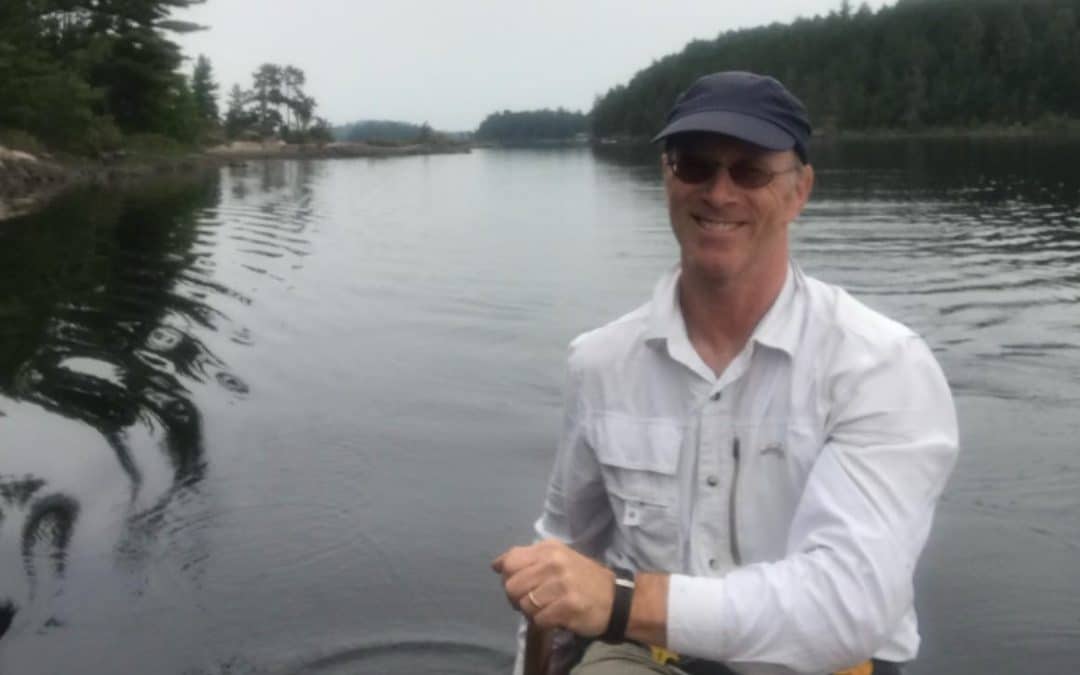
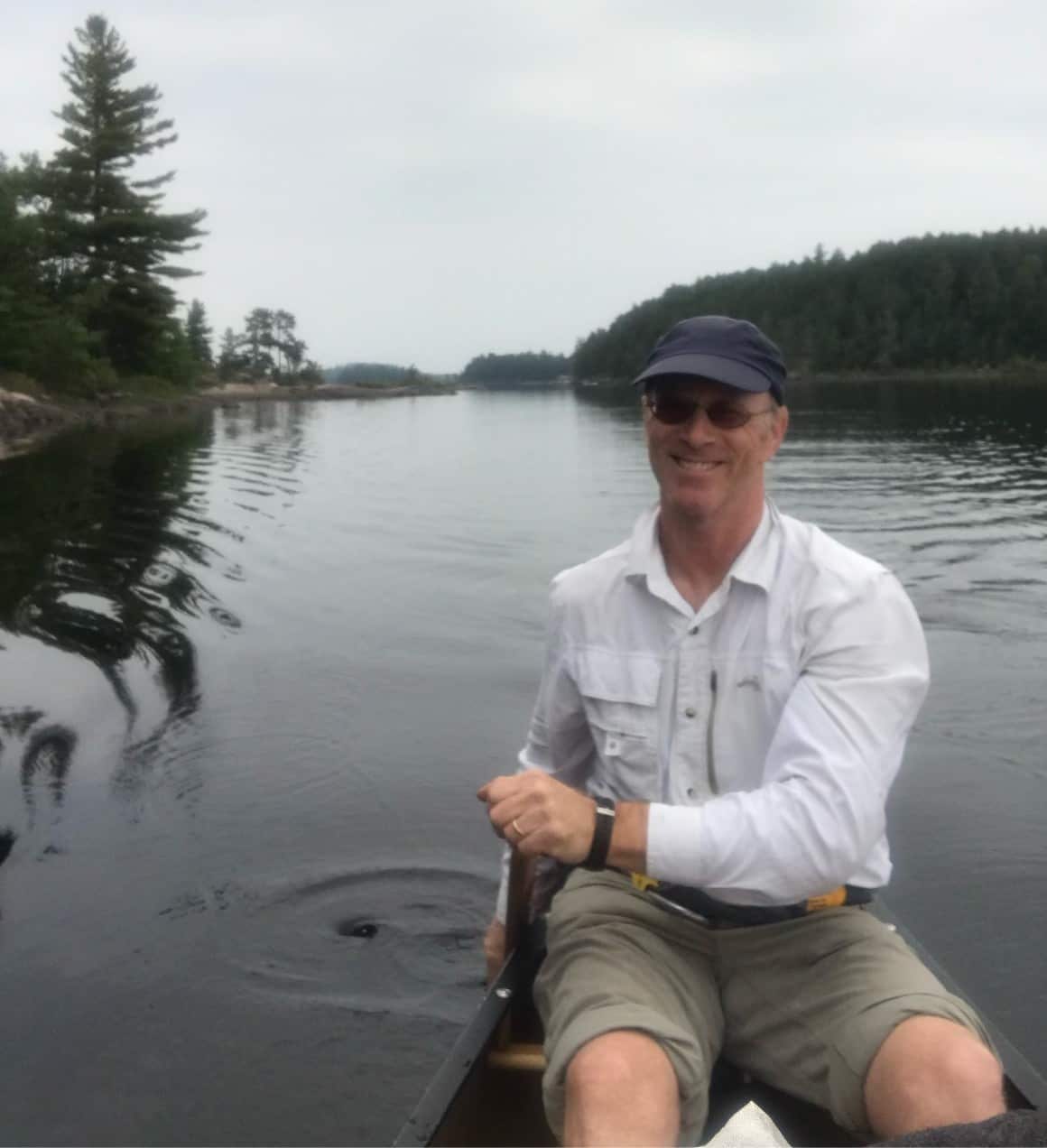
Mark Ham paddles in the BWCA. In this photo, Mark is wearing an NRS Zephyr PFD. Submitted image
Duluth Man Died in His Favorite Place: The Boundary Waters

By Joe Friedrichs
DULUTH – He didn’t have enough stubble.
That’s one of the first observations that Will Ham and his mother, Cathie, made when they saw their father and husband, respectively, after he was found dead in the Boundary Waters Canoe Area Wilderness this month.
“He always went in clean shaven,” Will said of his father, Mark Ham. “It looked like there was just a couple days’ worth of stubble when he was found.”
Mark Ham, 62, went on a solo camping trip that started May 3. His body was discovered by a father and son who were on a fishing trip to the Boundary Waters May 10. Mark entered the canoe-country wilderness at Entry Point 16, known as the Moose River North. It was an annual spring solo adventure to the wilderness. He was found partly submerged in the water of Lake Agnes a week later.
Will and Cathie looked at their father at a medical examiner’s office in Duluth soon after he was found in the BWCA. The reason the length of Mark’s stubble stood out to his son and wife when they saw his body is that the numbers didn’t add up. If he died May 10 as they were being told, Mark should have had a week’s worth of facial hair growth. He didn’t.
The St. Louis County Sheriff’s Office said a father and son on a canoe trip called 911 about 5 p.m. May 10 to report that they’d found a capsized canoe and a body nearby in the water. The body they found was Mark’s. Officials would later declare that he died May 10 by drowning. Initial reports in the media focused on the fact Mark wasn’t wearing his life jacket.
The reports didn’t match the family’s observations and information that was shared by those who were on scene when Mark’s body was recovered. Mark did have his life jacket with him when he was found dead on Lake Agnes. It was partially slung over one shoulder, his daughter Molly explained. He had a canoe pack slung over the other shoulder. His other pack was found strapped inside the capsized canoe. When the family later looked through Mark’s gear, they discovered he’d only eaten a day or two worth of the food he’d packed for the trip. The family believes Mark suffered a sudden medical event while loading or unloading his canoe at a campsite on Agnes. Both the canoe and Mark may have rested on the shore for a week before waves pulled them away from the shoreline.
The medical event could have been an issue with Mark’s heart.
“We suspect this would have occurred with the same end result whether he was out alone in the wilderness or back home,” Molly said.
The notion that Mark was being careless while traveling solo in the Boundary Waters troubles the family. And it’s not the truth, the family says. Mark always wore his life jacket when he was paddling in the Boundary Waters. During the heat of August or on the annual fall and spring solo trips, Mark never got in the canoe without wearing a life jacket. He was respectful of the wilderness, said Minhwa Choi, a friend of Will’s and the entire Ham family. Choi traveled to the Boundary Waters with the family in 2022. She was able to paddle with Mark on that trip, including a quick expedition from camp to a nearby island full of blueberries. Even in the August heat, Mark insisted they wear a life jacket while paddling in the canoe, Choi said. It’s the way the family traveled here.
“He always was upholding this respect and, to a certain extent, fear of nature,” she said.
Any such fears never kept Mark from going to his favorite place on the planet: the Boundary Waters.
~~~
Mark Ham learned to paddle canoes on the Bois Brule River in Wisconsin.
“Lucius canoes,” Ham’s longtime friend, Will Frost, explained.
These heavy, wooden canoes are legendary near Duluth, Superior, Wisc., and the Brule area. The Brule flows to Lake Superior. As teenagers one summer in the late 1970s, the duo paddled a long section of the Brule and then camped at the mouth on the shoreline of Lake Superior.
“My dad came and picked us up the next day,” Frost said.
Mark, who was just tapping into the roots of what would develop into a deep forest of yearning for outdoor adventures, loved the experience of paddling the cedar canoe down the Brule.
Frost met Mark in Lake Forest, Ill., their hometown. Mark was born July 7 in the Chicago suburb. After high school, Mark attended the College of Idaho near Boise. It was there that he met Cathie, who grew up in Idaho.
In college, Mark’s passion for the outdoors grew stronger and more diverse. He got into rock climbing and backpacking. He hitchhiked around the West to climb. The expanse of the West appealed to his playful, yet deep thinking and mindful state of being on the Earth.
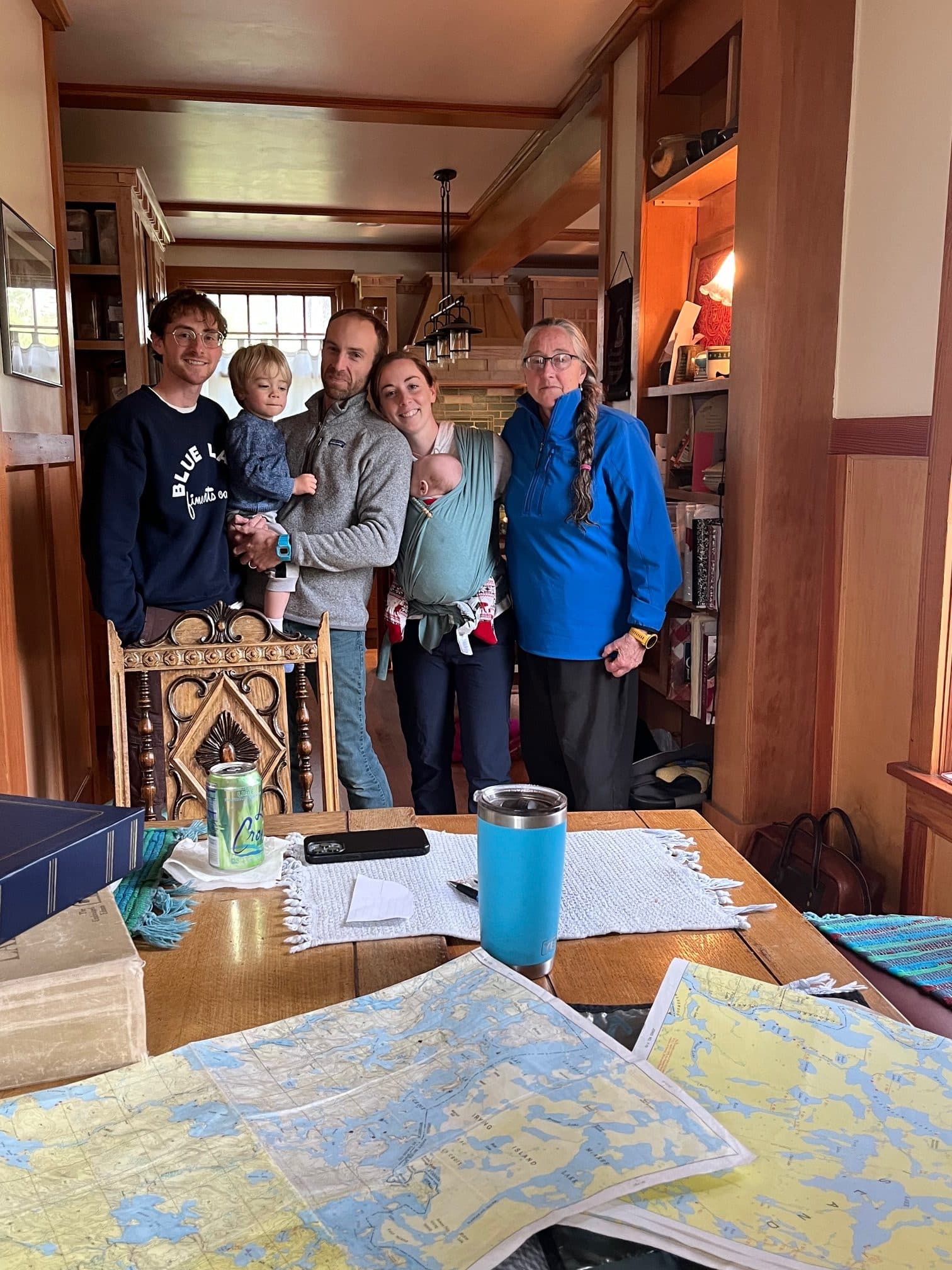
From left, Will Ham, Isaac Bohil, David Bohil, Molly Bohil w/August, Cathie Ham. Photo by Joe Friedrichs
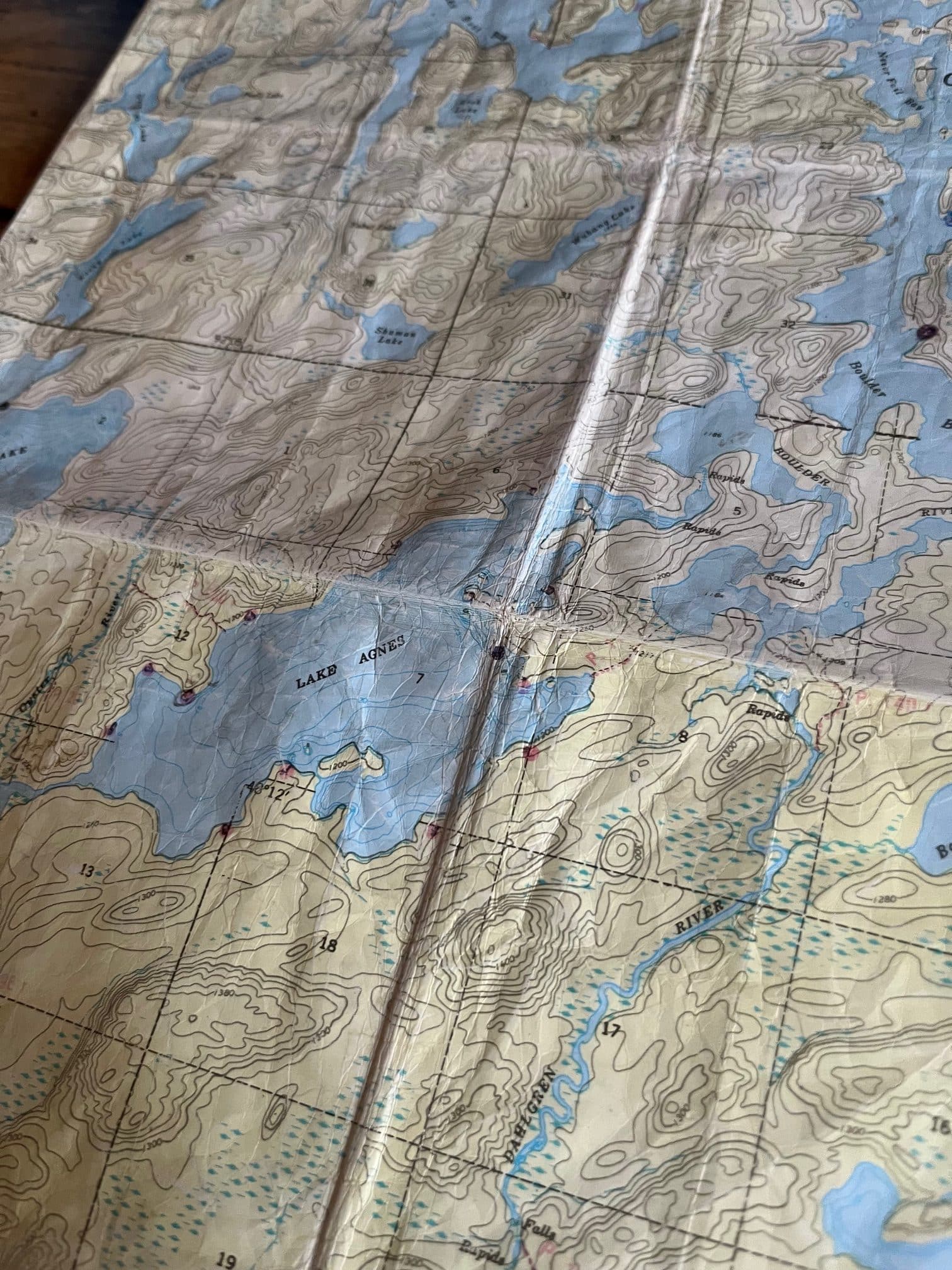
Mark Ham’s map from the BWCA. This map was with Mark on his final trip to the wilderness. Lake Agnes, where he was found, was his favorite lake in the Boundary Waters. Photo by Joe Friedrichs
Mark was interested in the human condition, and how the mind connects with emotion. He chose a career in psychology. After graduating from the College of Idaho, Mark and Cathie moved back to the Chicago area where Mark completed his PhD in psychology at the University of Chicago. He received his post-doc in clinical psychology at a university near Seattle. They later had Molly and Will, moving to Duluth in the early ‘90s.
Throughout his professional career, Mark specialized in providing services to children and families, as well as in research in predictive health models aimed at creating healthier communities. Mark was a popular, highly sought-after clinician in the Duluth area, Cathie said. He often had a waitlist exceeding six months, with some patients traveling internationally to see him, she added.
Outside of work, Mark loved to play, the family said. He enjoyed carpentry. A wooden chair in the basement of the family’s home near the University of Minnesota Duluth sits unfinished. Mark died before he could complete the project. The carpentry is outstanding.
“This was genius,” Will said of his father’s design. The chair’s back can be adjusted to various heights based on an irregularly cut piece of wood his father constructed.
The family’s home in Duluth is a testament to Mark’s skill in the woodshop and his eye for detail. He redid the flooring; created the trim on the windows, walls, and doorframes. Will is particularly proud of his father’s woodworking skills. He hopes to complete the chair in the basement that his father started.
“It’s going to take me longer than it would have for him,” Will said. “I’m still learning.”
~~~
Cathie and Mark started making annual trips to the Grand Canyon during recent years. They traversed the iconic outdoor destination and natural feature from the North Rim to the South Rim multiple times. The couple would train for the trips by hiking on sidewalks and streets throughout the steep hillside neighborhood where they lived in Duluth. They embraced the curious people who passed by, wondering why two people wearing backpacks appeared to be racing each other up the steep hill toward their house.
And while the Mountain West and great deserts of the Southwest appealed to Mark, it was the Boundary Waters that he connected with more than anywhere else. A spiritual, though not necessarily religious person, Mark was a firm believer in the power and importance of being present in one’s surroundings. He treasured the writings of Thich Nhat Hanh. Mark had a pocket-sized edition of the Buddhist teacher’s book with him on his final trip to the Boundary Waters.
Mark took great pride in introducing others to the canoe-country wilderness, including friends of Will and Molly. One friend, Lindsay Schlemmer, said Mark was “always so patient” when teaching new paddlers to navigate the Boundary Waters. He would show them paddling techniques, including the most effective stroke in the bow and stern of the canoe, Lindsay said. Mark also encouraged down time at camp. A canoe trip to the Boundary Waters with the Ham family was not about “conquering anything,” Lindsay said.
“He always wanted us to bring a book,” Lindsay said.
Harry Potter books were a favorite to bring on the BWCA trips when they were kids. Mark didn’t mind hauling the extra weight in his canoe pack, Lindsay said. He knew the children would be immersed in the stories while being surrounded by the boreal forest of the BWCA.
Depending on the time of year, swimming is often a big part of many trips to the Boundary Waters for the Ham family. Molly, Will, and Lindsay were all competitive swimmers while growing up in Duluth. During one summer trip, the three kids, who were in their teens at the time, swam across Round Lake and Brant Lake in the BWCA near Tuscarora Lodge & Canoe Outfitters. Mark and Cathie paddled in canoes beside the young swimmers, the way boats keep pace with swimmers on epic hauls across the world’s great oceans.
“Mark always loved scouting the lakes for us,” Lindsay said. “He liked finding the best lakes where we could swim for a good distance but that wasn’t too far that it would be risky or something. He was just always thinking like that. ‘What’s the best option here?’ type of mindset.”
~~~
When an officer from the Duluth Police Department knocked on the door of the Ham household in the early evening May 10, Cathie initially thought it was Mark returning home a day early from his canoe trip to the Boundary Waters.
“I heard this clomping at the door,” she said. “I was like, ‘hush!’ I wondered if he had a lot of gear, or maybe he doesn’t have his keys. Maybe he just wants to greet me. I opened the door and there’s a police officer standing there.”
The officer wanted to know if she was Cathie Ham. Yes.
They wanted to know if Mark Ham was her husband. Yes.
It seemed like an investigation. Something was off. Cathie wondered if Mark had done something wrong, perhaps broken a rule or cut down a live tree by mistake or violated some type of ordinance for the Boundary Waters. Cathie was listed on Mark’s permit as a secondary trip leader, though it was always intended to be a solo trip. When the other paddlers found Mark’s body on Lake Agnes, officials from the U.S. Forest Service and St. Louis County Rescue Squad, along with local and regional law enforcement, took action. Because Cathie was listed on the permit, they wondered if she was still out there, perhaps missing. A beaver float plane was called in to scan the area for another person, perhaps another body. Once it was discovered that Cathie was at home in Duluth, the search was called off. And then the news was shared. Mark was found dead in the Boundary Waters.
~~~
“When it’s my time, I hope I go in the Boundary Waters.”
The words echo in Will Ham’s ears. They were sentiments his father shared on more than one occasion. The reality of his father’s dream coming true, in one sense, is “a both-and” type scenario.
“It’s very frustrating for me,” Will said. “But at the same time, he got exactly what he wanted. And when I think about my own mortality, I would like to have a say in how I die. And that’s exactly what he got.”
Molly said that her father likely would have clarified that this should happen in his late 80s or 90s. Mark’s death at age 62 has impacted the Ham family and many in the Duluth community and beyond. A memorial service is set for Saturday, May 25 at The Beach House on Park Point in Duluth at 11:30 a.m. The grieving continues, though each day the reality of the situation sinks in a bit deeper, Molly said.
The family expressed gratitude to all the people who helped bring their father out of the Boundary Waters, including a responder from Ely who volunteered to paddle back to Lake Agnes and retrieve Mark’s equipment and bring it back to the family. The man who did this, Molly explained, brought his own son to accompany him on the recovery mission.
Mark paddled a solo Bell canoe known as a Magic. The Kevlar canoe is lightweight and ideal for Boundary Waters travel. Mark was an experienced paddler who respected the power of the canoe-country wilderness. It’s important that people know he was not a negligent paddler. The fact that media reports and online threads keep repeating that he wasn’t wearing a life jacket is hurtful to the family. It’s simply not true that he wasn’t wearing a life jacket, Molly said.
The family is not sure when they’ll return to the Boundary Waters, though they expect they will. Mark would be upset with them if they didn’t keep paddling canoes in the BWCA, they said. He would want them to keep going back.
Molly’s two young sons, Isaac and August, got to know their grandfather, however briefly. Molly was pregnant with August last fall on their final family trip to the Boundary Waters. Isaac got to share a camp with his grandpa in the Boundary Waters.
The lessons Mark shared with the family in the BWCA are far-reaching, Will said. They’re important. They’re why he plans to paddle again in the Boundary Waters.
“Those early years were really formative years with my dad,” Will said. “He taught me a lot. And all the lessons that I learned in the Boundary Waters were not just about the Boundary Waters. With him, it was really about life and how to live a good life. And so for me, I really feel like I need to be up there and I feel drawn to that area, because that’s where I can feel close to my dad.”
To support this type of content from and about the Boundary Waters, subscribe to Paddle and Portage.
Other Recent Articles

Minnesota DNR Considers Revisions to Lake Trout Fishing in and Around BWCA
Adam Mella and a loyal pal chasing lake trout in the BWCA on trout opener 2024. P&P file photoBOUNDARY WATERS – Ice fishing for trout will begin on certain lakes across northeastern Minnesota this week. The trout season doesn’t start for more than two weeks on...

Mining Exploration Plan Gets Green Light Near the BWCA Wilderness
Dean DeBeltz, Twin Metals VP of external affairs and project operations, with core samples in a Twin Metals core storage facility. Submitted photoBIRCH LAKE – They can keep looking for copper, nickel, and other precious metals. That was the message from the Minnesota...

Support Local News Covering the Boundary Waters Region
Paddling between borders on Crooked Lake. Photo Pam Wright for P&PBOUNDARY WATERS – We’ve covered a lot of news this year across the Boundary Waters region. Remote Area Border Crossing permits. Towboat usage in the Boundary Waters Canoe Area Wilderness. Changes to...