
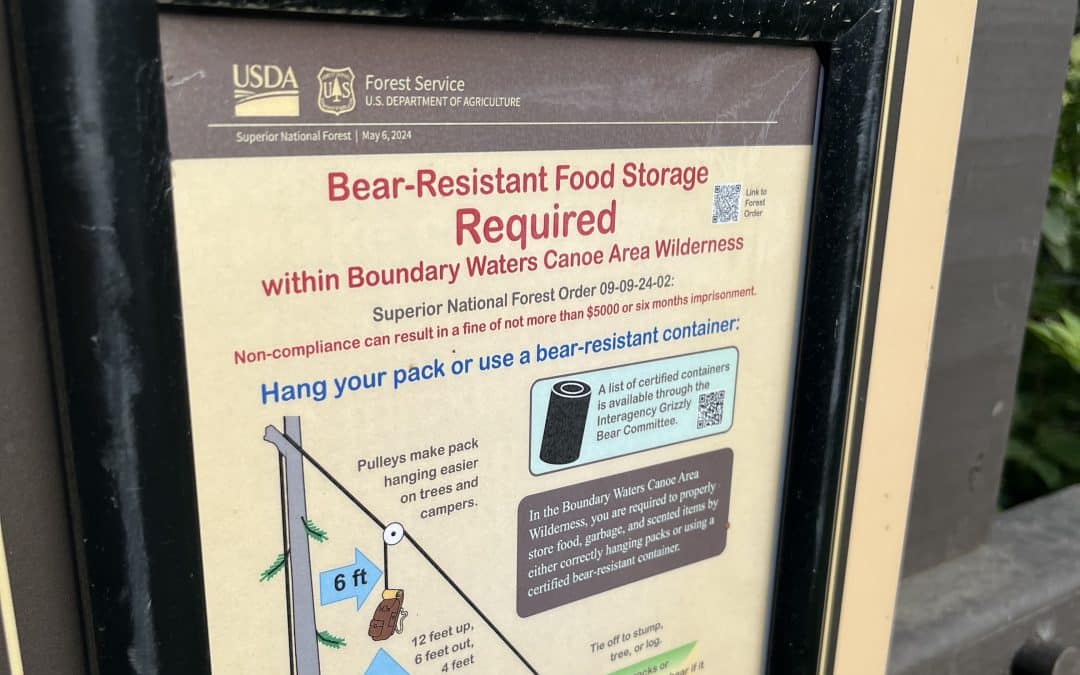

An example of food storage requirements in the BWCA Wilderness. Photo from August 2024 by Joe Friedrichs
Bear Encounters Up Across Minnesota, Down in BWCA Wilderness

By Joe Friedrichs
Black bear complaints were more abundant than any time in the past decade across Minnesota this year, except for one particular area: The Boundary Waters Canoe Area Wilderness.
State and federal officials are attributing the low number of bear-human conflicts in the BWCA Wilderness this year to a food storage order the U.S. Forest Service enacted at the start of the paddling season.
“The proactive enaction of this order likely circumvented a summer of problems for (Boundary Waters) campers and reduced available attractants across a wide area,” said Andrew Tri, bear researcher with the Minnesota Department of Natural Resources.
Though it was initially viewed as controversial in some circles of the paddling community – including notable paddler Cliff Jacobson declaring “war” on the Forest Service over the forest order – more secure food storage likely decreased the number of conflicts with bears this year across the BWCA Wilderness, according to multiple sources Paddle and Portage spoke with for this story.
The Forest Service says that, on average, there were approximately 40 conflicts between bears and people in the BWCA Wilderness during each of the past three years. This paddling season, there were about 10, according to the agency.
And while the food storage order could have, and likely did play a role in reducing the number of conflicts between bears and humans this year, what other circumstances could account for the decline this year?
For one thing, Tri from the DNR suggests, the rollout of the food storage order and the large amount of media coverage and online buzz it garnered, likely played a role in BWCA Wilderness visitors being more “bear aware” this year.
“The strong and regular messaging that the (Forest Service) has been pushing and being proactive with local alerts when bear issues do crop up are the major reasons there were so few complaints this year,” Tri said, adding that the food storage order is included on that list.
The Forest Service agrees, with Joy Vandrie, a spokesperson for the federal agency, telling Paddle and Portage Oct. 15 that they “are encouraged that forest and wilderness visitors understood the importance of proper food storage in reducing conflict and preventing the habituation of bears” in the Boundary Waters region.
“Our wilderness rangers heard a lot of support relating to the food storage order,” Vandrie said. “These types of food storage orders are common requirements in most national parks and many other national forests across the U.S.”
The Forest Service says it did not issue any tickets for violating the food storage order this year. If they were to, the fines would be $50, according to the Forest Service. This stands in contrast to the language on the forest order itself, which says violating the order could result in a fine of not more than $5,000 or imprisonment. Such a warning also remains emblazoned in red letters at some entry point kiosks as of this fall.
Looking back, many of the bear conflicts reported in recent years came from the east side of the BWCA Wilderness near the Gunflint Trail. Reports of problem bears in the Clearwater, Alder, Moon, and Caribou lakes area were fairly common, as were reports from the Duncan and Rose lakes area. Prior to that, reports of a problem bear near Alpine and Jasper lakes near Seagull were somewhat frequent. On the west side of the wilderness, in the La Croix/Cook area, a problem was routinely reported near Lake Agnes in recent years.
Paddle and Portage asked the DNR and Forest Service if the problem bears in these locations were removed from the area, including by lethal means. According to Tri, two bears were killed in the BWCA Wilderness as a result of human-bear conflict during the past five years. One incident, which occurred in 2022, involved the DNR shooting a problem bear near Lac La Croix that had “been a bane to (Boundary Waters) visitors and had bluff charged a couple parties after stealing packs,” Tri said. Another bear was taken in that same area of the BWCA Wilderness this summer on Agnes Lake, according to the DNR.
In addition to state or federal officers removing bears by lethal force from the Boundary Waters, hunters are allowed to harvest bears inside the wilderness. The number of bear tags issued by the DNR annually for inside the BWCA wilderness is 50. Unlike in other locations across Minnesota, hunters are not allowed to set up bear bait stations inside the wilderness. As a result, Tri said that very few bears are taken due to the restriction in the permit area and how hard it is to get a bear out quickly to prevent spoilage of the meat and other parts of the animal. That said, a total of 15 bears have been killed by hunters in the BWCA Wilderness during the past five years. Of the 50 tags available, two male bears were killed by hunters this year in the BWCA Wilderness. In 2023, two bears, a male and a female, were killed, with one male in 2022, and one male and two females being harvested in 2021. A total of seven bears were killed by hunters in 2020, four males and three females. Combined with the DNR and Forest Service removing problem bears, at least 17 bears have been killed by humans inside the BWCA Wilderness during the past five years.
The DNR says it is too difficult to estimate the total number of bears that reside inside the Boundary Waters Canoe Area Wilderness specifically. Wild animals have no knowledge of the lines people and agencies draw up, like international borders or wilderness designations. Nonetheless, despite the fear that some people have when it comes to various animals, aggressive bears are rare in places like the Boundary Waters, Tri said.
“Bear attacks are an extreme rarity, but they do occur,” he added.
In 1987, berries and other natural foods bears seek did not develop in northeastern Minnesota due to drought. After a wet spring and flooding in June, the region was very dry for the rest of the summer. Tri said the berry crop and other summer foods produced in 1987 was very similar to this year. That year, a bear attacked people on Wabang Lake. It’s not known why the bear did attack, but this bear clearly had targeted other campsites before and had extremely low levels of fat on the necropsy.
Despite the lack of conflicts between bears and people in the Boundary Waters this paddling season, Minnesota as a whole had more bear complaints this year than at any point in the past decade, Tri said. The reason, he said, is “mostly due to food,” or lack thereof.
Tri said 2023 was an abundant year for berries, nuts, and other natural food sources for bears, and statewide, yielded one of the lowest bear complaint totals in state history. Nonetheless, bear issues remained persistent last year in the BWCA Wilderness, with approximately 40 incidents involving bears and people reported. This year, the Forest Service says there were no more than 10 incidents reported. Paddle and Portage spoke with a person in May who had a bear come into their camp and attempt to rummage through a gear pack stored under a hammock. The individual, a solo paddler from Illinois, filled out a form that his outfitter on the Gunflint Trail said would be delivered to the Forest Service. It’s possible other such incidents went unreported this year because people were concerned that they might be cited for violating the food service order, but that is an untraceable figure.
Regardless, the DNR and Forest Service say another reason bear and human conflicts could be down this year is that visitation to the wilderness continues to decline, particularly when compared to 2020 and 2021, which peaked during the “COVID years.”
“I’d hazard a guess that fewer people created a reduction in tasty packs and coolers for bears to raid this year,” Tri said, while noting that with all factors considered, “the food storage order was the dominant factor” in reducing bear and human conflicts in the BWCA Wilderness this year.
Moving forward, the Forest Service says it’s important to keep bears “wild” in places like the BWCA Wilderness, and that properly stored food can play a big role in that.
“Any conflict between bears and people can be mitigated by following BearWise protocol,” Vandrie said. “Let’s keep them wild.”
Support this type of journalism from and about the Boundary Waters by becoming a member of Paddle and Portage.
Other Recent Articles
Forest Service Says Proposed Ely Facility Closure Not ‘Final’
State Highway 1 is the road between Ely and the North Shore. The future of a facility owned by the Forest Service along the highway near Birch Lake is in question. P&P file photo by Erica Dischino ELY – The problem is, the U.S. Forest Service won’t answer the most...
U.S. Senate Grapples With Mining Ban Near the BWCA Wilderness
U.S. Sen. Tina Smith talks April 15 on the Senate floor about her concerns for lifting a mining ban near the BWCA. Image courtesy of the U.S. Senate UPDATE: The U.S. Senate today (April 16) approved a resolution that would lift a mining ban from an area near the...

Stauber Cites Iran War as Another Reason to Build a Mine Near the Boundary Waters
Congressman Pete Stauber (center with cap on) and District 3A Rep. Roger Skraba talk with BWCA business owners at Crane Lake in fall 2025. Photo by Joe Friedrichs UPDATE: It's possible (even likely) the U.S. Senate will vote on Stauber's resolution as soon as...