

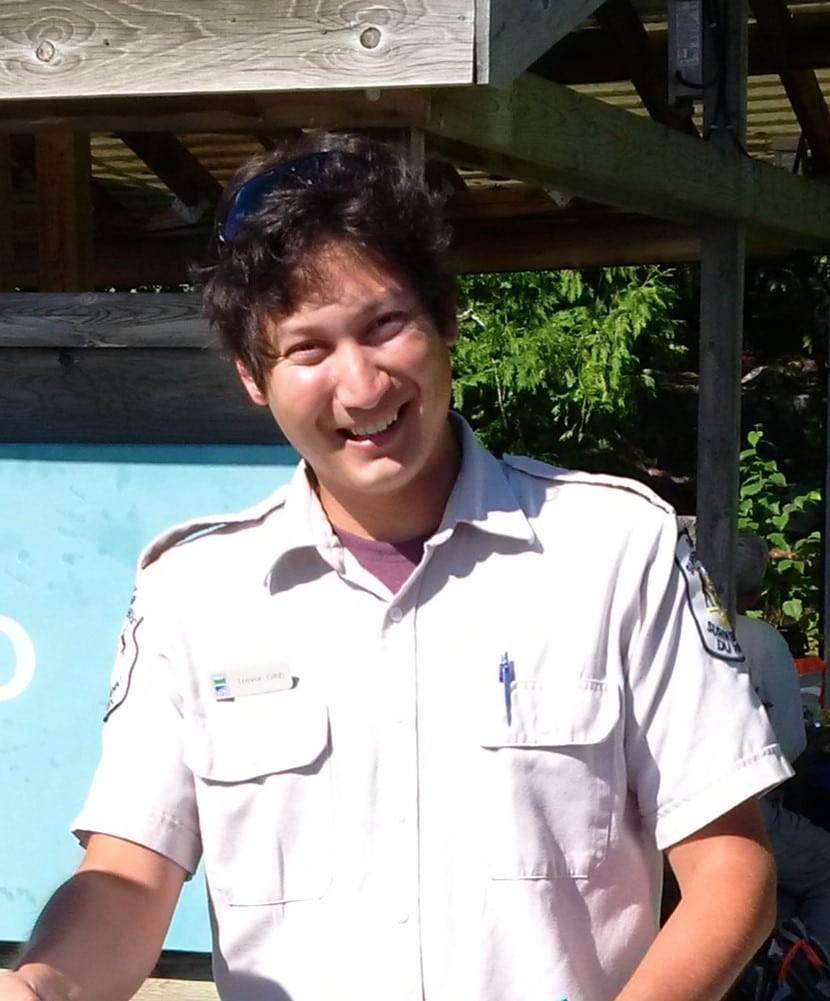
Trevor Gibb has been the superintendent at Quetico Provincial Park since 2014. His last day was Feb. 17. Submitted image
Quetico Park Superintendent Departs for New Role in Ontario Outdoors

By Joe Friedrichs
ONTARIO, CANADA – Massive wildfires. The park’s complete closure on multiple instances. It hasn’t always been easy, but for Trevor Gibb, his love for Quetico Provincial Park is stronger than ever.
Gibb has been the superintendent at Quetico Provincial Park since 2014. He announced publicly this month that he is leaving for a new role with the Ministry of Natural Resources in Ontario. Longtime Quetico Assistant Superintendent Jason Blier is serving as the acting superintendent on an interim basis.
Gibb spoke with Paddle and Portage about his time as the superintendent of the park, which sits directly across the U.S.-Canada border from the Boundary Waters Canoe Area Wilderness.
Note: This article has been edited for length. To listen to the entire conversation, watch the YouTube video at the bottom of the page.
Paddle and Portage (P&P): 1. I remember Janice Matichuk, the longest serving ranger in Quetico Park history, describing you as “the new young fella” when you were hired. How old are you?
Trevor Gibb: (TG) Well, that’s a secret, Joe. Just kidding… I’m 42 now. So, back when I was the ‘young fella,’ I would have been just over 30.
(P&P): What comes next for you and your career when you leave Quetico?
TG: The new position I moved into is a supervisor position with the Ministry of Natural Resources in the northwest region of Ontario. Geographically, it’s essentially everything west of northern Lake Superior, and everything north all the way up to Hudson’s Bay. I won’t be working in Quetico anymore, but I’m still living in Atikokan. I’ll be paddling and skiing and fishing in Quetico on the weekends still. I won’t be moving far from the park that I love.
(P&P): What are some things you’ll miss about Quetico?
TG: The landscape, the lakes, the forests and rivers. It’s just such a beautiful piece of geography. But I think the key thing I will miss is the people you know. The people who are connected to Quetico I will miss so much. And that includes the people that work at the park, the people that paddle in the park, folks that support the park and our partner, Indigenous nation, Gakijiwanong, on Lac La Croix. So yeah, I’m definitely going to miss being a part of all that and being connected with those people.
(P&P): Most of the visitors to Quetico come from the U.S., about 80 percent, roughly. With the pause on RABC permits in place, what does that mean for the park heading into the 2025 paddling season?
TG: Right now we’re waiting for further information from Canada Border Services Agency who administers the RABC program and in terms of impacts on park operations. We haven’t made any decisions around the 2025 operating season yet, and we’re encouraging people to book their trips as normal at this point.
We’re just currently waiting for more information from the Border Services Agency. We’re hoping to hear something soon, but without more information I can’t say much more.
(P&P): You’ve been through some major events during your time as the superintendent. COVID closures. Wildfires. What were some of the most challenging moments during your time as the superintendent?
TG: You pinned it with the 2021 fire season. That was easily the biggest challenge of my time at Quetico. And having fire on the landscape is an important part of maintaining the ecological integrity of the park. But there’s the balance of having that fire on the landscape and balancing that with public safety and recreational opportunities and future recreational opportunities as well. And 2021 was just a really, really tough and dynamic situation on the ground. Also, we were dealing with border restrictions related to the COVID-19 pandemic. So we had to deal with a lot of change with backcountry area closures, entry station closures, redistributing staff around the park, redistributing visitors around the park, and eventually, in 2021 complete closure of the backcountry and getting backcountry campers out of the park. It was a very, very busy summer.
(P&P): I mentioned Janice Matichuk earlier. It’s been five years now since Janice passed away. What is, or will be her legacy in terms of the park?
TG: Janice was our longest serving backcountry ranger. She’s dearly missed by our park visitors and by our park staff. Part of her legacy is sort of living on with our campers and with our staff that she interacted with. She really stressed the protection of the park and made sure that everybody that passed through the Cache Bay Ranger Station was going to have a safe and enjoyable trip into the park, but also respect the park environment. And she shared that with many park staff that she trained and influenced over the years. She influenced countless campers, countless paddlers that came through Cache Bay. She also influenced many park staff at Quetico. A big part of her legacy will be her love of the park, and that care and protection of the park that meant so much to her can live on through others.
(P&P): We do our best to cover the happenings at Quetico, both on the podcast, and our news coverage. It’s such a large area though, and there’s almost no media coverage of Quetico on a regular/routine basis. Is that a good thing, or a non-issue in terms of the lack of media coverage?
TG: A lot of people love Quetico on both sides of the border. For the most part, any coverage that we can get to provide information and to connect with the park in the Midwest and in Ontario and all over… I think anything is good. So, we appreciate any opportunities that we have to have media coverage about what’s going on in the park, recognizing, yeah, we don’t get nearly as much as the BWCA Wilderness or Superior National Forest. But discussions like the one we’re having today with you Joe, we really appreciate. And you’ve often helped to get the word out about what’s going on at the park and sharing that.
(P&P): Did work with the First Nations communities play a significant role in your management of the park? Please tell us about this with some anecdotes.
TG: Gakijiwanong Anishinaabe nation and Quetico have [a] long standing and special relationship. We have an agreement to have the First Nation operate the Western part of the park at Beaverhouse Ranger Station and the Lac La Croix Ranger Station, and also have staff work in the backcountry together with other Quetico staff. I really cherish the experience I got to have working with our First Nations communities on our 2018 Park Management Plan, and then also working together on lake monitoring and educational displays throughout the park.
(P&P): Do you have any favorite locations in the park?
TG: My favorite lake is Quetico Lake in the northwest part of the park that you access through the Beaverhouse Ranger Station. It’s just the feeling I get when I’m paddling on that lake that is so unique. There are so many special features in that area, cultural and environmental, and just some beautiful campsites, good fishing, and beautiful, clear water. The same could be said for countless lakes in Quetico. But you know, somehow Quetico Lake is the one that resonates with me the most.
(P&P): Any parting words for our listeners on the podcast and people who follow Paddle and Portage and Quetico?
TG: I assume most people listening to this have some connection to Quetico and the Boundary Waters. I’m sure many of you have paddled or continue to paddle in Quetico. And I want to thank you for visiting our park and caring about it. We encourage you to keep visiting the park in the future. It’s just a special place, and one of the best places to go canoeing in the world, in my opinion.
Subscribe to Paddle and Portage to support this type of journalism from and about the Boundary Waters region.
Other Recent Articles

Forest Service Prepares for Significant Announcements on BWCA Policy & Usage
BWCA Wilderness entry point sign. Photo by Joe Friedrichs The U.S. Forest Service continues to consider changes to a trio of policies that would impact people and businesses that interact with the Boundary Waters Canoe Area Wilderness. Of the potential changes, this...

Missing Hiker Found Alive & Alert at Isle Royale National Park
Isle Royale National Park. P&P file photo A hiker missing at Isle Royale National Park for a week has been found on the remote Lake Superior island. Craig Berg, 70, has been found alive and alert, the National Park Service announced Sept. 12. Berg, missing since...
A Tour of Areas Burned in 2026 BWCA Wildfires
The Sioux River North Entry Point in September 2026. Photo by Joe Friedrichs The fires that shut down the Boundary Waters Canoe Area Wilderness this summer made national news. Paddle & Portage media was invited Sept. 9, along with other members of the press, to...