
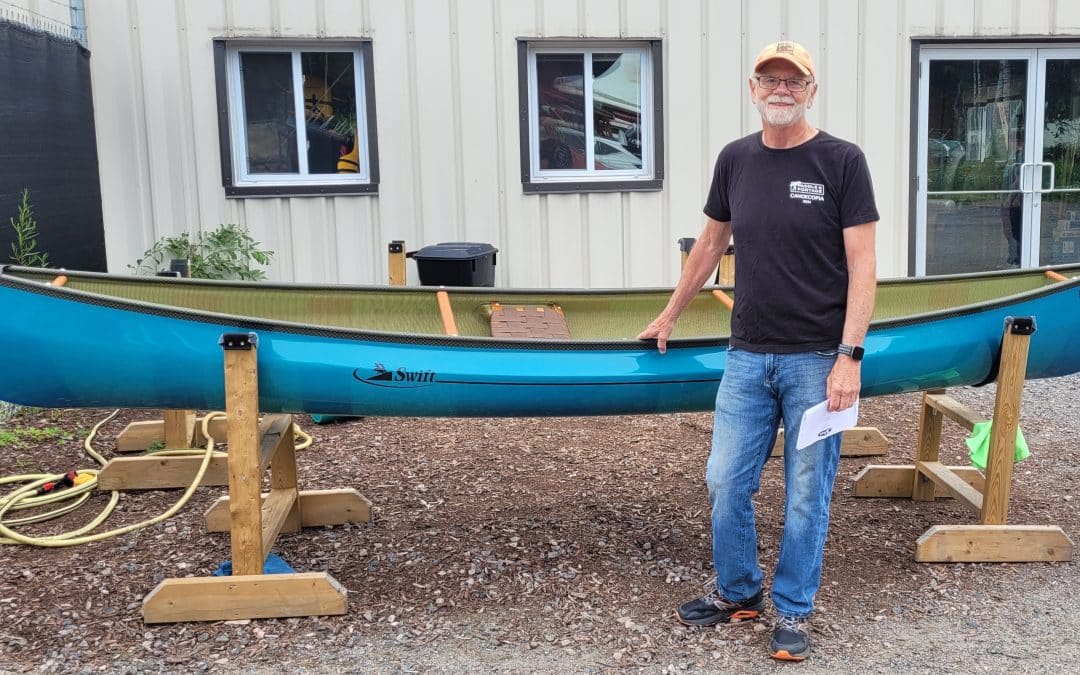

Dave Van Kley with his new Swift Prospector 14 solo canoe. Submitted image
Boundary Waters Enthusiast Hit With $500 Fee Bringing Canoe to U.S. From Canada

By Joe Friedrichs
MICHIGAN – The agents were kind at the Sault Sainte Marie Port of Entry.
Kindness didn’t prevent Dave Van Kley from paying an unexpected bill for more than $500. And all he wanted to do was get home with his new canoe.
As tariffs and trade wars dominate headlines across North America, Van Kley, who makes a paddling and fishing trip to the Boundary Waters Canoe Area Wilderness every year, finds himself in the center of a political and economic hotbed.
Van Kley, a retired pastor who lives near Marquette, Mich., recently purchased a solo Swift canoe from a Canadian branch of the company, officially named Swift Canoe & Kayak, located in South River, Ontario. Van Kley, along with his wife, Arlene, traveled during the first week of July from Michigan to Canada to buy the canoe. The solo canoe, a Prospector 14 model, came with a cherry portage yoke and a few other attributes that he desired in a new watercraft, namely stability. The canoe and yoke cost about $4,100 in U.S. currency. Van Kley paid $5,664 in Canadian currency, which includes a 13% harmonized sales tax that amounted to $649.35. The harmonized sales tax is a combination of federal and provincial taxes on goods and services in five Canadian provinces, including Ontario, where the rate is 13%. Van Kley was told by officials from Swift he would not have to pay additional fees related to the 25% tariffs on Canadian goods that the Trump administration established in early March.
“Swift canoes had told me that canoes and kayaks are covered under the Mexico-Canada-U.S. trade agreement and so were exempt from Trump’s tariffs,” Van Kley told P&P. “Which is true, but apparently only for registered importers and not for plebes like me, who transport their own canoes.”
This is where things get tricky.
Van Kley, along with the team from Swift canoes, including its president, Bill Swift, believe there should not have been an additional amount owed when the canoe crossed the border. In a phone call with P&P July 11, Bill Swift said this is the first time since March that an individual purchased one of their canoes in Canada, crossed the border back to the U.S., and then had to pay an additional amount as a result of the tariffs and ongoing trade war, which only escalated this week.
“We’ve sold about 20 canoes recently just like this to people who bring them back to the U.S.,” Bill Swift said. “And this is the first time this has happened.”
Bill Swift says that under the Canada-United States-Mexico Agreement (CUSMA), canoes are exempt from tariffs, including those issued this year under the Trump administration. This information was relayed to Van Kley before he traveled to Canada to purchase the canoe.
From a consumer’s perspective, Van Kley said the team at Swift Canoe & Kayak were and remain very helpful as he navigates this situation.
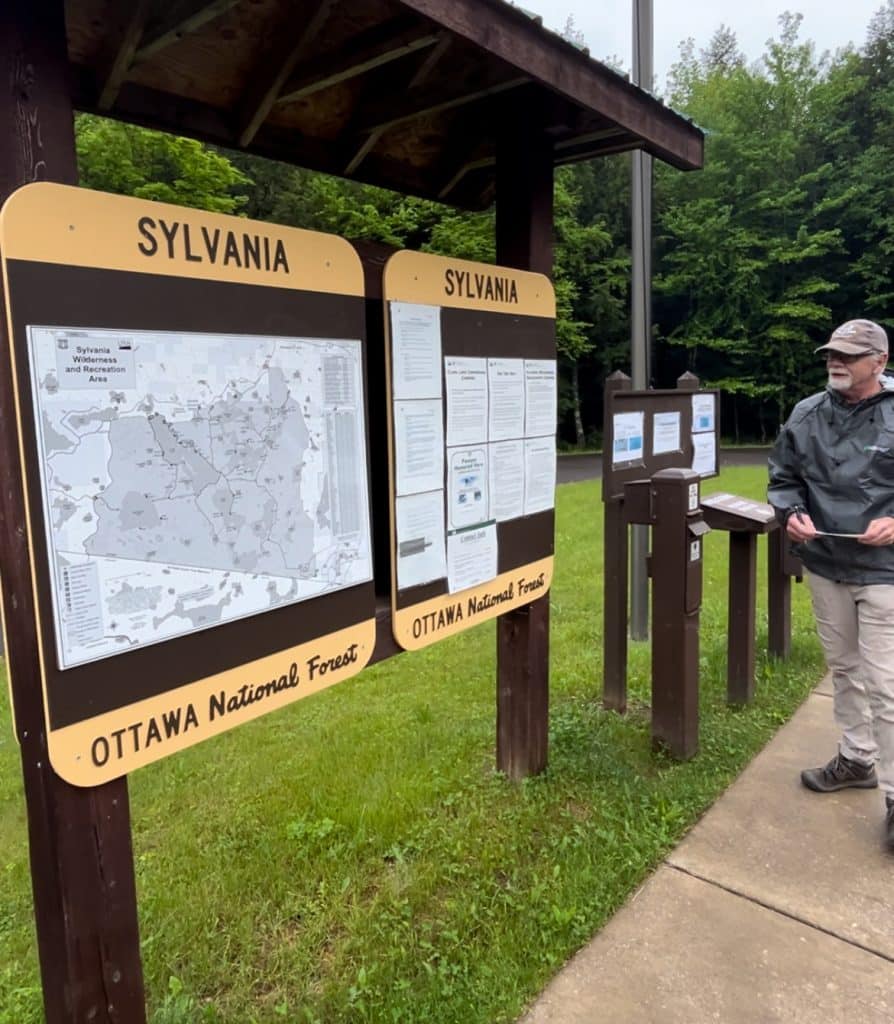
Dave Van Kley paddles wilderness areas across the Upper Midwest, including the Sylvania in Michigan. P&P file photo
After buying the canoe July 5 in Canada, Dave and Arlene spent a few days hiking and enjoying the area near South River before traveling back to the border crossing at Sault St. Marie, which is about three hours east of their home in Michigan’s Upper Peninsula. When they reached the border, Van Kley was expecting to pay some type of duty on the canoe, probably around $40. When he was told that the bill would be more than $500, something seemed wrong.
“The way the duty was explained to us,” Van Kley said, “the $509 charge was based on a total U.S. value, after various deductions were applied to the purchase value, including $800 each for Arlene and me, as we had been in Canada for more than 48 hours. So, it was the 25% tariff rate, plus the 1.5% rate we normally would have to pay anyway.”
Paddle and Portage communicated with Youssef Fawaz, a public affairs officer for the U.S. Customs and Border Protection’s media relations division, about this topic. Fawaz responded July 9, writing, “I’ve forwarded your inquiry on to our team that handles trade-related media inquiries. Someone should be in touch.” As of July 13, nobody from U.S. Customs and Border has responded to questions raised for this story.
Van Kley says a receipt provided by border agents did not include any detail. After disputing the fee, Van Kley had a paralegal assigned to help with this case. The paralegal, who works for U.S. Customs and Border Protection, drew a different conclusion. The agent, Brittini A. Penland-Broadnax, a supervisory paralegal specialist for U.S. Customs and Border Protection, told Van Kley the charges were not from the tariff. She did not, however, explain what the $509 fee was for.
In doing the math, it’s clear that the 25% tariff was applied to the canoe Van Kley purchased. Let’s break it down. Without the taxes considered, Van Kley paid $4,995 for the canoe and yoke in Canada. This equates to $3,522 in U.S. currency. The exemption that comes from staying in Canada for more than 48 hours is $800 per person, meaning $1,600 is exempt. This leaves the amount subject to duty and/or tariff at $1,922. Using that figure ($1,922) and multiplying at the 1.5% duty charge equals $29 U.S. Using the $1,922 sum and applying the 25% tariff is $480. Add those amounts and it equals $509, which is the amount Van Kley was charged at the border for his canoe.
Van Kley and Swift are certain that the tariff should not apply to the purchase of this canoe. What comes next in this process is cloudy, though Van Kley says he is considering contacting elected officials in Michigan to intervene on his behalf. Among the most troubling aspects of this situation, Van Kley says, is that the officials from U.S. Customs and Border Protection were seemingly unsure about if the tariff should apply to the canoe.
“The border agents were kind and apologetic,” Van Kley said. “They clearly didn’t want to charge me and yet, felt they had to. But they also seemed uncertain about the whole thing.”
Subscribe to Paddle and Portage to support this type of journalism from and about the Boundary Waters and other paddling destinations across North America.
Other Recent Articles

Canada Determining Location of ‘Telephone Reporting Sites’ as RABC Program Ends
The RABC Program ends Sept. 14, 2026. P&P file photoBOUNDARY WATERS – As the end of the popular Remote Area Border Crossing Program nears, more than 200 people responded to a request from the Canadian government for where people should report in from as they cross...

Lake Trout Season to End March 15 on Popular Gunflint Trail Lakes, Surprising Some Anglers and DNR
The 2026 trout season ends March 15 on Gunflint and Sag and other border lakes outside of the BWCA Wilderness. Photo by Chad KieperGUNFLINT TRAIL – The ice fishing season for lake trout will, at least on paper, end this weekend on Saganaga and Gunflint lakes due to a...

Shug the Hammock Camper Diagnosed with Rare Form of Cancer
Shug (right) and M Baxley at the 2025 Winter Camping Symposium. Photo by Joe FriedrichsOur friend Shug found out this week he has a rare blood disease called chronic myeloid leukemia. Shug introduced the joys of hammock camping to people all over the world. His videos...