
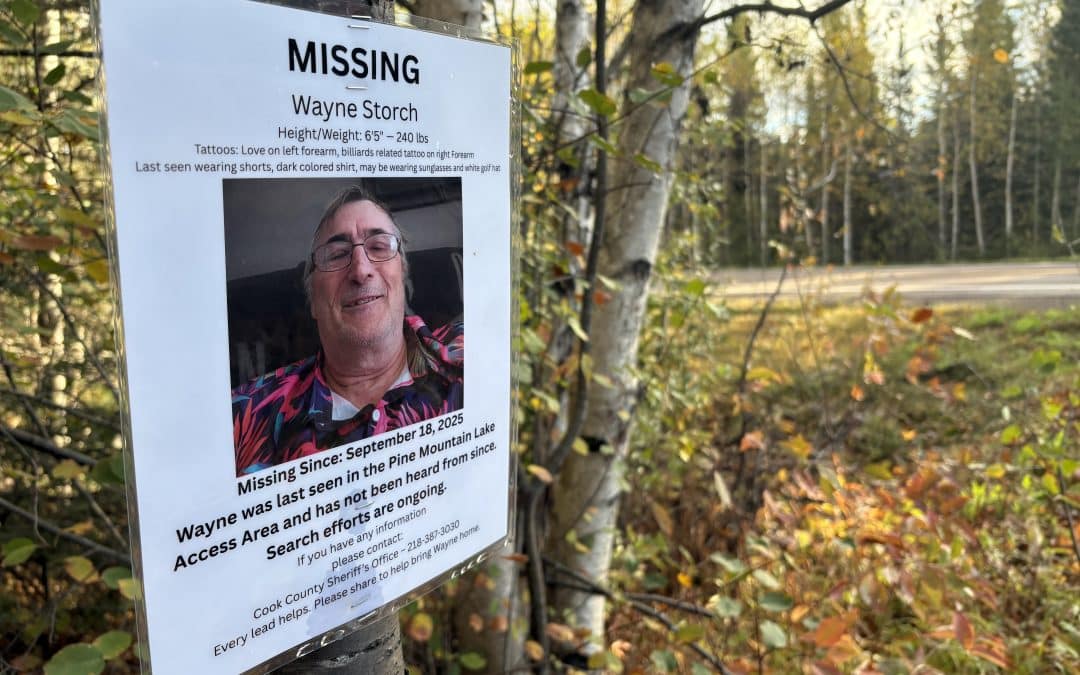

A flyer posted at a small parking area about 12 miles up the Gunflint Trail shares information about Wayne Storch, a Wisconsin man who remains missing in the area. Photo by Joe Friedrichs
The Challenges of Finding Missing People Near the Boundary Waters

By Joe Friedrichs
GUNFLINT TRAIL – The situation involving a Wisconsin man who vanished in late September reminds us that when people go missing near the Boundary Waters it is not typically easy to find them.
Wayne Storch, a 74-year-old man from New Richmond, Wisc., is believed to be somewhere in the vicinity of Pine Mountain Lake, a small trout lake used most commonly in winter by ice anglers. Storch was reported missing Sept. 18. The Cook County Sheriff’s Office located his vehicle parked on the side of the Gunflint Trail at the Pine Mountain Lake trailhead Sept. 24 after a local photographer and business owner, Katie Slanga, reported it to the authorities.
Cook County Search and Rescue, the St. Louis County Rescue Squad, the U.S. Forest Service, and other assisting agencies spent time in late September looking for him. They looked near Pine Mountain Lake and nearby Pickerel Lake, which is close to Elbow Lake. They combed ridgelines and bogs and remote timber. Nothing turned up despite the extensive searches.
The search has continued in a more grassroots fashion, with Wayne’s daughter, Ashley, and her partner, Joey Biener, remaining involved. On Oct. 8, Ashley thanked local residents for “being the sweetest group of people” she’s ever met. More than 20 local businesses put up a flyer notifying the public of Wayne being missing. One business even gave Ashely some fudge to take home, she said in an online post Wednesday.
“This has been one of the most difficult things I’ve faced and I appreciate every single one of you for reminding me of all the good in this world when it has been so difficult to see lately,” Ashely wrote.
The disappearance of Wayne Storch is not a singular incident for the Boundary Waters this summer, or in recent memory.
When the ground search was called off this summer for Gene Doherty – a 40-year-old man who has been missing since July 1, when he was last seen leaving his mother’s house in Silver Bay, Minn. – local law enforcement specifically referenced the “challenging terrain” as a reason for suspending the official search. Suspending the search came less than a week after Doherty’s vehicle was found July 11 near the intersection of Brule Lake Road and a Forest Service road known commonly as “The Grade.” Traveled frequently by visitors and locals recreating on Superior National Forest and in the nearby Boundary Waters Canoe Area Wilderness, The Grade offers access to Brule Lake, a popular lake in the BWCA, and Eagle Mountain, the highest point of elevation in Minnesota. The road is surrounded by dense forest, swamps, and unforgiving terrain.
Family members and friends of Doherty told Paddle and Portage in July they remain hopeful that he will be found. The latest post from a family member of Doherty came Sept. 8 from Brooke Doherty. It reads: “We still don’t have any updates for you guys. We are hoping at some point someone comes forward with more information but so far we haven’t heard anything. A few different family members have gone to psychics/mediums and have all gotten different information so that wasn’t all that helpful. As a family we are just hoping to get information to give us some sort of closure.”

Gene Doherty has been missing near the BWCA since July in the Brule Lake area off The Grade. Submitted image
In reviewing the history of search and rescue in the Boundary Waters Canoe Area Wilderness and other similar cases across Superior National Forest, we find these stories unfolding both ways. Sometimes the people are found. In other cases, they are not. There are several instances where people have never been found after they go missing in the Boundary Waters region.
Take the case of Lloyd Skelton, for example. In 2005, Skelton set off near Ely to hike the Angleworm Trail. This is the same hiking trail recently romanticized by the writer Terry Tempest Williams in an essay published in the New York Times. In it, Williams describes the Boundary Waters as a place of “peace and renewal, where landscapes of beauty become landscapes of our imaginations.” It’s impossible to determine if that’s what Skelton found and felt when he hiked here for the last time 20 years ago. We’ll never know, as Skelton has never been found. He vanished, though his shoes and some of this clothing were found near Whisky Jack Lake, a remote body of water found off the Angleworm Trail.
I visited the Angleworm Trail and hiked to Whisky Jack Lake in October 2021. With me were my longtime Boundary Waters podcast cohost Matthew Baxley, and Sean Emery, a YouTuber with a channel that focuses on hammock camping in places like the BWCA. Most people know Emery by his nickname, “Shug.” The three of us took our time walking the Angleworm Trail as we trekked the 5 miles to Whisky Jack. All of us had backpacks full of equipment, including hammocks to sleep in, food, and rain gear. Our hike started under clear skies, though we knew rain was in the forecast overnight. We observed sensational fall colors and talked about life and death: what it means to die and the fact that we’re all going to experience it. We observed strange mushrooms growing from the forest floor. The three of us listened to red squirrels chatter as they set about in their hysteria of preparation for the coming winter. The forest smelled of wet leaves and damp cedar. The air was rich with the changing of seasons. Still, it warmed up nicely throughout the day. By the time we made it to the campsite at Whisky Jack, we were all drenched in sweat from the inclines and the mildly strenuous walk.
With the knowledge that Skelton was in this very location in 2005, a certain energy found its way into our camp. We weren’t afraid; what we felt was a sense of wanting to know more. With our camp secure, I made a cup of Medaglia d’Oro instant espresso and took great comfort in the companionship of my fellow hikers.

Lloyd Skelton. Photo courtesy of Skelton family
On the day Skelton set off on the Angleworm Trail and disappeared, all of his outdoor gear, including his packs, food, water bottles, and camping supplies, were left in the van. Rick Slatten, captain of the St. Louis County Rescue Squad who we talk with often at Paddle and Portage, said this struck him as unusual, given that the round-trip hike to Whisky Jack Lake is about 10 miles. And while it’s not the same type of excursion as summiting a mountain in the Tetons, it’s nothing like a casual stroll around Lake Harriet in Minneapolis either. Slatten said there are whispers of suicide in Skelton’s case. Ultimately, what happened to Lloyd Skelton in the Boundary Waters will likely never be known. His death will forever remain a BWCA mystery, a tale shared by generations of canoe-campers and hikers in the nation’s most-visited wilderness area. Mystery aside, the thing that stands out to Slatten about this death is that Skelton was not prepared to be in the woods on the day he went missing.
“Within the context of Mother Nature, of it being harsh, going in unprepared is a bad idea,” Slatten said. “Skelton’s got all this stuff, and it’s in his car. He had gear, and he elected not to take it. He’s 5-and-some-change miles over extremely rough terrain back in the Boundary Waters with zero gear. Things happen back there: A windstorm comes through, blowdowns happen, thunderstorms kick up. Trails get obstructed. And I don’t go much farther than the pit toilet without my day pack on. You never know what’s going to happen.”
The Boundary Waters region is not unique to people going missing and being hard to find. There are stories from this year of people from Minnesota going missing in the mountains of the American West. Some have been found, others remain missing. The boreal forest of Canada, similar terrain to the Boundary Waters, is another place people go missing in dense forest and present great challenges for those who are looking for them. Take the case of Daniel Trask, for example. Conor Mihell, a Canadian journalist, writes about his experience in looking for Trask, a young man who went missing in Canada’s Temagami region. Mihell found some of Trask’s clothing along the shoreline of a remote lake the spring after he went missing. It would be three more years before they would find Trask’s skeletal remains. Paddle & Portage spoke with Mihell Oct. 9 about Trask, Gene Doherty, and Wayne Storch. The similarities are that all three had a deep connection to wild places like the boreal forest. The stories are similar, Mihell reasoned. There are commonalities, though what led to them all choosing to walk into the woods alone is different. The notion of escaping to the woods for them, forever or temporarily, remains unknown. We’ll be hearing more from Mihell in an upcoming episode of the Paddle & Portage Podcast.
And while the official search ground searches have been called off by local law enforcement, the search for Gene Doherty and Wayne Storch continues. Winter is coming on soon. Snow will blanket the woods of the Boundary Waters region. When it does, the search to find Gene and Wayne will become more challenging, if not impossible, until the snow melts away next spring.
During a book event for “Last Entry Point” in St. Paul at Next Chapter Booksellers last June, Lisa Skelton, the daughter of Lloyd Skelton, was there. Lisa shared her time and stories with me about her father for “Last Entry Point.” In the Q&A portion of the book event Lisa stood and addressed the people in attendance. At the time, two missing Minnesota men had not been found in the rapids near Curtain Falls, in what was the most publicized search event in the history of the Boundary Waters.
“I know what these families are feeling,” Lisa said. “The difference is, they’ve been feeling it for about 10 days. I’ve been feeling this way for almost 20 years.”
There wasn’t a dry eye in the room as Lisa spoke. These stories about people who go missing in the Boundary Waters region are more than headlines in a newspaper or on a website. They’re deeper than quick sound bites heard on the radio or TV. They’re real experiences that happen to real people. And the results reshape lives.
Subscribe to Paddle and Portage to support this type of journalism and storytelling from and about the Boundary Waters.
Other Recent Articles

Scope Narrows For Telephone Reporting Sites Across the Boundary Waters Region
The border lakes of the Boundary Waters. P&P photo BOUNDARY WATERS – The end of the Remote Area Border Crossing Program and permits that allow people to cross many of Minnesota’s border lakes is approaching. The RABC Program as it currently operates will close...

Forest Service Returns Camping Gear to BWCA Paddlers Who Narrowly Escaped Wildfires
Photo courtesy of Bailey Shinn A Texas family was camping in the Boundary Waters Canoe Area Wilderness earlier this month when a wildfire took off not far from where they were staying. While camping on Pipestone Bay (Basswood Lake) Bailey Shinn, her three young...

Firefighters Talk of ‘Protecting Structures’ Near BWCA, She Helps In Advance
Teresa Floberg at a property managed to reduce wildfire risk near Ely. Photo by Joe Friedrichs Protective measures done in advance, that’s the key, she says. “We try to encourage homeowners to think in advance about the risks of wildfires,” says Teresa Floberg, the...