
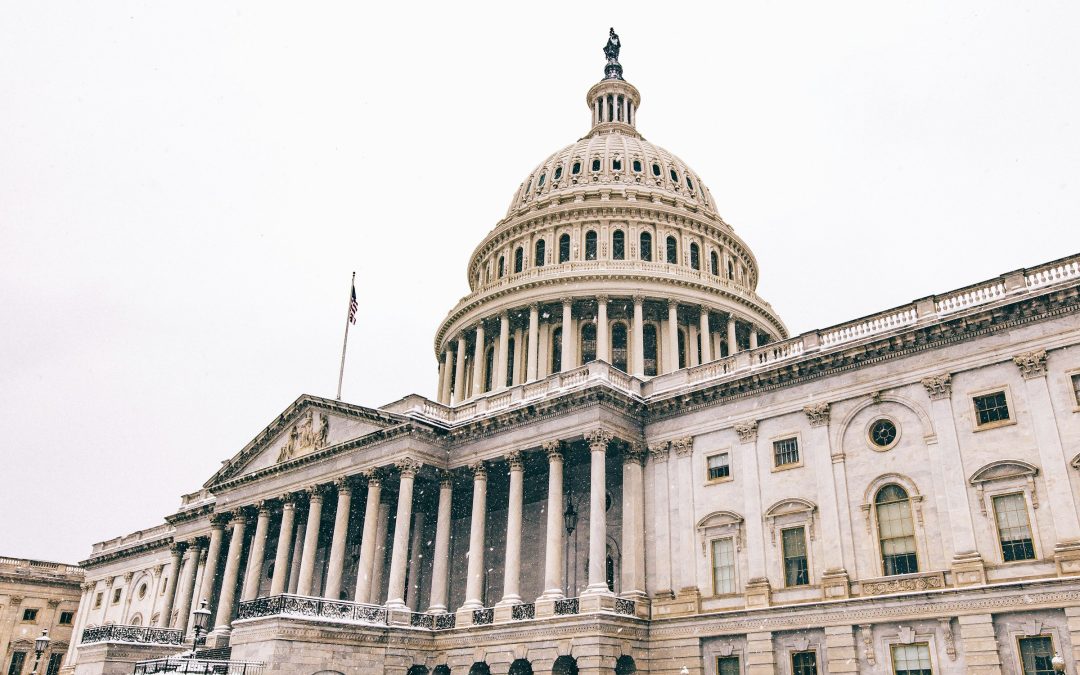

Elizabeth MacDonough, the Senate parliamentarian. Photo courtesy of the U.S. Senate
Largely Unknown Figure in Senate Could Determine Fate of Mining Ban Near the Boundary Waters

By Joe Friedrichs
WASHINGTON DC – She’s not a household name. And the fate of a mining ban currently in place on 225,000 acres of Superior National Forest may rest in her hands.
Elizabeth MacDonough is the Senate parliamentarian. In this role, which she has held since 2012, MacDonough interprets the Senate’s complex rules as they apply to Senate proceedings. If senators were playing in an NFL football game, the parliamentarian would be the referee determining when to call a penalty or a violation of the rules. MacDonough is the sixth person and first woman to hold the title of chief Senate parliamentarian. She’s been featured in profiles by some of the nation’s largest media companies, from the Wall Street Journal to The Economist.
MacDonough is in the news this week after the U.S. House of Representatives voted Wednesday to overturn the mining ban near the Boundary Waters Canoe Area Wilderness that was put in place by the Biden administration. The reversal or removal of the ban has long been a campaign promise of the Trump administration.
The House voted 214 to 208 to overturn the ban yesterday. The vote came on a resolution introduced by Pete Stauber, a Republican who represents the Boundary Waters region in Congress. Now the bill heads to the Senate. Before the Senate takes action, MacDonough will likely make a determination on if Stauber’s bill constitutes a rule under the provisions of something known as the Congressional Review Act, or if it’s an order. We recently reported extensively on this topic. Ultimately, MacDonough’s decision on this specific point could stop the resolution in its tracks and restart the process for Stauber in the House. It could also determine if Stauber’s bill can pass through the Senate with a simple majority or if it needs to reach a 60-vote threshold in the Senate. Republicans currently hold a 53-seat majority in the 100-person Senate.
The Senate parliamentarian is a nonpartisan role. MacDonough has agitated Republicans and Democrats alike during the past decade-plus that she’s been the parliamentarian, on issues from the minimum wage to the Affordable Care Act. She’s had direct involvement with Stauber’s previous attempts to rescind the Biden-era mining ban on Superior National Forest, most specifically last summer when a similar reversal was scrapped from the federal budget bill. Senator Tina Smith was involved in making sure the parliamentarian knew Stauber’s bill was not tied directly to the budget.
“Today marks a victory in our fight to protect the Boundary Waters,” Smith said last June after Stauber’s bill was dropped. “Buried deep in President Trump and Republican’s Big Beautiful Bill was a provision that gave a foreign mining company full permission to build a copper-nickel sulfide mine right on the doorstep of the Boundary Waters. I vowed to do everything in my power to protect this precious place.”
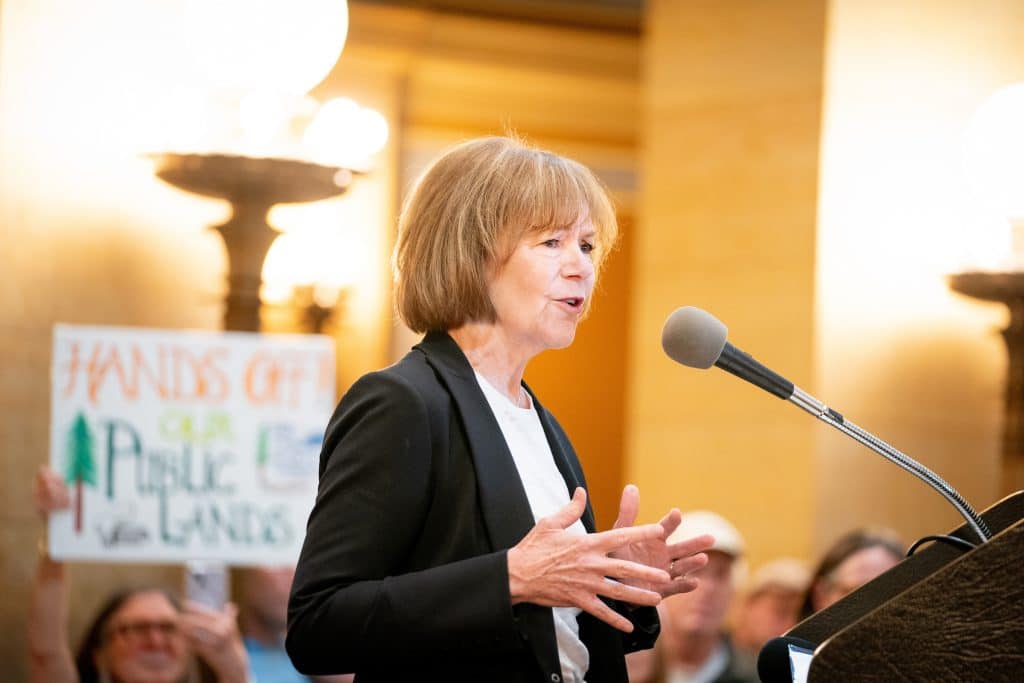
Minnesota Sen. Tina Smith. P&P file photo
That same day last June, Smith said “the fight is far from over,” while noting that “Donald Trump and House Republicans are determined to revoke the protections I worked to put in place and that Minnesotans have made clear they support. Republicans want to sell off our public lands to the highest bidder, and the Boundary Waters is no exception.
Regardless of how MacDonough rules, which is likely to come in the days or weeks ahead, the Senate would still need to approve Stauber’s bill for it to move forward. Even then, this action would reverse the mining ban, not allow for any proposed mining operation near the Boundary Waters to begin. Twin Metals Minnesota, an offshoot off the Chilean mining company Antofagasta, would first need to have its mineral leases reinstated. It would then have to have a mining plan of operations approved by both the state and federal governments. All of these scenarios are likely to have deep entanglements with the courts and involve various lawsuits. Advocacy groups acknowledge this fact, while also citing the larger importance of Stauber’s bill and how it could impact public lands across the country.
Paddle and Portage will continue to closely follow when and how the Senate parliamentarian rules on Stauber’s bill.
Subscribe to Paddle and Portage to support journalism from and about the Boundary Waters.
Other Recent Articles
A Visit to Sigurd Olson’s Listening Point as Senate Nears Vote to Reverse Mining Ban
Photo from inside Sigurd Olson's house in Ely, now the headquarters for the Listening Point Foundation. Photo by Joe FriedrichsA bill that was introduced by a Minnesota Congressman to overturn a 20-year mining ban near the Boundary Waters is heading to the Senate...
Talking Boundary Waters Politics with Candidate for Minnesota Legislature
Joe Friedrichs (left) talks with Minnesota District 3A Candidate Aaron Kania during the Ely Winter Festival. P&P photoFresh off his retirement from the U.S. Forest Service, Aaron Kania announced in January 2026 his candidacy for the Minnesota House of...
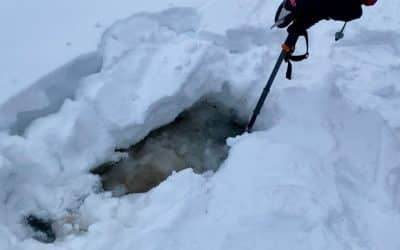
Chicago Man Recounts Experience Breaking Through Ice Near BWCA’s Stairway Portage
Ice hole on the Duncan narrows. Photo by George PastorinoDUNCAN LAKE – George Pastorino knew the sound. The ice was giving way underneath him and soon at least part of his body would be in the water. A casual snowshoe trek Wednesday, Feb. 4 in the Boundary Waters...