


Sheila Johnston, “The Loon Lady” of Minnesota, at the June 13 event on East Bearskin Lake. Photo by Joe Friedrichs
Gunflint Trail Event Puts Spotlight on Loons Near the Boundary Waters

By Joe Friedrichs
GUNFLINT TRAIL – The state bird of Minnesota was the centerpiece of an event June 13 held along this scenic byway that weaves between two sections of the Boundary Waters Canoe Area Wilderness.
Billed as a ‘loon rescue training’ for residents of the Gunflint Trail and others interested in the topic, the event brought more than 30 people to the Mid Trail area Saturday. A collection of guests, presenters, and loon experts from across the country joined residents of the Trail for the hands-on workshop and educational event, which was organized by Mona Hanson, a resident of the Gunflint Trail. Hanson said there’s been a troubling uptick in loons who come into harm’s way during recent years along a number of Gunflint Trail lakes. Hanson shared a story about a loon she and others tried to help on Leo Lake last year after noticing it had a Rapala-style fishing lure attached to it. That loon was able to free itself from the lure, she said, but it was just one of several cases during recent years where loons have become entangled in fishing lines or lures, or both.

Nearly 30 people attended the event focused on loons near the Boundary Waters. Photo by Joe Friedrichs
Putting her concern into action, Hanson organized the loon rescue training so others would know what to do if they came across an injured loon. Some of Minnesota’s most spirited and knowledgeable people when it comes to helping people assist loons traveled to the Gunflint Trail Saturday for the event. Among them was Sheila Johnston, commonly known as “The Loon Lady,” of Minnesota. In fall 2024, Johnston, a resident of the Brainerd Lakes area, launched a program known as Minnesota Loon Rescue, a grassroots organization that helps sick or injured loons across the state. Last year, Johnston told Paddle & Portage media on the shores of East Bearskin Lake Saturday afternoon, the group helped nearly 60 loons from across Minnesota.
Johnston said she was encouraged by the upbeat tone of the attendees during the event Saturday, which started at the Mid Trail Fire Hall before moving to East Bearskin for the afternoon sessions.
“It’s very obvious the people up here care about loons and about these lakes all around us here,” Johnston said.
Echoing Johnston’s sentiments was Gail Buhl, a Minnesotan who has spent decades helping sick and injured birds across the state, primarily raptors and loons. Buhl, who wore a pair of loon earrings to the event Saturday, talked about the complexities of loon rescues (they often need to happen at night, for example) and explained why discarded fishing tackle remains a serious threat to Minnesota’s loon population. Lead tackle in particular, Buhl said, is a significant threat to loons. A loon becomes emaciated and often dies within two or three weeks after swallowing a lead jig or sinker, according to the Minnesota Department of Natural Resources.
“It typically only takes one lead sinker or jig to poison a loon,” Buhl said.

Gail Buhl cares deeply for loons in Minnesota, as her earrings showcase. Photo by Joe Friedrichs
Buhl said anglers who fish in places like the lakes along the Gunflint Trail and across the Boundary Waters region can help loons by switching to lead-free tackle, for example. They can also be mindful of fishing line that breaks or spools free when fishing, she added.
Participants during the event Saturday took to the water on East Bearskin to simulate what a loon rescue looks and feels like from a motorboat and a canoe. Buhl said most of the rescues need to occur when it’s dark outside so the loon is less likely to dive under the water when humans attempt to capture it, albeit with the intent to help the injured bird. Other discussions and educational components of the event focused on how to remove hooks or fishing line once it gets tangled up in a loon, how to use a net to secure a loon so it can be assisted, and understanding when or if a loon actually needs to be helped by humans.
Many of the people who participated in the event Saturday, including New York-based researcher Nina Schoch, are quick to point out the collective passion for loons across North America. And people coming together, including the Gunflint Trail community, can help the loon population now and into the future.
“When it comes to wildlife rehabilitation,” Schoch said, “One bird, one loon being helped out, that can and does make a big difference in the overall population.”
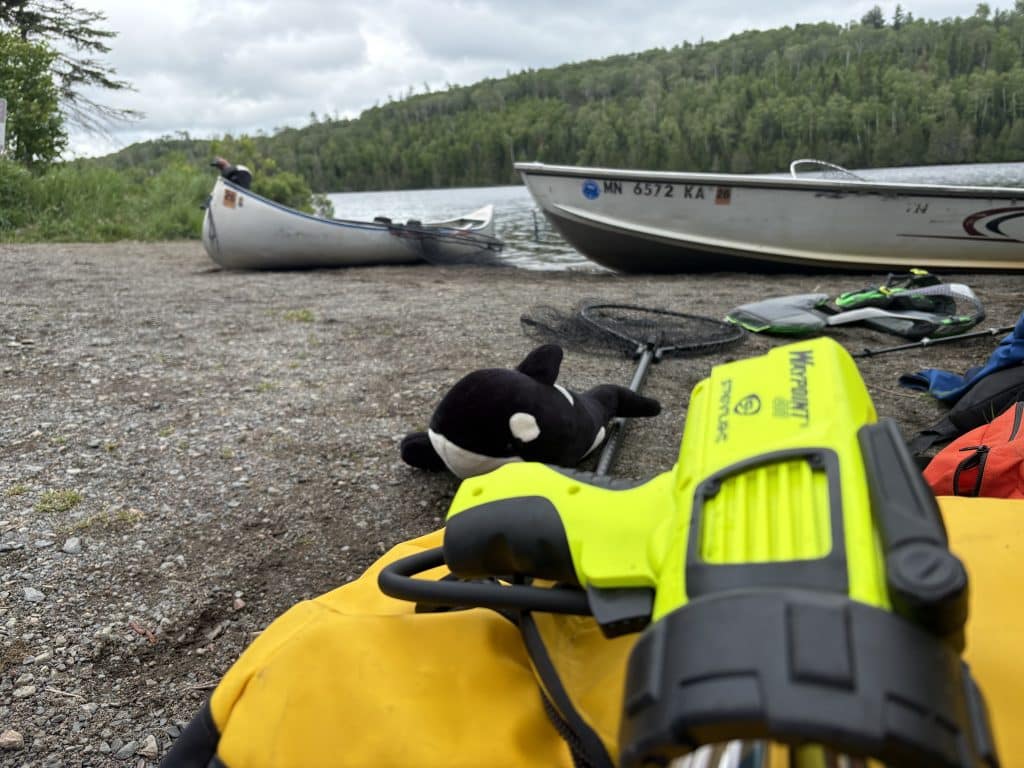
A prop stuffed animal filled the role of the loon during the event June 13. Photo by Joe Friedrichs
Many of the participants at the event Saturday on the Gunflint Trail praised the research of Dr. Walter Piper, who Paddle & Portage met and paddled a canoe with on Poplar Lake in 2024 to discuss loons. Hanson also thanked longtime Gunflint Trail resident Phyllis Sherman for raising loon awareness on the Trail.
To learn more about loons near and in the Boundary Waters region, click here to visit Chik-Wauk Museum & Nature Center’s Loon Program.
Subscribe to Paddle and Portage to support journalism and updates from and about the Boundary Waters.
Other Recent Articles

Scope Narrows For Telephone Reporting Sites Across the Boundary Waters Region
The border lakes of the Boundary Waters. P&P photo BOUNDARY WATERS – The end of the Remote Area Border Crossing Program and permits that allow people to cross many of Minnesota’s border lakes is approaching. The RABC Program as it currently operates will close...

Forest Service Returns Camping Gear to BWCA Paddlers Who Narrowly Escaped Wildfires
Photo courtesy of Bailey Shinn A Texas family was camping in the Boundary Waters Canoe Area Wilderness earlier this month when a wildfire took off not far from where they were staying. While camping on Pipestone Bay (Basswood Lake) Bailey Shinn, her three young...

Firefighters Talk of ‘Protecting Structures’ Near BWCA, She Helps In Advance
Teresa Floberg at a property managed to reduce wildfire risk near Ely. Photo by Joe Friedrichs Protective measures done in advance, that’s the key, she says. “We try to encourage homeowners to think in advance about the risks of wildfires,” says Teresa Floberg, the...