

Ryan Rodgers at an old cabin near Spaulding Lake in the BWCA. Photo by Joe Friedrichs
Discovering an Old Cabin and Silver Mine in the BWCA

By Ryan Rodgers
GUNFLINT TRAIL – I had bushwhacked halfway down the lake without finding one bit of the rusting machinery or decaying cabin walls that Joe and I were looking for. I scrambled along a vein of shattered boulders that a prospector from the 1800s named Captain Spalding claimed contained great mineral wealth. Here, Spalding promised investors, he’d discovered an ancient mine, worked centuries ago by native silversmiths.
Back then, when talk of the mine spread, the local paper in Grand Marais boasted the activity would bring wealth to the region. Spalding built a road, hauled in equipment, and excavated a shaft in what is today a remote corner of the Boundary Waters. On this last day of May, I came across a shadowy natural crevice still holding snow, as well as a quarried pit filled with water, but nothing resembling a proper mine. Through a screen of shoreline balsam and coming from the water, I heard the clunk of paddle shaft on canoe gunnel and looked to see Joe paddling to the far side of the lake to try his luck there.
The first I heard of the Spaulding Mine (note the difference in the name, a clerical error made at the time Spalding filed his claim) was from an elderly Hovland woodsman who said an iconoclastic homesteader named Frank Kugler had tried to kill his father at Spalding’s old cabin. Kugler shot a man at the cabin, the woodsman said, because Kugler believed the man was the woodsman’s father, who was a rival trapper. Then the dead man turned out to be someone else entirely, or so the story goes. A little later, I was looking for forgotten trails on an old map and saw a beguilingly titled “Ancient Silver Mines” next to “Spaulding’s Claim.”

Deep in the BWCA Wilderness is an old site where reports of silver surfaced in the late 1800s. Photo by Joe Friedrichs
Spaulding Lake is in the eastern Boundary Waters to the south of Pine Lake. It’s about a mile long and 40 acres in area. The lake is not on any point-to-point canoe route, and I’d never visited it. When I mentioned to Joe Friedrichs that I planned on canoeing there in early spring to see what was left of Spalding’s mine, he suggested we partner up on a long daytrip. We settled on a date in early May but had to delay when ice on the Gunflint lakes lingered.
In the meantime, I read about Spalding’s mine, which boasted a name with the cachet of a new age retreat, Ancient Diggings. The Grand Marais Pioneer promised Ancient Diggings would “bring Grand Marais to the front and win fame abroad.” In 1868, a silver rush started in the Northland when a rich deposit was discovered near Thunder Bay. Shares in the Silver Islet Mining Company soared from $50 to $25,000, as a 1,300-foot-deep shaft yielded millions of dollars worth of silver. Prospectors fanned across the region seeking the motherlode. One of these was William P. Spalding, from Sault Ste. Marie, Michigan. In 1875, Spalding was 53 years old. The papers called him Captain, an honorific from Spalding’s service in the Civil War as quartermaster in a Michigan infantry division. Spalding had a nose for financial opportunity. Back in the 1840s, he’d traded his native Connecticut for the Upper Peninsula’s copper rush. Then, after the war, he tried his hand at carpetbagging with a short-lived stint operating a southern plantation.
In 1875, Spalding used the Homestead Act of 1862 to file for 147 acres on today’s Spaulding Lake, a name that contains a slight misspelling of his surname. The year 1875 in the Boundary Waters is going back to the early days of American settlement. The old pine forests were intact. Grand Marais and the North Shore were reached by ship. Neither Ely nor Winton had yet been incorporated, and fur company trading posts operated on the border lakes, while Ojibwe riced and trapped in today’s wilderness and had a village on Basswood Lake. Other than the Vermillion Trail, which had been built the prior decade from Duluth to Vermillion Lake amidst the hype of an unsubstantiated gold rush, travel routes in the Boundary Waters were paddle and portage trails. Sometime in the 1870s and based on an indigenous route, a Grand Marais entrepreneur named Henry Mayhew roughed out an early version of the Gunflint Trail to access a trading post Mayhew built on Rove Lake on the international border. Captain Spalding likely traveled Mayhew’s newly blazed path to Bearskin or Clearwater Lake as he made his way to Spaulding Lake.

The author of this story at the old mine site in the BWCA. Photo by Joe Friedrichs
This was the same way Joe and I took to Ancient Diggings on the last day of May. We launched from Bearskin Lake on a warm morning. Early May had been windy and bitter, but then summer suddenly arrived. The day was very fine—the sky the confectionery blue of a raspberry slushy, and tender aspen leaves unfurling with the dayglow green of sweet lime. Birdsong came varied and whimsical—melodies pouring from a freshly cracked open rainbow. Joe and I had 8 miles and four portages to reach Spaulding Lake, which took about three hours in his red canoe. I’d never been to Crystal Lake and admired its clear green water. We portaged to Spaulding Lake where the water was shallow and tinted brown.
The first thing we did on Spaulding Lake was paddle to its eastern end to see whether what maps label as the start of the Stump River was navigable. On maps, the Stump flows east out of Spaulding into Long and Stump lakes before continuing to its confluence into the Pigeon River. Joe noticed before I did, however, that the stream on the east end of Spaulding Lake does not flow out of the lake, but rather into the lake. Therefore, the maps showing a stream linking Spaulding and Long lakes are incorrect. Instead of a continuous waterway through the 2-mile gap between Spaulding and Long lakes, there must be a small watershed break within the span, with one side flowing down into Spaulding, and the other flowing west into Long as the true start of the Stump River.
I had read so much about Captain Spalding that I’d neglected to pinpoint precisely where his cabin and mine stood. After crashing around in the woods for more than an hour, I worried we weren’t going to find anything more interesting than the pocket of lingering snow. Spalding had claimed this land before the United States government had surveyed it. By the time the General Land Office got around to surveying this portion of Cook County, in July 1877, the surveyor found Spalding had “a good house and clearing.” The surveyor, William Kindred, went on: “Ancient mines near Spaulding’s house have the appearance of having been worked extensively ages ago…the veins on which the work was done carries native silver.” Spalding was apparently at his homestead to regale Kindred, because Kindred eagerly recounted in his survey notes how a white pine tree growing over the ancient silver mines had been felled, its rings counted, and the tree determined to be 400 years old. By that logic, at least 400 years had passed since the natives mined silver here.
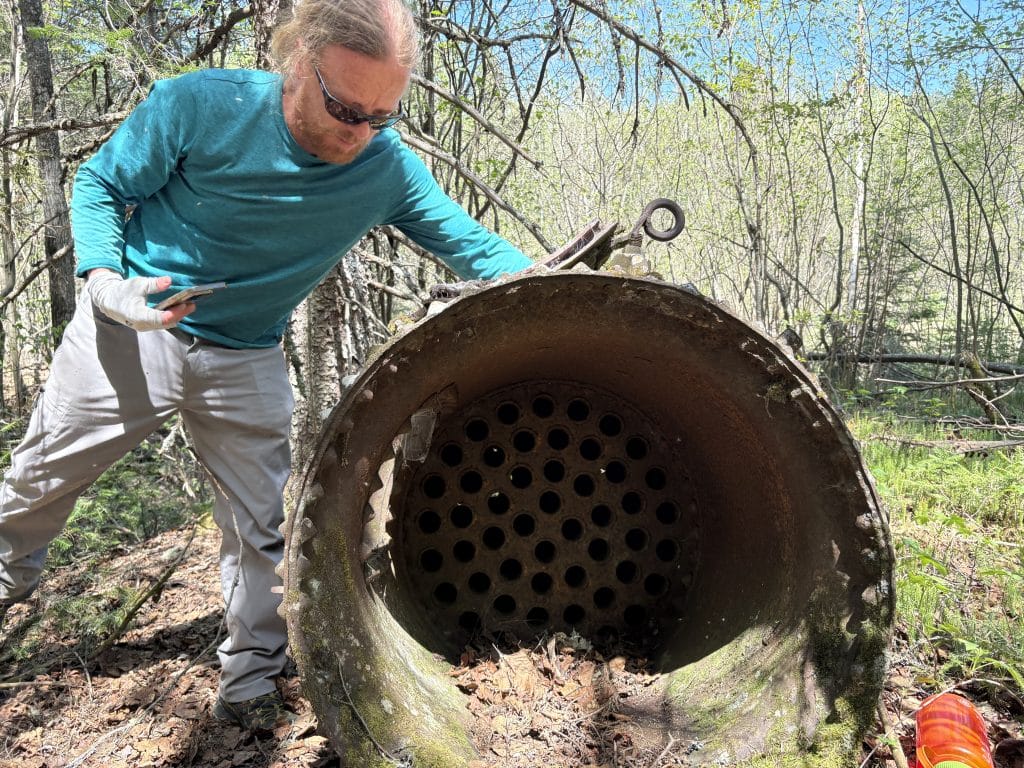
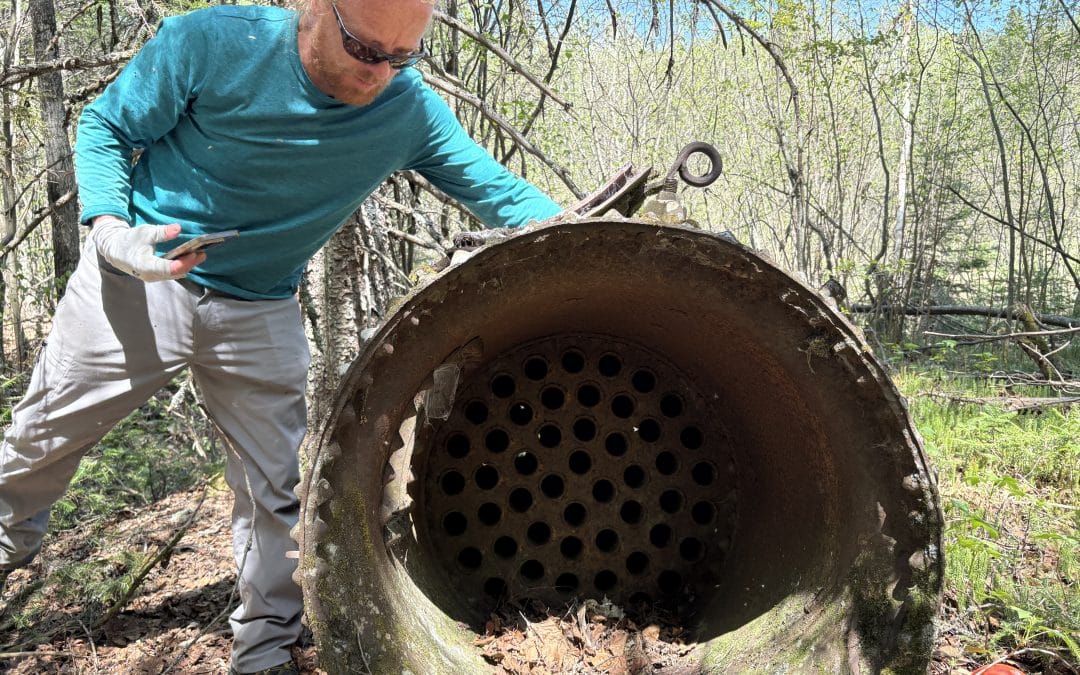
Rodgers at the mine site examining the equipment. Photo by Joe Friedrichs
I tromped the shore of Spaulding Lake curious about what form the mysterious rock vein would take. Only 30 feet back from the lake’s edge rose a short cliff. Beneath the cliff was a jumble of talus-like rocks running parallel to the shore. In places between the boulders underfoot were pockets of empty space—not really caves, just openings resulting from contrasting boulder angles coming together. These spaces contained what Spalding had claimed was the ancient silver mine. Reading at home, I’d pictured excavated caverns in a distinctive geology, giving Spalding the benefit of the doubt with his interpretation of the Ancient Diggings. Now that I was seeing the fault for myself, however, it was not an unusual landform for the Boundary Waters.
Three years after Spalding publicized his silver strike, Minnesota State Geologist Newton Winchell visited Ancient Diggings. Winchell was the scientist-adventurer who Grand Marais photographer Bryan Hansel once described to me as Minnesota’s Indiana Jones. In 1878, Winchell and his team reached Ancient Diggings by birchbark canoe on what was then called Lake Miranda. Spalding had evidently named the lake after his wife, Miranda Sexton (Crystal Lake was formerly called Fannie, likely also named by Spalding but I couldn’t find any family members of his with this name. Spalding, who lived fulltime in Sault Ste. Marie, was absent from the mine during Winchell’s visit. Winchell wrote of the spaces in the rocks in his subsequent report that came out later in the year: “These depressions show some openings within, between large boulders, and nearly large enough to admit a man, and after clearing out a little one was followed downward some feet.” Winchell avoided directly refuting Spalding’s Ancient Diggings claim, though noted he found no native silver, tactfully concluding, “No ancient hammers or implements of any kind have been found in the vicinity.” He also stated native peoples of the region had not been known to use silver.
In 1981, Bill Raff published a history of Cook County called “Pioneers in the Wilderness.” Raff includes a chapter about Spalding’s mine based on years of local newspaper articles and Cook County records. For several years after Winchell’s visit, Raff found little mention of Spalding or Ancient Diggings. A couple of things happened in the 1880s, though, which revived Spalding’s prospect. Most notably, silver was discovered just 20 miles to the northeast in Canada, where the Rabbit and Silver Mountain mines began producing many pounds of high-grade silver. Then, in 1885, funded by the county, the Rove Lake Road officially opened between Grand Marais and Rove Lake, on the international border to the north of Clearwater Lake. Rove Lake Road later became the Gunflint Trail, but, initially, before reaching Poplar Lake, it continued north to Mayhew’s trading post.

Snow lingers near the old mine site in the BWCA. Photo by Ryan Rodgers
Shortly after the early Gunflint Trail became a public road, Spalding constructed a side road leading to his mine. Bill Raff determined that Cook County and Spalding shared the costs of building the road to Ancient Diggings. Spalding’s Tote Road was built more or less along today’s Old Greenwood and Shoe Lake Roads. From near Carrot Lake, Spalding’s road continued 2 miles north to his mine. This last portion no longer exists. Presumably it was over this road that Spalding hauled in the heavy equipment Joe and I were looking for—a large steam engine, boiler, and winch. The machinery would have been sent to Grand Marais via ship, then hauled rest of the way by horse.
Tromping through the woods along Spalding’s vein, I could see Joe’s red canoe beached on the opposite shore. Frustrated, I retraced my steps and followed the rock vein in the opposite direction, eventually coming across another pool that appeared to have been excavated, then a ditch that was too straight to be natural. This was followed by a missing bite of cliff that must have been quarried away. Still no cabin or equipment. In 1991, going from Raff’s book, a man named Timothy Dawson wrote an article in the Boundary Waters Journal about the Spalding Mine that featured a black and white photo of some serious heavy equipment surrounded by balsam fir. I was so far from the lake I thought about turning back twice before spying what looked like a large pipe. Before I reached it, I saw water glint and looked down to see a mine shaft. The round piece of iron was Spalding’s boiler—a big tube 12 feet long. A small door on its side still opened. I turned around to find Joe.
We hadn’t found Spalding’s cabin, so, before returning to the mine, we set out looking for it in a new direction. After the initial two hours of finding nothing, we were on a lucky streak and quickly located the cabin. For being built in 1875, I was amazed that the thing was still discernable. There are other Boundary Waters cabins decades newer than Spalding’s that have completely decayed. Although the roof had collapsed long ago, one corner of the cabin walls still stood several feet tall. Raff described the cabin as being “15 x 20 feet in size, using hewed logs, and cedar bark for shingling.” Supposedly Spalding had outbuildings that included a horse barn, but we were running low on time so couldn’t linger. The cabin’s hewed logs were impressively thick and had been planed square. Joints were neatly fitted with dovetails and square nails.
We returned to the mine, which was called, perhaps grandiosely, Shaft Number 1, in a May 1891 article in the Pioneer. The writer of the article was eagerly awaiting Spalding’s return to Minnesota and the wealth that was sure to follow. The writer described Shaft Number 1 as: “65 feet deep, 9 x 10, and the diamond drill placed at the bottom, was set at 45 degrees, and a hole drilled to the depth of over 40 feet which proved to be a success, having passed through rich veins of silver.” The dimensions of the shaft opening appeared to match. Whether it was really 65 feet deep was anyone’s guess because the shaft was filled to the brim with dark, ice-cold water. The Pioneer’s claim of rich veins of silver seems dubious, particularly considering what was to come next. The article gushed about the Captain: “His faith has never wavered regarding the richness of these inexhaustible silver mines.” But was there ever any silver, let alone an inexhaustible supply. Or was it all a con?

Ryan Rodgers stands near the deep mine pit, which is likely 65 ft. deep. Photo by Joe Friedrichs
After the ecstatic 1891 newspaper article, Spalding failed to show up in Grand Marais not only that summer, but for several years to come. Had there been silver in the ground, one would think Spalding would adjust his schedule to come extract it. Yet, Cook County remained confident Ancient Diggings would provide. After an economic downturn in 1893, the county reduced the taxable value of other lands to ease taxpayer burdens, with Ancient Diggings specifically exempted. Spalding was busy back home with another matter. An esteemed citizen in Sault Ste. Marie, the newspaper there noted that in 1893 the Captain and Miranda celebrated their 45th wedding anniversary. Then, in 1895, Spalding went before the U.S. Supreme Court. Spalding v. Chandler regarded a piece of land in Michigan, with Spalding as the plaintiff. The dispute came after the U.S. government dissolved an Ojibwe reservation and reclaimed the land. Spalding attempted to take part of the erstwhile reservation through squatters’ rights. Another person, however, a nonnative named Chandler, held the official deed for the property. The Supreme Court Justices ruled unanimously against Spalding in 1896.
The next year he returned his sights to Ancient Diggings. Spalding’s statements, as found by Raff, began to take on a farcical quality. In 1897, the New York Herald quoted Spalding claiming that he discovered “only two weeks ago” at his mine “deposits of copper, and some silver and a little gold.” Spalding was now 74 years old, and Raff found no sign that he’d been in Grand Marais anytime in the last several years. Spalding continued: “I claim to have been the first discoverer of ‘ancient diggings’ on the north shore of Lake Superior, made in the fall of 1895.” Of course, he’d homesteaded Ancient Diggings 20 years before, and appeared to be luring a new crop of investors. Spalding described a mound on the property that he intended to excavate. The mound, Spalding said, “will be found rich in tools, in ornaments of copper, silver and gold.”
In June of 1897, a work crew employed by Spalding passed through Grand Marais headed to Ancient Diggings. The Duluth Herald recorded this and mentioned that Spalding was acting at the behest of “Milwaukee parties.” Spalding showed up himself in mid-June with “a large amount of mining tools and supplies.” He hired local men and departed into the woods with “a couple of team loads of tools and provisions Thursday morning for the scene of operations.” Despite the sudden flurry of activity, this was the last mention Raff found of Spalding’s work at Ancient Diggings. As far as Raff could discern, Spalding never returned to Ancient Diggings. The next year, 1898, the Sault Ste. Marie paper celebrated that “Captain and Mrs. Spalding” had lived in town for almost 50 years.
Financial markets in 1890s gilded-age America were minimally regulated; the country was rife with get-rich-quick schemes, corruption, and fraud. In Arizona, for example, the Spenazuma Mine reaped investor dollars and grew to include buildings and pits, until an investigative reporter found it was all pretend and that the ore its owner showed off had been bought from real mines. I couldn’t say for certain that Spalding fell under this category. Perhaps he’d found a little silver, or was such a cockeyed optimist he truly believed the next shovelful would yield the glint of ore. Yet, he’d been in the mining game since moving to the Upper Peninsula a half-century before. Spalding’s occasional flurries of activity at Ancient Diggings predictably followed buildups of silver mining hype, then quickly faded. If Spalding raised $100 and spent $75 developing the mine, that still left $25 in his pocket. Ancient Diggings was both geologically feasible for having silver, as well as sufficiently remote to discourage outside scrutiny. In 1959, the Minnesota Geological Survey revisited the Spaulding Mine, concluding: “A little pyrite was observed, but there is no dependable evidence of mineral content of any real value in the area.”
I love exploring these forgotten places in the Boundary Waters, not so much for the history itself, but to see the continuum of a land that has so far absorbed the incursions of an insatiable society. Spalding’s road has disappeared into the trees, his boiler rusts into the earth, and the only glint in the water-filled shaft is the reflection of sky. What was going to transform the land left barely a trace. On Spaulding Lake and the Boundary Waters as a whole, rather than the monetary ambitions of people swallowing the land while leaving little trace of what was, as is so often the case, here the land remains sprawling and free. It’s an outcome so fine it’s almost as hard to believe as the Ancient Diggings itself, and all the more wonderful for being true.
Subscribe to Paddle and Portage to support storytelling from and about the Boundary Waters.
Your support also helps us produce the Paddle & Portage Podcast. Listen to this episode from the mine site in the BWCA with Rodgers.
Other Recent Articles

Forest Service Prepares for Significant Announcements on BWCA Policy & Usage
BWCA Wilderness entry point sign. Photo by Joe Friedrichs The U.S. Forest Service continues to consider changes to a trio of policies that would impact people and businesses that interact with the Boundary Waters Canoe Area Wilderness. Of the potential changes, this...

Missing Hiker Found Alive & Alert at Isle Royale National Park
Isle Royale National Park. P&P file photo A hiker missing at Isle Royale National Park for a week has been found on the remote Lake Superior island. Craig Berg, 70, has been found alive and alert, the National Park Service announced Sept. 12. Berg, missing since...
A Tour of Areas Burned in 2026 BWCA Wildfires
The Sioux River North Entry Point in September 2026. Photo by Joe Friedrichs The fires that shut down the Boundary Waters Canoe Area Wilderness this summer made national news. Paddle & Portage media was invited Sept. 9, along with other members of the press, to...