
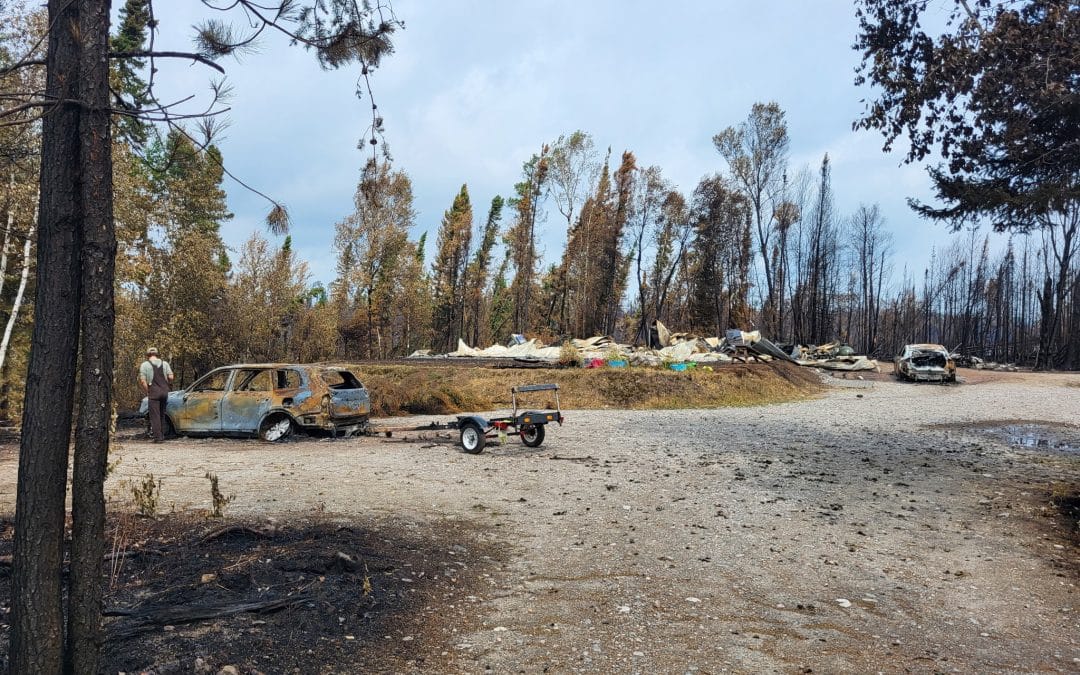

The site of the main lodge at Wabakimi Outfitters after a wildfire burned it to the ground in July. Submitted photo
Wabakimi Origins Rooted in the Benefits of Fire, Then the Lodge Burned

By Joe Friedrichs
WABAKIMI PARK – Bruce Hyer says Smokey the Bear was a liar.
Considered by some – or at least by his own standards – to be the “Father of Wabakimi,” Hyer says that humans can’t prevent wildfires, as the fictional bear claims. All humans can do with wildfires, Hyer says, is postpone them.
“Smokey lied to us,” Hyer says.
Hyer discovered firsthand this summer how devastating a wildfire can be when his main lodge for Wabakimi Outfitters, and three of the seven outposts he operates inside the massive provincial park, burned to the ground. The wildfire causing the destruction started in early July and eventually became known as Thunder Bay 36. At more than 700,000 acres, it is the largest wildfire in the history of Ontario, a landscape that is no stranger to huge, destructive blazes.
In a summer marked by wildfires, including those that shut down the entire Boundary Waters Canoe Area Wilderness and Quetico Provincial Park, the closure of Wabakimi went largely under the radar in the paddling community. Also missing from most comment threads focused on the fires impacting 2026 paddling was the devastation to Wabakimi Outfitters. The business’s main lodge and numerous other buildings burned to the ground. Hyer and his team lost dozens of canoes in the fire, a mix of Northstars, Wenonahs, and Souris River models.
During the peak of the wildfire activity in July, more than 2,800 people were under evacuation because of the Thunder Bay 36 fire and other nearby wildfires, many of them Gull Bay and Whitesand First Nation band members. Also under evacuation for most of the summer were Hyer and his staff of eight from Wabakimi Outfitters. As of Aug. 17, just over 700 people remain displaced from the wildfires, according to Ontario’s Ministry of Emergency Preparedness and Response team. Most of Wabakimi remains closed to paddlers, though Hyer’s team are back up and running in a limited capacity from their new headquarters on McKenzie Lake.
Hyer’s history with Wabakimi Provincial Park dates to the mid-1970s when he first arrived in the area, which is located about three hours north of Thunder Bay. Concerned about potential logging in what he considered a sensitive ecosystem, Hyer worked diligently to establish government oversight and protection of the land and water. Among the reasons Hyer wanted to set up the park was to allow it to burn when it needed to.
“First and foremost is the preservation and protection of a huge piece of boreal forest… and to allow fire and other natural forces to reign,” Hyer’s website reads in describing the origins of the park.
Hyer lost about $3 million in assets this summer when the wildfire swept through in mid-July, he estimates. He’ll recoup about $1.4 million from insurance when the dust settles, he expects. The business was underinsured, he admits.
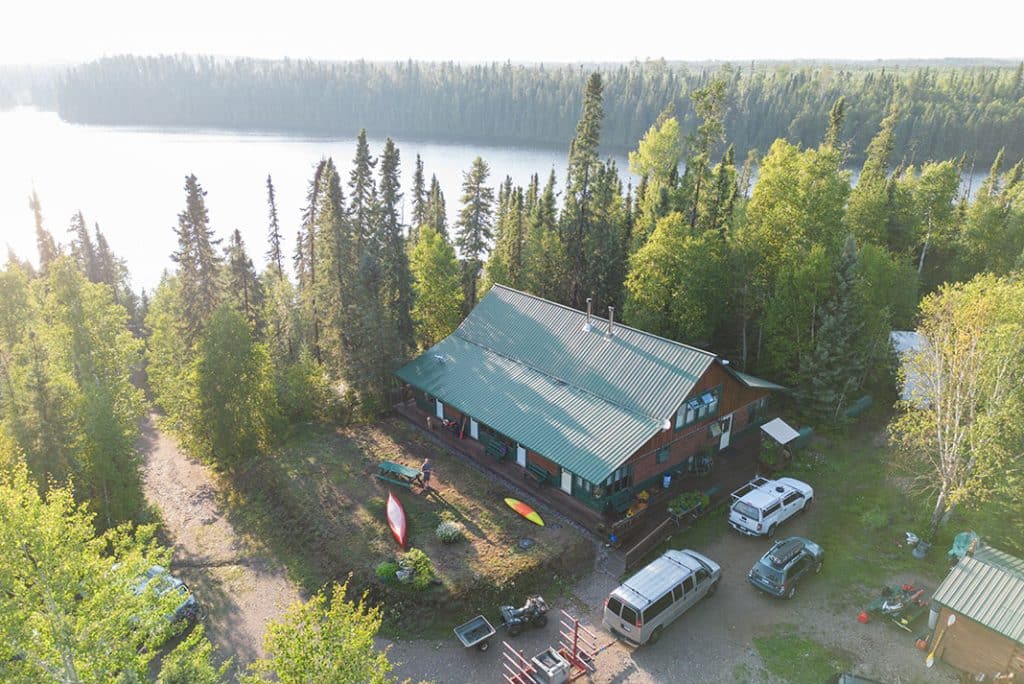
Wabakimi Lodge before the July fire. Submitted photo

Hyer spoke with Paddle & Portage media Aug. 29 about the history of Wabakimi and the wildfires from this summer. Hyer said the lodge he and his wife built in 1998 on the shores of Mattice Lake burned sometime between July 13 and 14. Three staff members were inside the lodge the night of the fire, and they were only able to escape after someone from the nearby Whitesand First Nation called to say a fire was coming.
“The government didn’t tell us anything,” Hyer, who previously served two terms as Member of Parliament, told Paddle & Portage.
Hyer arguably knows Wabakimi better than any other living person. In addition to his advocacy in establishing the park, he claims to have created 90 percent of its recreational routes, including portages he and his staff continue to maintain. Today, Wabakimi Provincial Park is about five times larger than the entire BWCA Wilderness; at approximately 5 million acres it’s the second-largest provincial park in Ontario, behind only Polar Bear Provincial Park, which sits in the far north near Hudson Bay.
Hyer was in Thunder Bay when his main lodge, many of the canoes in his fleet, numerous other buildings and almost all of 12 acres of timber near his headquarters were turned to smoking ashes in mid-July. In the days that followed, Hyer learned that he also lost three of his remote outposts in the park, including the cabins on Burntrock Lake and Shawanabis Lake that he built by hand.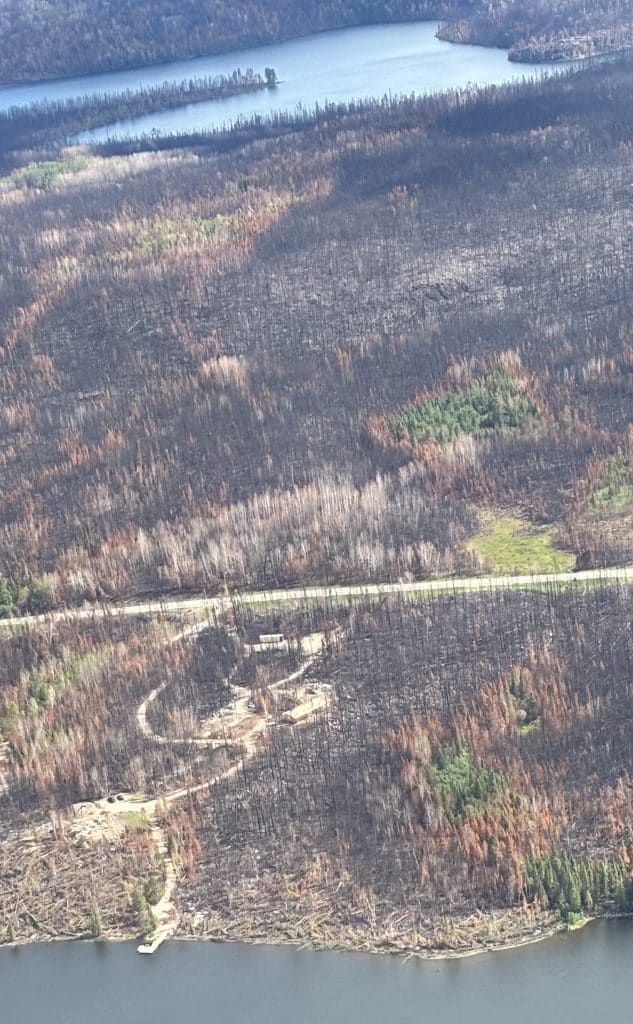
Hyer is 80 years old now and his legacy is cemented with the establishment of Wabakimi. The formation of the park served him well, from his humble beginnings of living off the land in a small shack to one whose assets measure into the millions of dollars. When we spoke with Hyer from his home in British Columbia this week (one of several homes he now owns across Canada), he used the word “fortuitously” nearly a half-dozen times within a 30-minute period. It’s too early to tell what, if any, good the largest wildfire in the history of Ontario will bring to Wabakimi and the dominion Hyer built within it, but there’s no question that he’ll do everything he can to make the stars align in accordance with a future that supports his business endeavors. Indeed, talking with Hyer is much akin to chatting with the late Bruce Kerfoot, the longtime proprietor of Gunflint Lodge on the edge of the Boundary Waters. What Hyer’s approach has in common with Kerfoot’s is a full understanding of the importance of the natural world, as well as enthusiastic pursuit of financial rewards from the deep interior of the boreal forest.
Despite losing his lodge, three outposts, and all manner of gear and equipment to the fires, Hyer remains confident in the future of his enterprise. He also remains supportive of the notion of letting fire do what it needs to do in the timber here. Continually putting out spot fires and using massive amounts of resources (money) to fight every fire that pops up in places like the Boundary Waters – as is the standard approach by the U.S. Forest Service – is a foolish endeavor, Hyer says. Such action only leads to bigger fires down the road, as was evident this summer, he adds.
In talking with Hyer about the wildfires and destruction of his property, it’s easy to be sympathetic. He’s very intelligent and likable. He says logical things and is a legend in many ways. However, there is an inescapable sense of irony in the fact that Hyer worked tirelessly to protect nearly 5 million acres of boreal forest, with the primary reason for protection rooted in creating a place where “fire and other natural forces” are allowed to “reign.” Smokey the Bear could be a liar, as Hyer suggests, but one truth prevails: The wild spaces the fictional creature speaks of will forever remain unconcerned with anyone’s financial journey.
Support this type of reporting from and about the Boundary Waters by subscribing to Paddle and Portage today.
Other Recent Articles

Forest Service Prepares for Significant Announcements on BWCA Policy & Usage
BWCA Wilderness entry point sign. Photo by Joe Friedrichs The U.S. Forest Service continues to consider changes to a trio of policies that would impact people and businesses that interact with the Boundary Waters Canoe Area Wilderness. Of the potential changes, this...

Missing Hiker Found Alive & Alert at Isle Royale National Park
Isle Royale National Park. P&P file photo A hiker missing at Isle Royale National Park for a week has been found on the remote Lake Superior island. Craig Berg, 70, has been found alive and alert, the National Park Service announced Sept. 12. Berg, missing since...
A Tour of Areas Burned in 2026 BWCA Wildfires
The Sioux River North Entry Point in September 2026. Photo by Joe Friedrichs The fires that shut down the Boundary Waters Canoe Area Wilderness this summer made national news. Paddle & Portage media was invited Sept. 9, along with other members of the press, to...