
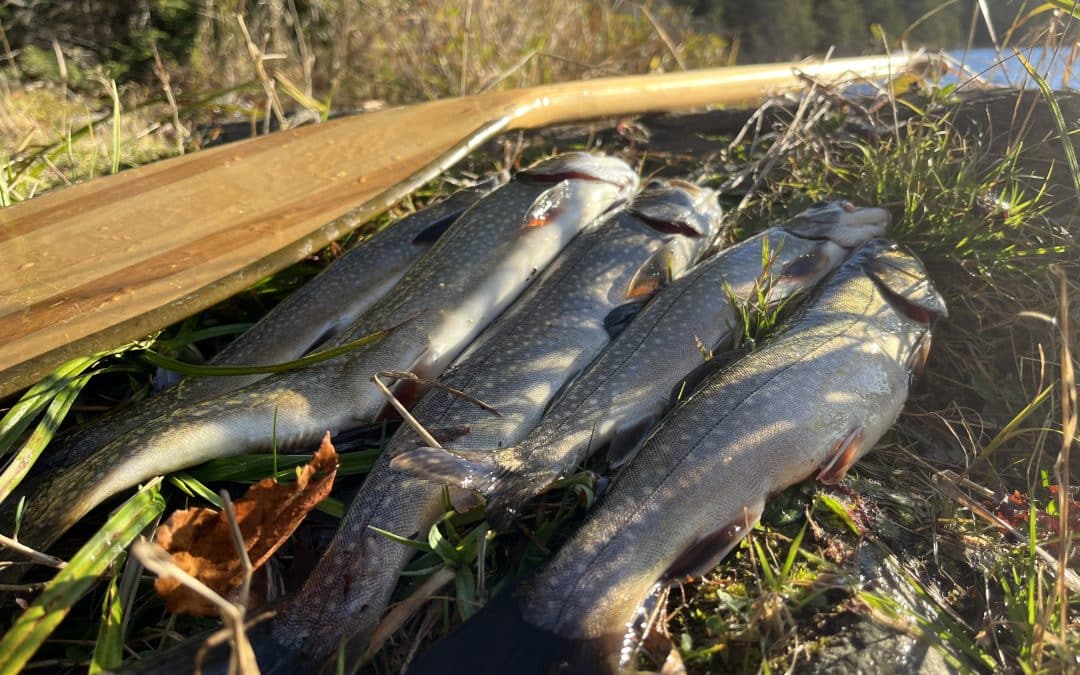

BWCA brook trout. Photo by Joe Friedrichs
Fall Trout Fishing in the BWCA Wilderness

By Joe Friedrichs
Cooler weather and high winds across the Boundary Waters will stir lake trout into fall spawning patterns. Such behavior will trigger anglers to target lake trout during the final two weeks of the season across the BWCA Wilderness.
Lake trout season closes Sept. 30 for all lakes in the BWCA and across northeastern Minnesota.
Brook trout, splake, rainbow, and brown trout fishing continues until Oct. 31.
With temperatures dipping the 30s Sept. 14, following days of strong wind, the water temperatures will start to pull trout species from the depths where they harbor for most of July, August, and the start of September.
We’ve covered numerous stories about fall angling for trout over the years, including a fly-in trip we did with the DNR in 2024 to study lake trout on Little Saganaga Lake in the BWCA.
Full story:
LITTLE SAGANAGA LAKE – It was quiet. At least six portages and many miles from the nearest entry point, it was to be expected.
The only sounds at first light were the birds. Until the motor roared.
“A beautiful morning,” said EJ Isaac, the Grand Marais area fisheries supervisor for the Minnesota Department of Natural Resources.
The motor, a gray Honda outboard with 2.3 horsepower, was pulled to life by Isaac on this remote lake in the Boundary Waters Canoe Area Wilderness. It took three aggressive tugs on a pull cord, like one found on an old lawnmower, to start the motor. The machinery was mounted on the back of an aluminum square-stern canoe. The hull and gunnels rattled with excitement as Isaac gave more fuel to the motor and increased our speed. We were off to find fish. In the name of science.
The DNR has been using motors inside the federally protected BWCA Wilderness for many decades. The uses of motors range from the stocking of fish by airplane to the studying of fish populations using boats and nets on the many scattered lakes across the Boundary Waters. The DNR is allowed to use motors in the nation’s most visited wilderness. This permission comes from the U.S. Forest Service.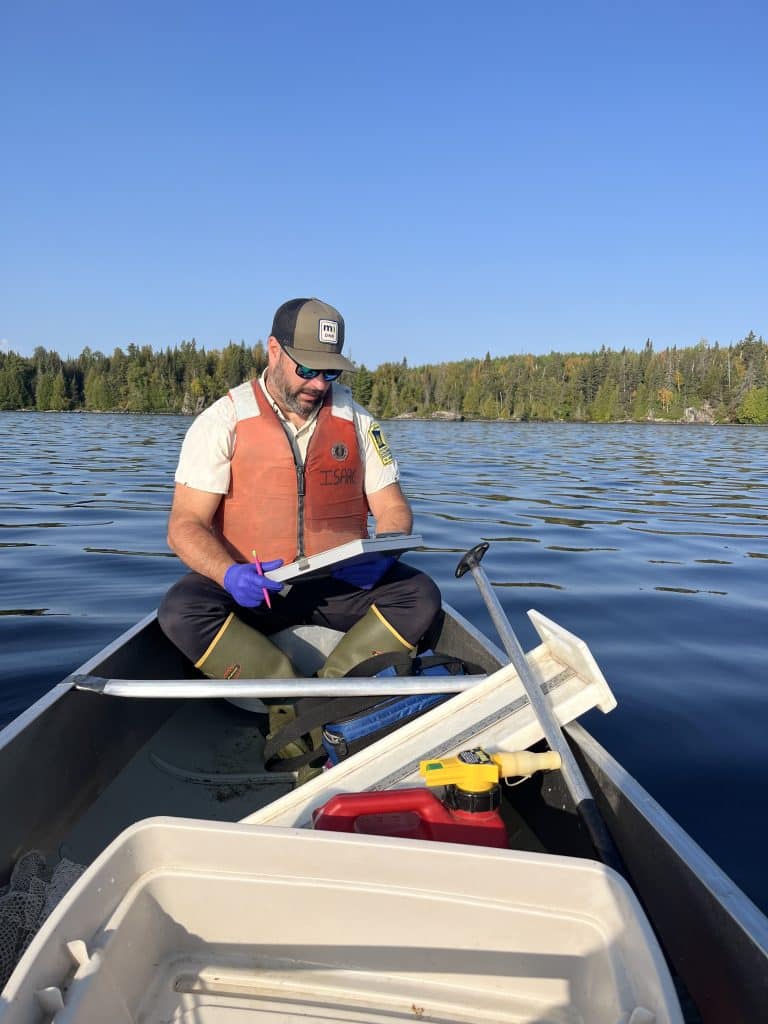
Conducted under the label of fisheries management, each year the DNR performs something known as a “fish survey” on a handful of lakes in the wilderness. These surveys range from remote lakes near the end of the Arrowhead Trail to the far reaches of Lac La Croix. Lake surveys consist of periodic monitoring of fish populations, water chemistry, and fish habitat, according to the DNR. In September, Isaac and I, along with an abundance of gear belonging to the DNR, were flown into Little Sagananga Lake, known commonly as “Little Sag,” via the U.S. Forest Service de Havilland Beaver float plane. I was there as an official volunteer with the DNR, and as a reporter. The purpose of the trip, at least for Isaac and the DNR were concerned, was to document changes in the fish community and to study various components of the lake, including oxygen levels in the deep basins of Little Sag.
It was a particularly warm week in mid-September when we visited this remote wilderness lake, spending three nights and four days setting gill nets and gathering information from the fish they captured. During that time, many fish were caught. Some were released, others scaled and cut up for research purposes. Lake trout, northern pike, burbot, perch, and white suckers, were the primary haul. We also happened upon more than a dozen canoeists and were within earshot of many more during the trip, despite the lake’s distance from the nearest entry point.
Fish research like this is commonplace across the state, and the DNR uses motors in almost every survey it conducts across Minnesota. The only difference in the BWCA Wilderness is that paddlers are expecting to experience solitude, or at least a motor-free experience, when they arrive to a remote location like Little Sag. However, for the better part of this week in September, canoe-campers and others were greeted by the occasional sounds of a gasoline-powered motor and a rattling square stern across the calm waters of this remote lake.
State and federal agencies using motors in the nation’s most visited wilderness area raises a host of questions: Why is it essential to study fish population and health in lakes the DNR does not actively manage, particularly when they need to use motors to do the work? Why, at least on occasion, don’t the survey results match angler reports from these wilderness lakes? Do the costs and impact on wilderness character justify the practice of doing fish surveys in the Boundary Waters?
If you ask the DNR the latter question, you’ll hear some inexplicit version of “yes.”
The Forest Service is more likely to lean on documents and longstanding agreements between the two agencies as a stopgap to the question.
As for the approximately 150,000 people who visit the wilderness each year, the consensus is split between supporting fisheries management, and discomfort with the arrangement, particularly when it comes to the use of motors in the wilderness. It’s also possible some of the people who visit the BWCA Wilderness have no idea the DNR uses motors to study and stock fish in the wilderness. Until now.
The Arrangement
Since at least 1949, the DNR and the Forest Service have operated under a series of agreements that detail how they will work together to achieve common goals in terms of land, water, and wildlife management in the Boundary Waters region. In government talk, these are known as “Memorandums of Understanding,” or MOUs.
In 1988, the DNR and Forest Service signed a “master MOU” for the purpose of working together to, among other purposes, protect and manage fish and wildlife populations and habitat within the Superior National Forest. This MOU remains in place today and is a guiding tool for fisheries management in the BWCA Wilderness. The document has been updated, or modified, several times over the years, most recently in 2020.
At some point every winter the DNR presents a list of lakes they would like to conduct fish surveys on in the BWCA Wilderness for the upcoming year, and which lakes they would like to stock with fish. There are certain thresholds that the DNR must adhere to before a motor can be used on any given lake in the BWCA Wilderness. For example, according to the MOU, during any given year, no more than five remote lakes less than 450 acres and no more than 10 lakes larger than 450 acres will be accessed via airplane inside the wilderness. In addition, in each year, no more than 15 non-motorized lakes larger than 450 acres will be surveyed by motorboat and no more than 15 non-motorized lakes will be crossed by motorboat to survey other lakes, the MOU states. Inside the BWCA Wilderness, motorboats may be used to conduct surveys only on lakes larger than 450 acres. The most motorboat use that could occur in any given year on non-motorized lakes in the BWCA Wilderness is a combined total of 30 lakes.
Given that context, some of the lakes the DNR uses a plane to access and then spends the better part of a week motoring around on are not lakes the agency actively manages. This means the DNR does not stock the lake with fish, have special fishing regulations on the lake, or play an active role in any capacity in terms of the fish populations in that lake. Little Sag is an example of this. The last time lake trout were stocked on Little Sag was 1950. Any fish in the lake now are there because of natural reproduction. If the DNR did not find a single lake trout in the lake, (they caught about a dozen in 15 different net sets), it could ultimately lead to some changes to how the DNR manages the lake. As it stands, the DNR did find lake trout. At the cost of contracting with the Forest Service to fly in the plane, a week of staff time spent on the lake, and other expenses like meals and fuel, in addition to the disturbance motors cause paddlers who are on a canoe trip to the Boundary Waters, why does the DNR do this work on a lake it does not actively manage or stock with fish?
“There is a strong public demand for information about our fisheries,” said David Weitzel, the assistant regional fisheries manager for the DNR’s Northeast region.
In the BWCA Wilderness, the DNR says that strong public demand for information about fish and fishing justifies the use of motors, despite the fact the agency does not actively manage most of the lakes in the wilderness. In September, multiple people on Little Sag stood on the shoreline appearing visibly agitated as Isaac drove by a campsite. For his part, Isaac points out the DNR only visits the lake every 15 to 25 years. Furthermore, the work follows the guidance of the MOU allowing the use of motors in the wilderness given the data the work yields.
“We don’t do this often. It’s not like we come here to do this with any regularity,” Isaac told me one afternoon in the Boundary Waters. “It’s been a decade and a half since we were last here.”
Cathy Quinn is the assistant wilderness program manager on Superior National Forest. She said the MOU is indeed the document that guides determinations about what lakes the DNR will survey and stock, but that those conversations remain fluid. Sometimes, Quinn said, requests are denied. These include recent requests by the DNR to use a motorboat on a certain lake in the Boundary Waters and to use a trail camera that would be left in the wilderness for an extended period of time.
“There can be a learning curve when it comes to those types of requests that come in, and just having those conversations about wilderness character,” Quinn said. “And so, can we instill wilderness character in other managers’ minds? We can sure try, but ultimately, (the DNR) have a different mission as an organization than we do.”
Wilderness Character
Once they reach the water, motors are not part of the experience for most people who take a canoe trip to the BWCA Wilderness. That’s primarily because motors are banned in most sections of the wilderness, following a series of legislative and other legally binding arrangements that remain in place. However, the use of motorboats in the BWCA Wilderness still occurs, beyond simply for research purposes by state and federal agencies. There are motorized corridors in places like Saganaga Lake at the end of the Gunflint Trail, and on Moose Lake closer to Ely. There are about a dozen lakes that allow motors in the wilderness. The motorized corridors allow towboat operators and others to travel across certain sections of the wilderness using motors, though the practice is currently under review and not without its critics. In addition, search and rescue squads are occasionally granted permission to help people who are in distress, or to remove bodies when people die in the backcountry.
According to a document shared by the Forest Service, “Wilderness is essentially unhindered and free from the actions of modern human control or manipulation.” This same document describes a series of factors that degrade wilderness quality. Among those factors are the use of motor vehicles, the use of motorized equipment, and stocking fish using an airplane. The DNR engages in these practices in the BWCA Wilderness on an annual basis when they study fish populations and stock trout and other species in lakes inside the federally protected wilderness. Nonetheless, Quinn said the Forest Service rarely hears from the public about the DNR’s use of motorboats in the BWCA Wilderness.
“It’s usually about, ‘hey, we saw a motorboat on such and such lake, or an airplane flew really low, or an airplane landed and dropped some people off or picked them up,’ and these sorts of reports,” Quinn said. “Most of the time it’s people just honestly trying to do good and make sure that there isn’t anything illegal happening.”
The term “wilderness character” is something land managers from the Forest Service will toss out on occasion when they’re talking about the rules and regulations of the Boundary Waters. A 2015 document assembled by the federal government, known as Keeping it Wild 2, identified and defined five tangible “qualities” of wilderness character:
—Untrammeled: wilderness ecological systems are unhindered and free from intentional actions of modern human control or manipulation.
—Natural: wilderness ecological systems are substantially free from the effects of modern civilization.
—Undeveloped: wilderness is essentially without structures or installations, the use of motors, or mechanical transport.
—Outstanding Opportunities for Solitude or Primitive and Unconfined Recreation: wilderness provides outstanding opportunities for solitude or primitive and unconfined recreation.
—Other Features of Value: wilderness may have unique ecological, geological, cultural or other features of scientific, educational, scenic, or historical value.
Weitzel said the DNR is mindful of the disruption the use of motors can have on someone’s canoe trip to the Boundary Waters. Disruption is a fair word, the DNR acknowledged, as the chug of a motor is not part of the “singing wilderness” romanticized in the minds of those who are charmed by the words of Sigurd Olson, for example.
“We certainly understand those concerns. And we are very mindful of that, so we really try to target low use periods, early in the season, late in the season, and try to reduce that impact as much as we possibly can,” Weitzel said. “But, unfortunately, with some of these locations, it just wouldn’t be possible to collect the data without using a motorboat.”
Jason Butcher is the forest aquatic biologist for the Forest Service on Superior National Forest. He said the development of the MOU that the state and federal governments crafted does not mean the implementation of the document is always “warm and fuzzy” between the two agencies.
“We acknowledge that we have different missions and goals, and are coming at it from different ways,” Butcher said. “There’s a fair amount of hashing things out, behind the scenes. We’ve had numerous meetings about the MOU, and folks looking into policy and guidelines and law and things like that. And it’s not all warm and fuzzy, those conversations. Though it fosters good partnership and good discussion, it was hard, hard work to get us to that point.”
Studying Fish
During the September trip to Little Sag, Isaac from the DNR spoke with several paddlers who were camping, canoeing, and fishing on Little Sag. The reactions were a mixed bag, from the noticeably agitated campers who stood with their arms crossed near the shoreline, to a group of six canoeists in three separate canoes whom Isaac engaged in conversation.
“Talking with some of the anglers and canoeists that were here, they were kind of curious at first maybe,” he said. “They saw the float plane come in and land, and wanted to make sure what was going on. People might wonder if there’s a search and rescue or some other activity happening. After talking people through, they are excited, and they’re asking lots of questions about the lake survey, asking if it was better than in years before and that sort of thing.”
Isaac, who’s worked for the DNR since 2023 – though he’s been working in fish and wildlife management in the region for over a decade – said there are a lot of people who come to the Boundary Waters specifically for the fishing.
“A lot of people here are enjoying the recreation of the Boundary Waters,” he said. “And fishing is a huge component of what I think most of the people are doing on their trips, to some extent. So, people are really curious, ‘How is the fishing? Where are the fish? How do we catch some bigger fish?’ So fisheries opens that door for communication where people are wanting to learn, share, and for us to share.”
The DNR is the lead agency responsible for fisheries management in Minnesota. As written and clearly defined in 1978, the BWCA Wilderness Act recognizes the DNR’s ongoing jurisdiction and management responsibilities for various aspects of fish and wildlife within the BWCA Wilderness. How much management they are able to exercise often comes to funding and the agency’s ability to provide staff to do the work. Things like moose research and fish surveys take both resources and humans to do the work, things the DNR has a tendency to be lacking on occasion.
The DNR says it is important to travel to remote lakes in the BWCA Wilderness to keep tabs on how fish populations are doing in the lakes it’s tasked with overseeing, though not necessarily in terms of management. Lake survey data is used to track fish population trends, evaluate the effectiveness of management actions such as stocking, and establish realistic management goals for a given lake, according to the DNR. The surveys are not intended to tell the agency or anglers exactly how many fish are in the lake, or to serve as a litmus test for how the fishing will be.
“Angler reports can be very subjective,” Issac said. “Anglers can also target the best spots in the lake that are most productive or hold the most fish. Lake surveys are designed to target fish spatially across the entire lake and over the depth ranges fish occupy. For instance, gill nets are not set on steep depth changes, reefs or humps, or in areas with lots of debris like trees. These are typically all good places to fish. Lake surveys are designed to track population level changes, not find out where the best fishing spots are.”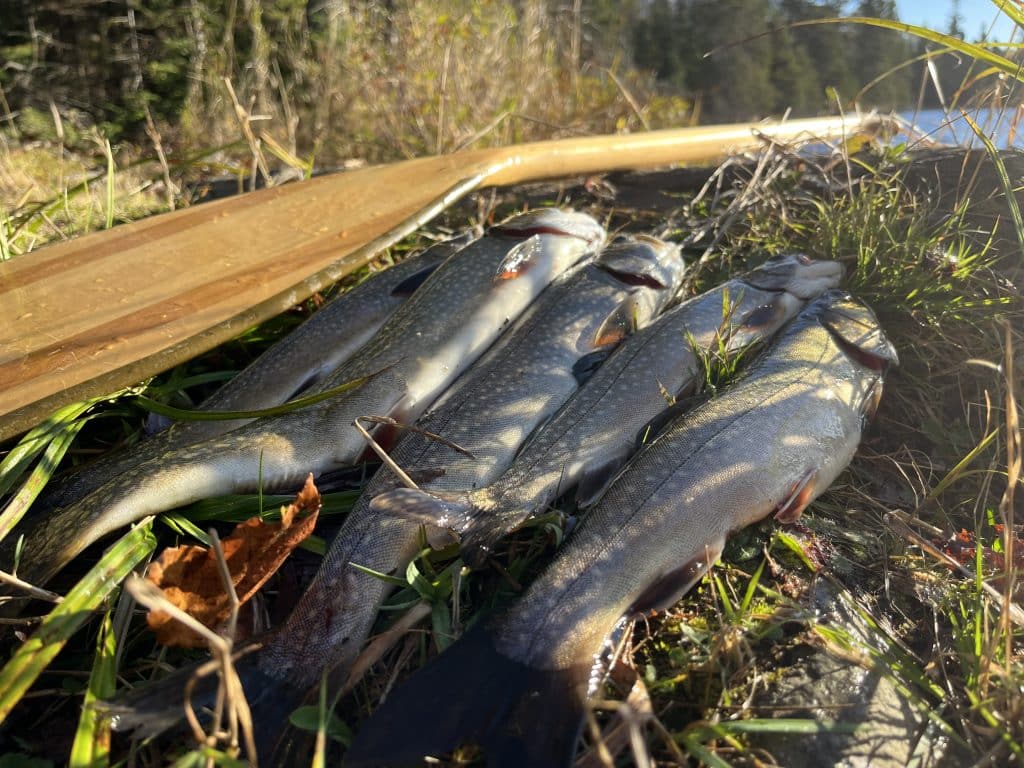
On average, the DNR conducts 650 lake surveys each year. Most of the “important fishing lakes” are surveyed once every three to five years. The 11 largest lakes in the state, including Mille Lacs, Superior, and Lake of the Woods, are surveyed annually. Smaller, more remote, or lightly used lakes, including the nearly 1,200 lakes spread across the BWCA Wilderness, may only be surveyed once every 10 to 20 years.
The DNR thinks of fish surveys as marking a spot in time, Isaac said. Remote lakes like Little Sag are indicators of how things like climate are impacting lakes where humans have little direct influence on what’s happening beneath the surface of the water.
“These lakes don’t receive much angling pressure. This means we get a glimpse into how these lakes function naturally in the absence of strong human harvest,” he said. “We can see how the lake trout is doing out here in a more natural setting in the absence of harvest. We also get information on this big body of water. And we do have concerns for lake trout and some of our lakes be able to continue to support lake trout. Do we have enough thermal habitat? Do we have enough water that’s cold and well oxygenated for these fish?”
In addition, the surveys can provide information regarding the number of fish people should be eating, even from lakes people think of as “pristine wilderness lakes” in the Boundary Waters, Isaac said.
“Fish tissues collected from (Boundary Waters) surveys are needed to help create fish consumption advisories,” he said. “It is important to have information about the health benefits and risks of eating fish in environments where the general public may consider all fish safe to consume.”
From the public’s perspective, fish surveys primarily tell anglers what fish are in the lake and how big some of these fish are. This helps them determine what type of gear and tackle they should bring on their trip. For example, if an angler sees from the DNR’s Lakefinder page that there are lake trout in a lake, they would bring certain lures or bait that increase the odds of catching that species. The same goes for walleye, pike, bass, and so on. Lake survey data is also used to track fish population trends, evaluate the effectiveness of management actions such as stocking, and establish realistic management goals for a given lake, according to the DNR.
“In some cases, surveys are conducted simply to increase our understanding of the fishery and share that knowledge with anglers and other stakeholders,” Weitzel said.
The trouble with that reasoning, at least through the lens of the many thousands of people who fish in the Boundary Waters every year, is that the findings in the lake survey don’t always align with how many fish people may or may not catch on any given lake. For example, the DNR reports “Little Saganaga Lake has a low- to medium-density population of lake trout.” The September findings support that, with most of the nets Isaac pulled not holding a single trout. However, outfitter and angler reports shared with Paddle and Portage for this story tell a much different story.
Anecdotal reports of lake trout fishing on Little Sag coming from two different outfitters near the end of the Gunflint Trail both suggested their guests have reasonable to good success catching fish on Little Sag, particularly early in the season. These reports were secondhand, to be fair. One outfitter who spoke with Paddle and Portage said they have a group that comes nearly every season and reports catching almost 100 lake trout in Little Sag over the course of several days. Other reports shared with Paddle and Portage for this story came directly from people who’ve fished the lake multiple times in recent years.
“Little Sag is full of lake trout,” said one angler, who happens to be a DNR employee. “It’s an amazing lake for fishing.”
That being the case, the angler groups Isaac spoke with in September said the lake trout fishing was slow, with some groups not finding any trout, and others only one or two per group.
Regardless, the DNR says angler reports don’t always match the findings of a lake survey.
“I think there’s a misconception that the main thing that we’re looking at with those surveys is the number of fish that we catch per net,” Weitzel said. “The fact most people probably don’t understand is that surveys are conducted in a standardized manner to assess changes to the population, not find the most fish. That is an important piece of information to us, but that’s not really the index that we’re using to determine the health of the fishery.”
Weitzel said the DNR is more concerned with how quickly fish grow in any given lake, and how long they are living. The DNR is also interested in when fish are reproducing in a lake, and where.
“The total number of fish in a lake is just one small piece of the puzzle for us,” he said. “For us, we’re using a lot more information from those surveys to give us a lot better picture of the health of the fishery. And that’s why you can get that misalignment between angler reports and our surveys sometimes.”
The same reasoning works for why sometimes the lake surveys show high numbers of fish, Weitzel said, and anglers say fishing is bad in the same body of water.
“Fish abundance doesn’t equal angler success,” he said. “Just because fish are there, doesn’t mean they bite. In some cases, fishing can be good with few fish present. Just like there are a lot of variables that impact survey catches, angler success is highly variable and influenced by season, weather, angler skill, and prey abundance for the target species.”
The Future of Fisheries Management in the Boundary Waters
The DNR was unable to provide the exact, or even approximate cost, for doing a fish survey in the BWCA Wilderness.
Weitzel said the DNR only tracks survey costs by the overall program, not by individual lakes, so the agency could not break it down into that degree of detail. More specifically, Isaac said the cost of fisheries work can vary greatly between water bodies statewide, including in the BWCA Wilderness.
“Larger lakes require more effort to sample effectively, and the fisheries activities depend on the specific objectives for the lake,” he said. “Some lakes require different sampling methods and collect different types or amounts of information.”
That said, a lake in the BWCA Wilderness might cost twice as much as a non-wilderness lake depending on the amount of effort required to safely conduct this work, Isaac said.
For its part, the Forest Service does little in the way of fisheries management in the BWCA Wilderness. They don’t use nets to study fish. They don’t stock fish. They don’t do angler surveys. Butcher, the forest aquatic biologist on Superior National Forest, says the Forest Service plays more a passive role inside the wilderness when it comes to fish.
“It’s really more of a monitoring role in the wilderness,” he said. “We’re tracking invasive species, where they’re at and in what lakes and what some of those avenues of infestations can be. We’re more involved with best management practices around water and water resources.”
The DNR and Forest Service both acknowledge that fishing is an important part of the experience for many paddlers who travel to the BWCA Wilderness. A recent survey by the U.S. Fish and Wildlife Service shows 1.7 million anglers went fishing in Minnesota in 2022. Of those, 69% were residents and 31% were from out of state, according to the report. The MOU for fisheries management that is agreed upon by the DNR and Forest Service recognizes “the importance of the surface water resources in addition to its land resources makes the BWCAW extremely important for hunting and fishing opportunities.”
Regardless, by what means and for how long the DNR will be studying fish populations in remote Boundary Waters lakes such as Little Sag could depend on a variety of factors, according to Weitzel.
“If you look at what our staffing level was when I started 20 years ago, DNR fisheries is downsized quite a bit,” he said. “We’ve got less resources, particularly with staffing. So, we simply can’t survey all the lakes that we traditionally did.”
Whatever is decided in the court of public opinion on the agency using motors in the wilderness, or the language of the MOU and the legally binding agreement with the Forest Service, ultimately, Weitzel said, the future of fish research in the Boundary Waters by the DNR will come down to one thing: money.
“Like a lot of issues, it comes down to funding,” Weitzel said. “And sometimes tough decisions have to be made, and we definitely have to prioritize our workload. And if we’re going to go do a survey, we really need to identify, what is that information need that we’re trying to collect. And this isn’t just the Boundary Waters, this is statewide. So we’re having to really prioritize where we collect data and really justify why we collect data statewide. And the Boundary Waters is certainly no exception to this.”
Subscribe to Paddle and Portage to support journalism and updates from and about the Boundary Waters. Use the promo code ‘Summer25’ this week to get 25 percent off an annual membership.
Other Recent Articles

Forest Service Prepares for Significant Announcements on BWCA Policy & Usage
BWCA Wilderness entry point sign. Photo by Joe Friedrichs The U.S. Forest Service continues to consider changes to a trio of policies that would impact people and businesses that interact with the Boundary Waters Canoe Area Wilderness. Of the potential changes, this...

Missing Hiker Found Alive & Alert at Isle Royale National Park
Isle Royale National Park. P&P file photo A hiker missing at Isle Royale National Park for a week has been found on the remote Lake Superior island. Craig Berg, 70, has been found alive and alert, the National Park Service announced Sept. 12. Berg, missing since...
A Tour of Areas Burned in 2026 BWCA Wildfires
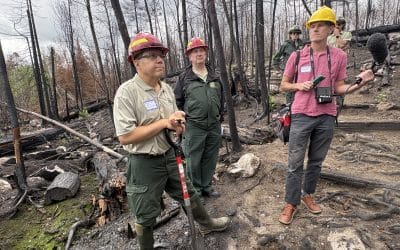
The Sioux River North Entry Point in September 2026. Photo by Joe Friedrichs The fires that shut down the Boundary Waters Canoe Area Wilderness this summer made national news. Paddle & Portage media was invited Sept. 9, along with other members of the press, to...