

Jordan Grider in Kentucky, months before he died in the BWCA. Photo courtesy of the Grider family
Forensic Expert Shares New Analysis of Camper Likely Eaten by Wolves in the BWCA

By Joe Friedrichs
ECHO TRAIL – A new report from a national forensic expert sheds light on how a hammock camper potentially died in 2018 in the Boundary Waters Canoe Area Wilderness.
The report, shared this week with Paddle & Portage media, centers on the death of 29-year-old Jordan Grider, a New Mexico man who died near the Sioux Hustler Trail sometime between October 2018 and April 2019. Grider arrived to the Boundary Waters that fall with a plan to spend the winter in the woods. He died before the depths of winter arrived, likely soon after arriving in Minnesota.
John Oliveira is a forensic crime scene analyst and senior investigator with Applied Forensic Solutions, headquartered in Arizona. In a summary analysis sent to Paddle & Portage media Sept. 21, Oliveira said he believes Grider experienced a medical emergency involving coughing up blood inside the hammock he planned to use over the winter in the BWCA. Following this, Grider most likely exited the shelter, fainted, and was unable to return to the hammock, according to the report.
“Prolonged exposure to the environmental conditions most likely resulted in fatal hypothermia,” Oliveira wrote in his analysis.
The report from Oliveira’s firm is the first to suggest that Grider coughed up the blood found inside the hammock. Prior to Oliveira’s report being made public this week, speculation on how Grider died often involved only a description of wolves consuming his body. In addition, there’s a common understanding from law enforcement and others involved with the case that Grider first died by an accidental injury, possibly from a hatchet or a similar blunt object, before wolves consumed him. Other theories have suggested that Grider accidentally shot himself with the 9 mm Beretta pistol located inside of the bloodstained hammock and was then eaten by wolves.
Though it does not conclude what led to Grider coughing up the blood, the analysis mentions several times that he had a “nearly empty 1.75-liter bottle of Karkov vodka” at his campsite.
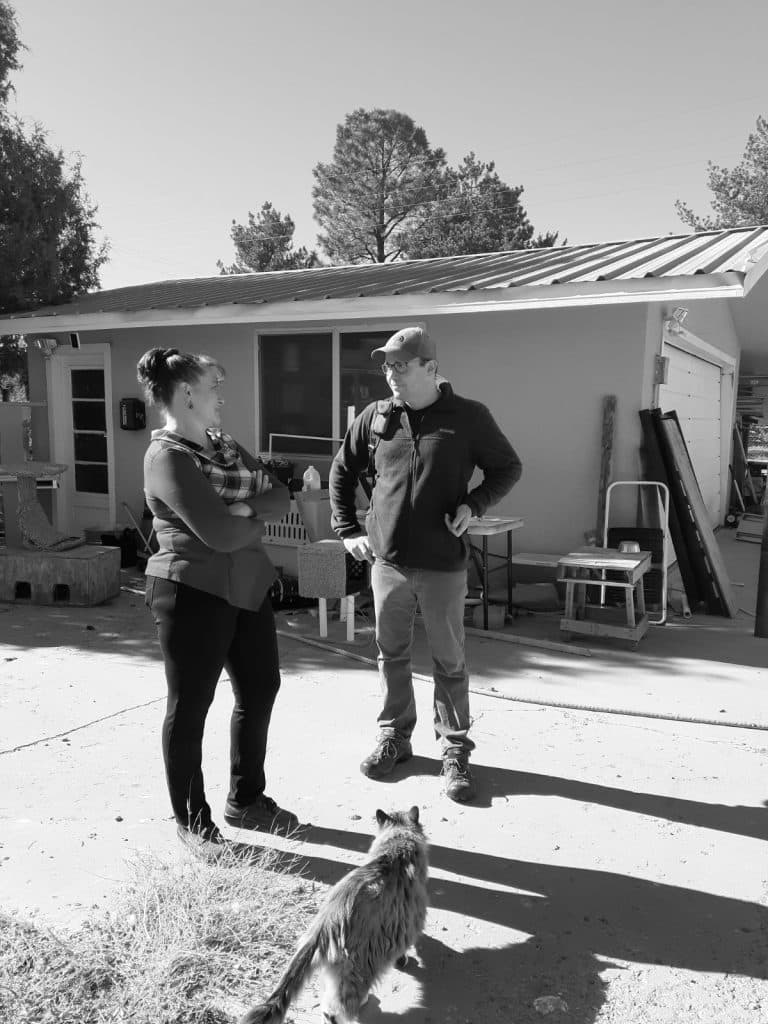
Rebecca Grider and Joe Friedrichs at the Grider home in New Mexico in October 2022. Photo by Peter Rice
Oliveira’s claim that Grider coughed up blood in the hammock and eventually succumbed to hypothermia does not dispute that wolves ate him afterward. However, Oliveira wrote that the nature of his death did not involve wolves. Others, including Grider’s mother, have long speculated that wolves killed Jordan at his campsite.
“I’m pretty convinced they got him in his sleep that first night,” Rebecca Grider, Jordan’s mother, said in 2019. “The police don’t think it was an animal attack because there’s no destruction to property other than clothing. I suspect he was caught the first night. They said, ‘Lunch!’”
Oliveira and many others dispute that claim.
“The evidence strongly supports and my professional opinion remains that Mr. Grider died as the result of a medical emergency rather than an act of violence,” Oliveria wrote to Paddle & Portage media Sept. 21.
Grider traveled more than 1,400 miles from his hometown of Moriarty, New Mexico, to get to the Boundary Waters. As authorities searched the area of his final campsite, some of Grider’s bones were discovered. Most were not. After a number of extensive searches, only a dozen of Grider’s bones were ever found. Nearby, about 30 yards from the spot where law enforcement officials found his bones, they found Grider’s hammock and sleeping bag hanging between two poplar trees. Both the hammock and the sleeping bag were marked with Grider’s blood.
Oliveira told Paddle & Portage media that the bloodstaining documented within the shelter consists predominantly of blood that was likely coughed up by Grider. Blood found inside the hammock appears to be from a violent cough, with additional smearing of the blood, Oliveria wrote.
“The patterns do not support substantial external blood loss or a violent traumatic event within the shelter,” he concluded.
Before producing their report, Oliveira and his firm received 181 photographs and other materials specific to the Grider case from the St. Louis County Sheriff’s Department. The firm received the materials in March 2025, including photographs of the blood-stained hammock and trap. The materials were obtained through a third-party public record request. Oliveira said his firm takes on a couple cases each year at the request of individuals who are curious about certain cases, including situations where people die in remote settings like the Boundary Waters. Oliveira said the conclusions in his report are limited to a reasonable forensic interpretation of the materials available and remain subject to revision if additional records or evidence become available.
Subscribe to Paddle and Portage to support journalism and our variety of content from and about the Boundary Waters.
Other Recent Articles
DNR Seeks to Close Grand Marais Harbor to Fall Fishing to Protect Coaster Brook Trout
DNR fisheries staff with a coaster brook trout near Grand Marais. Photo courtesy of MN DNR GRAND MARAIS – The Minnesota Department of Natural Resources is considering shutting down fall fishing in the harbor of this Lake Superior tourist town to protect brook trout...
Local Governments Keep Asking: How Much is the BWCA Wilderness Worth?
The Cook County Courthouse in Grand Marais. Photo by Joe Friedrichs Local governments near the Boundary Waters Canoe Area Wilderness have asked this question before, and they’re still wondering: How much money is the BWCA worth? The root of the question stems from...
Wildfire Evacuation Stands Out in Otherwise Quiet Year for BWCA Search & Rescue Operations
Towboat evacuation July 14 in the BWCA Wilderness. Photo courtesy of Vosburgh's Custom Cabins BOUNDARY WATERS – A stretch of three days in July where thousands of paddlers were evacuated from the Boundary Waters Canoe Area Wilderness was the peak of an otherwise quiet...