
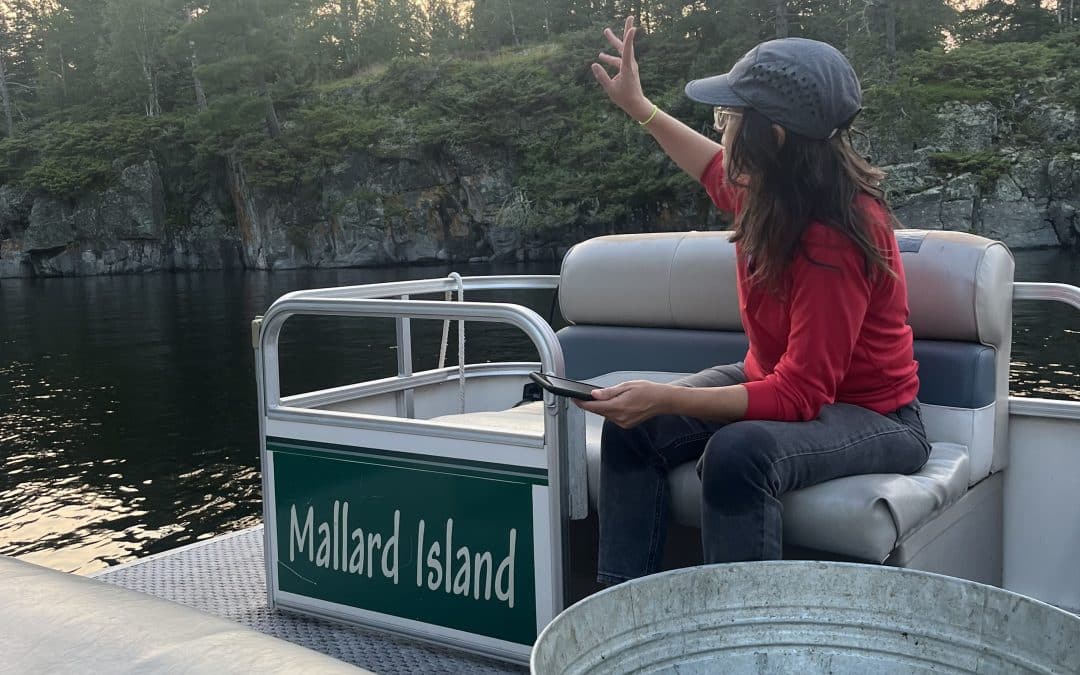
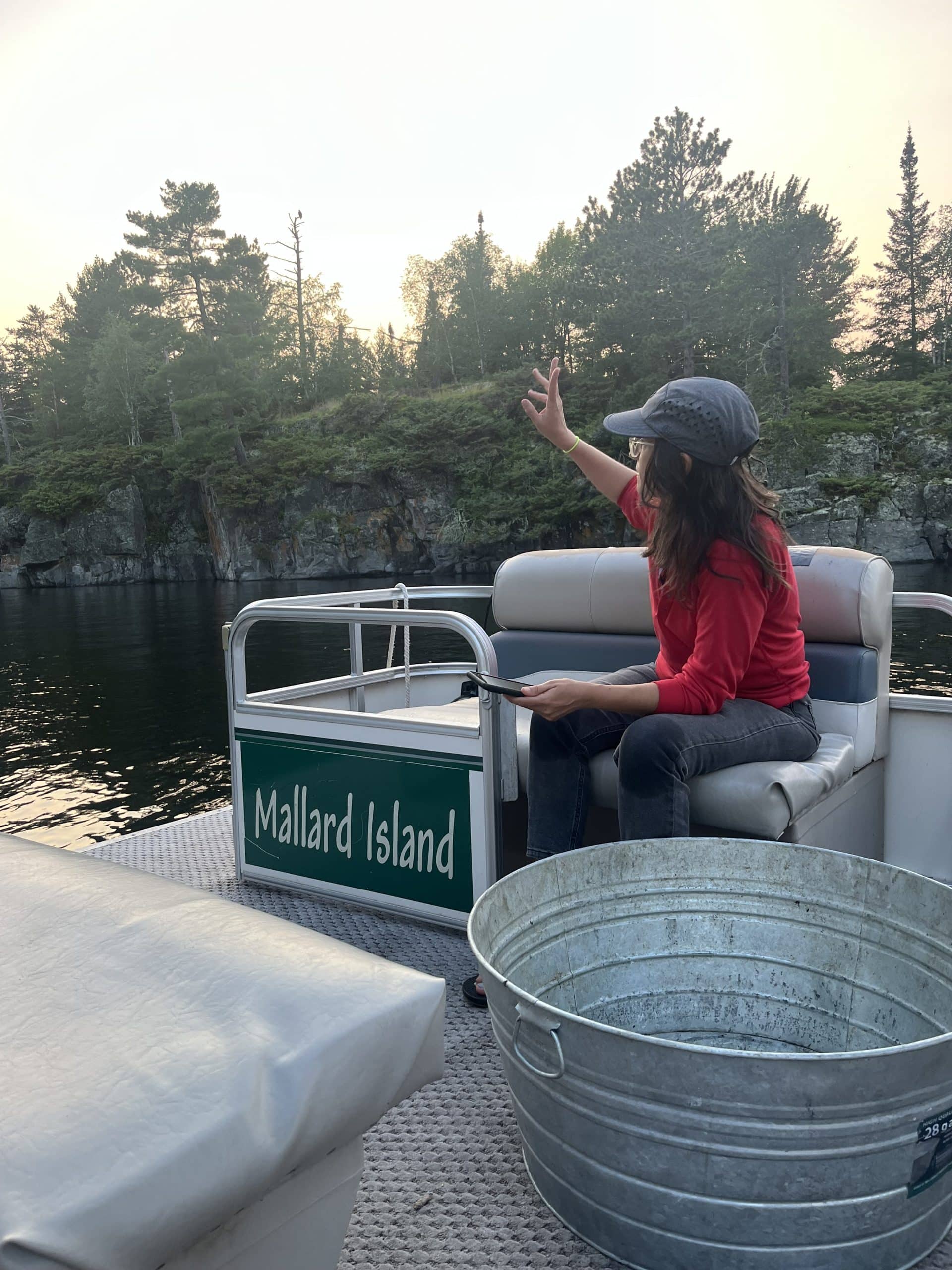
Natalya Egon is an architect from Chicago. She stayed at Mallard Island from July 14-20. Photo by Joe Friedrichs
Mallard Island Continues to Inspire on the Edge of the Boundary Waters

By Joe Friedrichs
MALLARD ISLAND – It was just past 10:30 p.m. when the good smell of woodsmoke drifted through the third level of the structure.
The smoke came from a nearby woodstove, in a cabin occupied by Dewey and Bambi Goodwin, two other temporary inhabitants of the island.
We were among the nine artists, writers, architects, and others settling in for the night on the island. The temperature was 49 degrees. Overcast conditions were giving way to clear, cool skies on this July night on Rainy Lake. The stars were coming out.
I stepped inside the quiet confines of my temporary home, a building known as the Bird House at Mallard Island. Three stories tall, it resembles a fully assembled replica of Jenga, one waiting to be played. It’s one of seven buildings on the island where people temporarily reside throughout the spring, summer, and fall each year. The Bird House features a ground-floor room full of maps and old documents. In the lower level, I came across a booklet from 1969 published by the U.S. Department of Agriculture. It was titled “Management Handbook” for the Boundary Waters Canoe Area. A plastic book binding comb held together the hundreds of pages. These were the early days and the first rules in place for what is now the most visited wilderness area in the nation. There was dust on the cover. I read some policy. Rules and regulations. I set it aside.
On the second floor of the Bird House there are two twin beds. A wooden bridge leads from the spine of the island to the second level. Inside, a stairway that looks and feels more like a ladder leads people to the third floor. And this is where the magic lives. Books. On the top floor is a small library and a study. Hundreds of books line the walls and hang from shelves attached to the ceiling in the top level of the Bird House. A full-size bed is stationed along the south wall. A massive wooden desk is situated on the opposite wall. I occupied this room on the third floor from July 14 to 20. It is arguably the greatest bedroom in Minnesota.
Mallard Island is a gathering place for tremendous things. It’s a place where people share ideas, food, history, knowledge, and experiences. Ernest Oberholtzer, more commonly known as ‘Ober,’ first arrived to the Boundary Waters region in 1909 during a college trip to the North Woods. Three years later, an Anishinaabe canoe guide, Billy Magee, traveled with Ober on a canoe journey across Canada. The trip cemented a place in Ober’s mind about the power and importance of water and healthy forests.
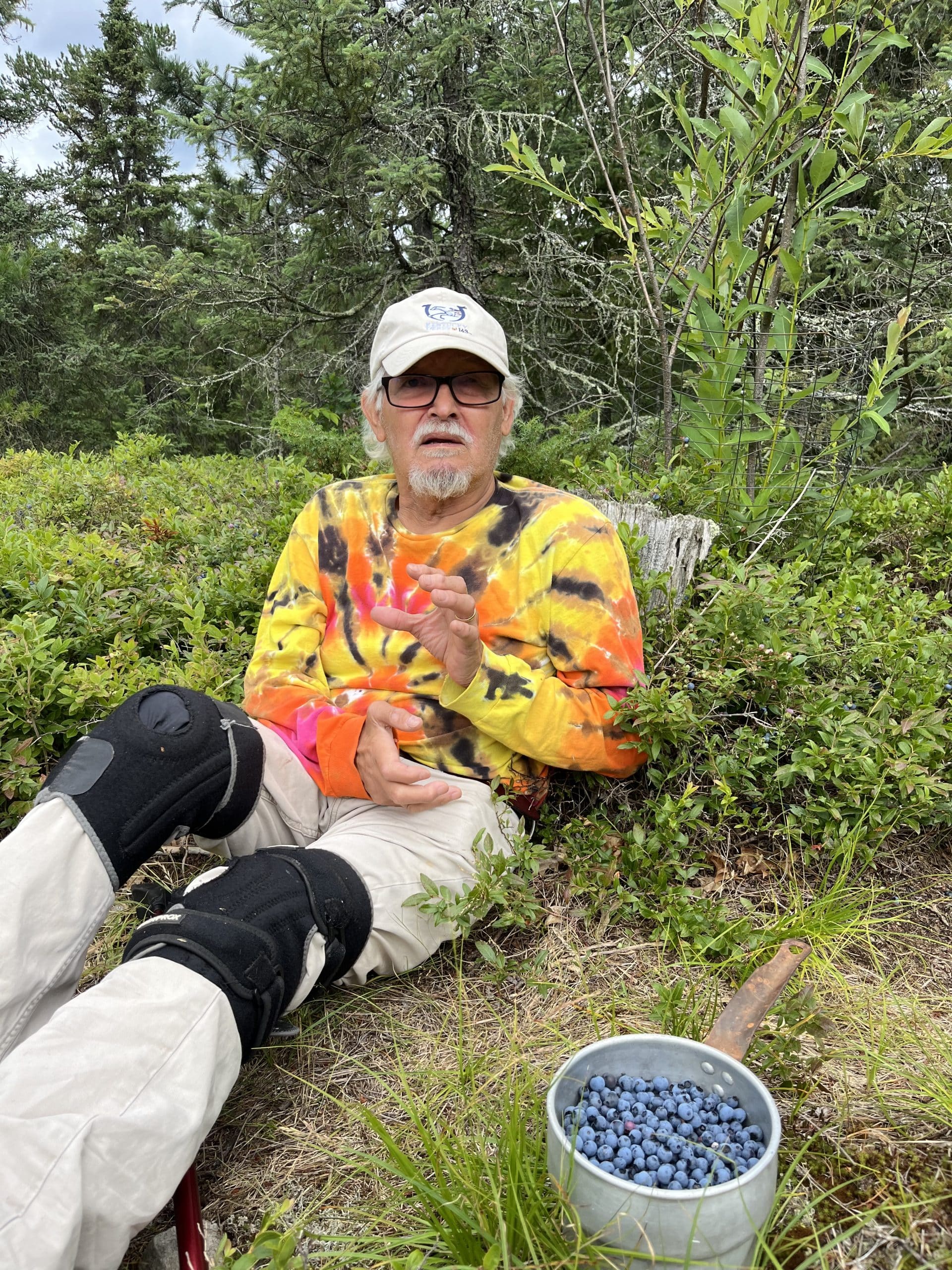
Dewey Goodwin is an Anishinaabe artist. Pictured here with a full pail of fresh blueberries. Photo by Joe Friedrichs

The library on the third floor of the Bird House at Mallard Island. Photo by Joe Friedrichs
Rainy Lake is located on the far northwestern side of the Boundary Waters region, about 100 miles from Ely. Oberholtzer lived on Mallard Island in Rainy Lake for most of his adult life. These days, Mallard Island is the base of operations for the Oberholtzer Foundation. Each year, artists, Boundary Waters enthusiasts, and people who appreciate the legacy of Ober, come to gather, create, and connect. This was my second time being on the island.
The days during my recent week were spent writing, talking with the other temporary residents of the island, swimming, fishing, exploring, and paddling. We found great bunches of wild blueberries on Mallard, as well as on nearby Crow and Hawk islands. I talked with Dewey Goodwin about his life and adventures growing up as an Anishinaabe man in northern Minnesota. At the age of 16, he left home and traveled west. He met people who huffed unknown substances from brown paper bags. He slept on the streets of San Francisco. He went to Grateful Dead concerts. Art entered his life and mind and came out through his hands in the form of beadwork, painting, and sculpture. After returning home to White Earth, he found love. There was also violence, from white men and his fellow Indigenous band members. Dewey wove story after story for me as we picked berries, filleted fish, and talked of the past.
At night, I was alone on the top floor of the Bird House. I worked and read under two glowing lamps. I picked books off the shelves and stayed up late every night.
All of the books that I read were hardcover. I read a book published in 1886 about Two Arrows, the great Nez Perce warrior. There were many history books about Native Americans written by white men. From the top shelf I grabbed a book titled “My Host the World” by George Santayana.
From the book, I read: “The great question is not what age you live in or what art you pursue but what perfection you can achieve in that art under those circumstances.”
It was past 1 a.m. I set the book down and went to bed. Rain fell outside the third-story window.
The next night, when the others on the island went to bed in their own occupied space, I was at it again.
I read about Lucretius, the Roman poet and philosopher who lived more than 2,000 years ago. Where human strength comes from or what purpose human existence might serve, most people neither know nor care, he reasoned. The island was quiet. I continued reading. I found “The Rise of American Civilization” by Charles Beard. I picked up a copy of “Gardening Without Poisons.” There was a book about William Clarke Quantrill, the controversial Confederate outlaw who roamed Texas, Missouri, and Kansas during the Civil War.
Every night there were new stories to read. New characters to discover. These were all Ober’s books. His fingers combed through the pages. These stories are meant to be shared.
Outside the window, I could again smell the woodsmoke from the Goodwins’ cabin. I moved slowly to the cedar porch connected to the top floor of the Bird House. The night was starting anew. Smoke curled up toward the clear night sky as I stepped back inside, both becoming and reading another chapter on the island.
~~
Become a member of Paddle and Portage to support this type of storytelling from in and around the Boundary Waters.
The audio below is the most recent episode of the Paddle and Portage Podcast.
Other Recent Articles

Fate of Mining Ban Near BWCA Could Hinge on ‘Rule’ vs. ‘Order’ Distinction
Rep. Pete Stauber filed a joint resolution in the House of Representatives Jan. 12 that aims to repeal the Biden-era mineral withdrawal, which placed a 20-year moratorium on mining in a watershed neighboring the Boundary Waters Canoe Area Wilderness. Photo by Joe...

Forest Service Extends Food Storage Order in BWCA Wilderness Until 2031
The BWCA food storage order is in effect from April 1 to Nov. 30 through 2031. Photo by Joe FriedrichsBOUNDARY WATERS – A food storage order is being extended for another five years in the Boundary Waters Canoe Area Wilderness, plus, a new annual start date means it...
Walleye Limit Likely to be Reduced to Four Starting in 2027 for BWCA Anglers
Cook County resident Barbara Jean Meyers with a stringer of BWCA walleye. Photo by Joe FriedrichsAnglers who fish for walleye in the Boundary Waters Canoe Area Wilderness and other places in Minnesota will likely be able to keep two fewer walleye than the current...