
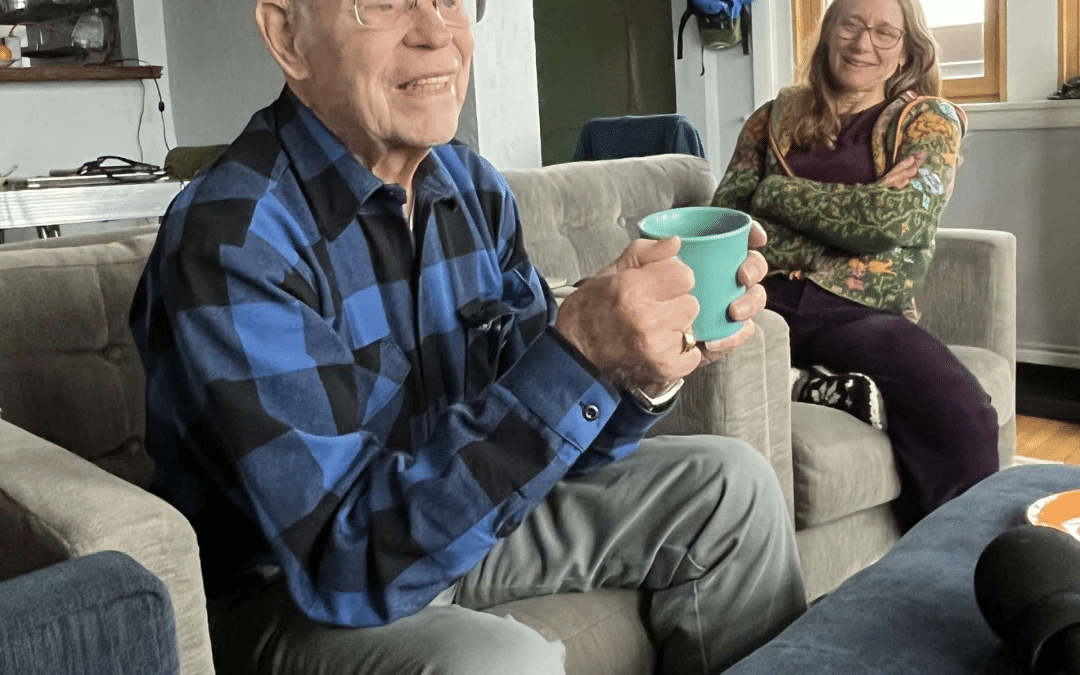
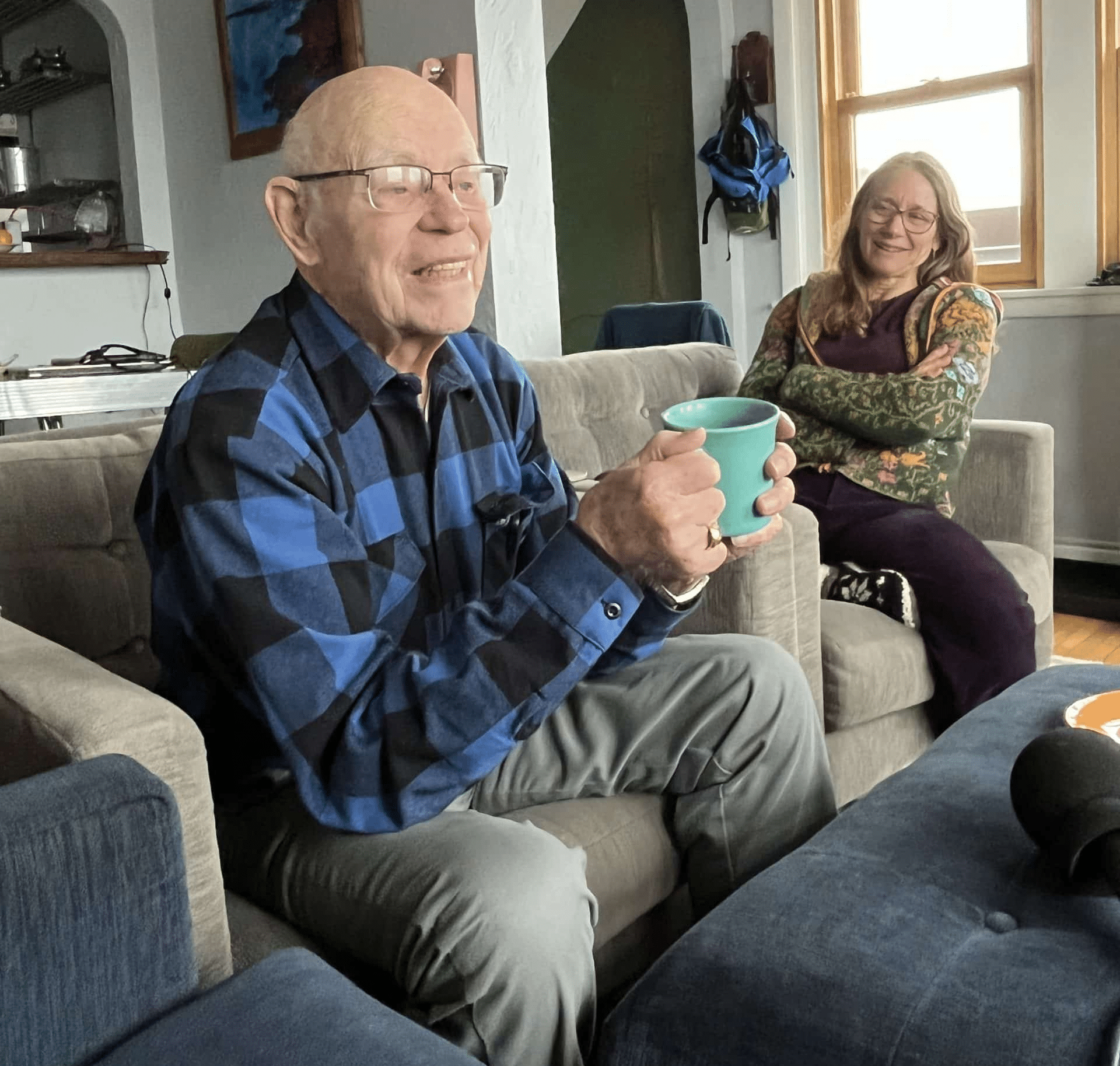
Richard “Dick” Swenson invented the Sven-Saw in Minnesota after a trip to the Boundary Waters. Dick and his daughter, Linnea, visited Grand Marais in February 2024. Photo by Joe Friedrichs
Founder of Saw Forever Linked to the BWCA Dies at 93

By Joe Friedrichs
Richard E. Swenson (Dick), 93, died at his home in Duluth Oct. 28.
In 1961, Swenson invented “the famous folding Sven Saw,” which he humbly called “a hobby that paid for itself.” He invented the compact folding saw one year after seeing a wounded paddler between Knife and Carp lakes on a Boundary Waters portage. After learning the injured person had cut himself with an axe at camp, Swenson thought “there has to be a better way.” So he invented a saw that could fit into a portage pack and featured a blade protected by its handle. In other words, the teeth of the saw aren’t exposed when it’s in the collapsed state.
Not long after making the first model, Swenson patented the design and founded Swen Products. It’s worth noting that the original name for the saw was the Swen-Saw, but so many Scandinavians in northern Minnesota called it “Sven-Saw” that Swenson let the name stick. The company continues to be family-owned and operated to this day, and the parts are still manufactured and packaged in Minnesota.
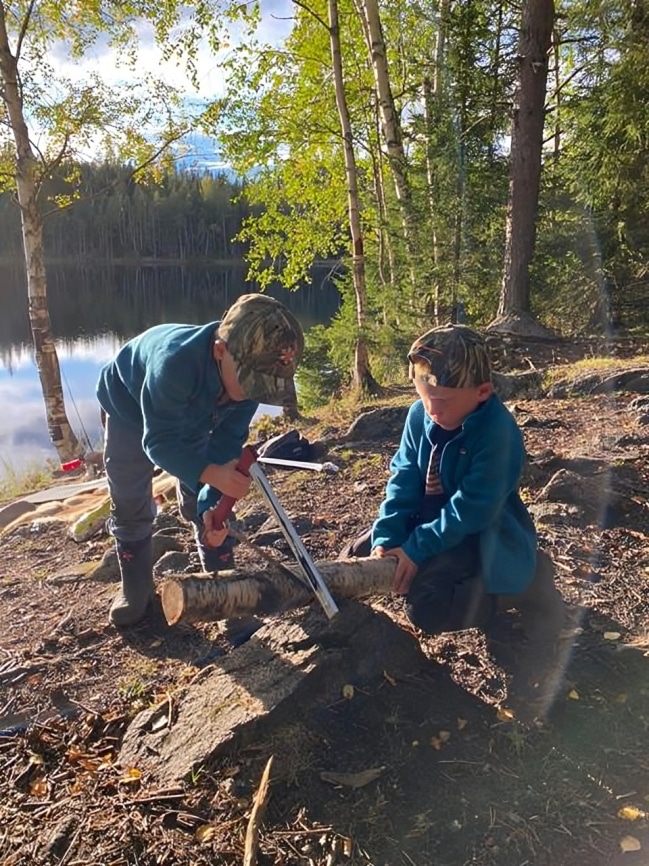
Photo courtesy of Sven-Saw
Swenson, a lifelong Minnesotan, grew up paddling, fishing, and camping in the Boundary Waters region. His late wife, Cecile Swenson, had a family cabin on Cummings Lake, in what is now the federally protected BWCA. The couple met in Lutsen. Together, they had three daughters, whom they raised in Duluth, which is where Swenson lived for most of his adult life.
Swenson grew up in the Twin Cities. Minnesota is his home, he told the Paddle & Portage team when we met him near Lake Superior in Grand Marais in the winter of 2024. Swenson and his daughter, Linnea, traveled from Duluth and spent several days in Grand Marais that March.
In talking with Swenson, it was obvious that he’d always been intrigued by the world, rather than fixated on its problems. When something isn’t working, or so reasons the Swenson mindset, you fixed it. Swenson graduated from the University of Minnesota with an engineering degree and worked for many years at a Honeywell machine shop. That’s where he learned “how to make and invent things,” he explained at that time.
Dick met Cecile not long after he moved to Duluth in 1960, the same year he encountered the injured canoeist near Knife Lake. The couple married in 1961 and made “countless” trips to the Boundary Waters over the years, often with the entire family joining for the overnight expeditions. During every canoe trip from 1961 on, a Sven-Saw was along for the journey.
A turning point for the saw happened in 1962. The World’s Fair came to Seattle that year. Dick and Cecile traveled to the West Coast to gauge interest in the newly invented saws. Literally combing through the yellow pages of the Seattle phone book for outdoors stores, Dick found Recreational Equipment, Incorporated. Today, most people know the company by its common name: REI. What is now a retail giant in terms of outdoor gear was a one-person show at the time. The store was located on the second floor of a dilapidated building in downtown Seattle. Dick traveled to the building and introduced himself to the person standing behind the counter. That person was Jim Whittaker, who later became the first U.S. citizen to climb Mount Everest. Whittaker looked at the saw and said, “That’s kind of clever. Send me six.” By the time the Swensons arrived back to Duluth, Whittaker already had ordered a dozen more, Dick told P&P in 2024.
Closer to home, the first person to purchase multiple orders of the Sven-Saw was Bill Rom from Canoe Country Outfitters. Rom is a legend in the history of the Boundary Waters, owning the Ely-based outfitter from 1946 to 1975. He was also an activist, working alongside Sigurd Olson and others to help create federal protection for what is now the BWCA wilderness. Rom’s daughter, Becky, is also a well-known activist who works to protect the BWCA, primarily through the Save the Boundary Waters Campaign.
Becky Rom said it was important for her father to purchase Minnesota-made equipment for their guests, particularly high-quality items like the Sven-Saw.
“My dad was committed to hiring local people to work for him, and (to) using gear he could trust,” she told Paddle and Portage.
Rom recalled a specific trip to the BWCA in August 1975 when her father loaned her canoe party his personal Sven-Saw. Along with three of her friends, Becky Rom paddled across Sarah and McIntyre lakes in Quetico Provincial Park, went across Brent Lake, and canoed down through Elk and Gardner to Crooked Lake.
“My kind dad lent us his personal Sven-Saw for the canoe trip,” Becky said. “I recall one of us dropping a wing nut from Dad’s saw into the fire and being unable to recover it. We felt terrible about losing a piece of Dad’s saw.”
Rom said she remembers this trip for other reasons, most notably that President Richard Nixon resigned from office while she and her friends were on the canoe trip. They also had an encounter with an unruly bear on a portage.
“It was a memorable trip,” Becky said, “and it included a Sven-Saw episode.”
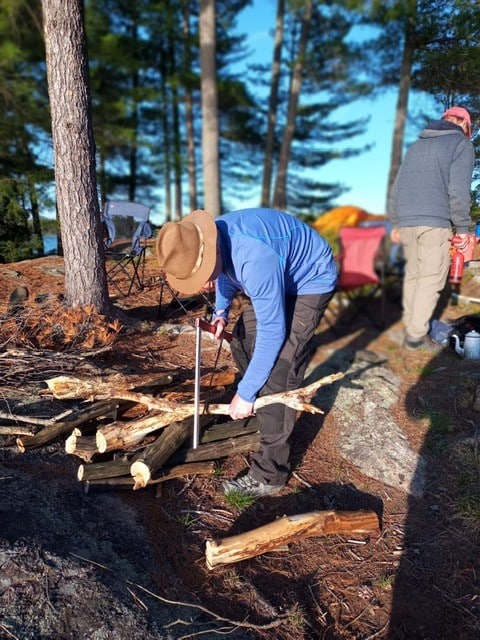
Photo courtesy of Sven-Saw
Dick’s daughter, Linnea, said the Sven-Saw will forever be connected to the Boundary Waters, and not just because its origins can be traced back to the portage near Knife Lake and the man with the injured foot.
“Dad loves the Boundary Waters,” Linnea said in 2024. “He’s been going there since he was a kid, so my whole family feels really connected to this place.”
Linnea and her husband, Jon Swenson Tellekson, now manage the company. Over the years, Linnea said, “We have had the good fortune of selling saws through L.L. Bean, ACE Hardware, the Scouts (Boy Scouts of America), and countless independent, locally-owned outdoors, garden, and hardware stores,” including many near Grand Marais and Ely. They’ve sold an estimated half-million of the saws during the past 60 years, an achievement Dick never imagined when he started tinkering with the saw’s simple blueprints many decades ago.
“I’m just happy the saw has worked to help keep people safe,” Dick said in 2024. “That’s what it was intended to do.”
A memorial service will be held at noon, Friday, Nov. 14, with a visitation beginning at 11 a.m. at First Lutheran Church in Duluth.
Subscribe to Paddle and Portage to support this type of storytelling from and about the Boundary Waters.
Other Recent Articles

Canada Determining Location of ‘Telephone Reporting Sites’ as RABC Program Ends
The RABC Program ends Sept. 14, 2026. P&P file photoBOUNDARY WATERS – As the end of the popular Remote Area Border Crossing Program nears, more than 200 people responded to a request from the Canadian government for where people should report in from as they cross...

Lake Trout Season to End March 15 on Popular Gunflint Trail Lakes, Surprising Some Anglers and DNR
The 2026 trout season ends March 15 on Gunflint and Sag and other border lakes outside of the BWCA Wilderness. Photo by Chad KieperGUNFLINT TRAIL – The ice fishing season for lake trout will, at least on paper, end this weekend on Saganaga and Gunflint lakes due to a...

Shug the Hammock Camper Diagnosed with Rare Form of Cancer
Shug (right) and M Baxley at the 2025 Winter Camping Symposium. Photo by Joe FriedrichsOur friend Shug found out this week he has a rare blood disease called chronic myeloid leukemia. Shug introduced the joys of hammock camping to people all over the world. His videos...