

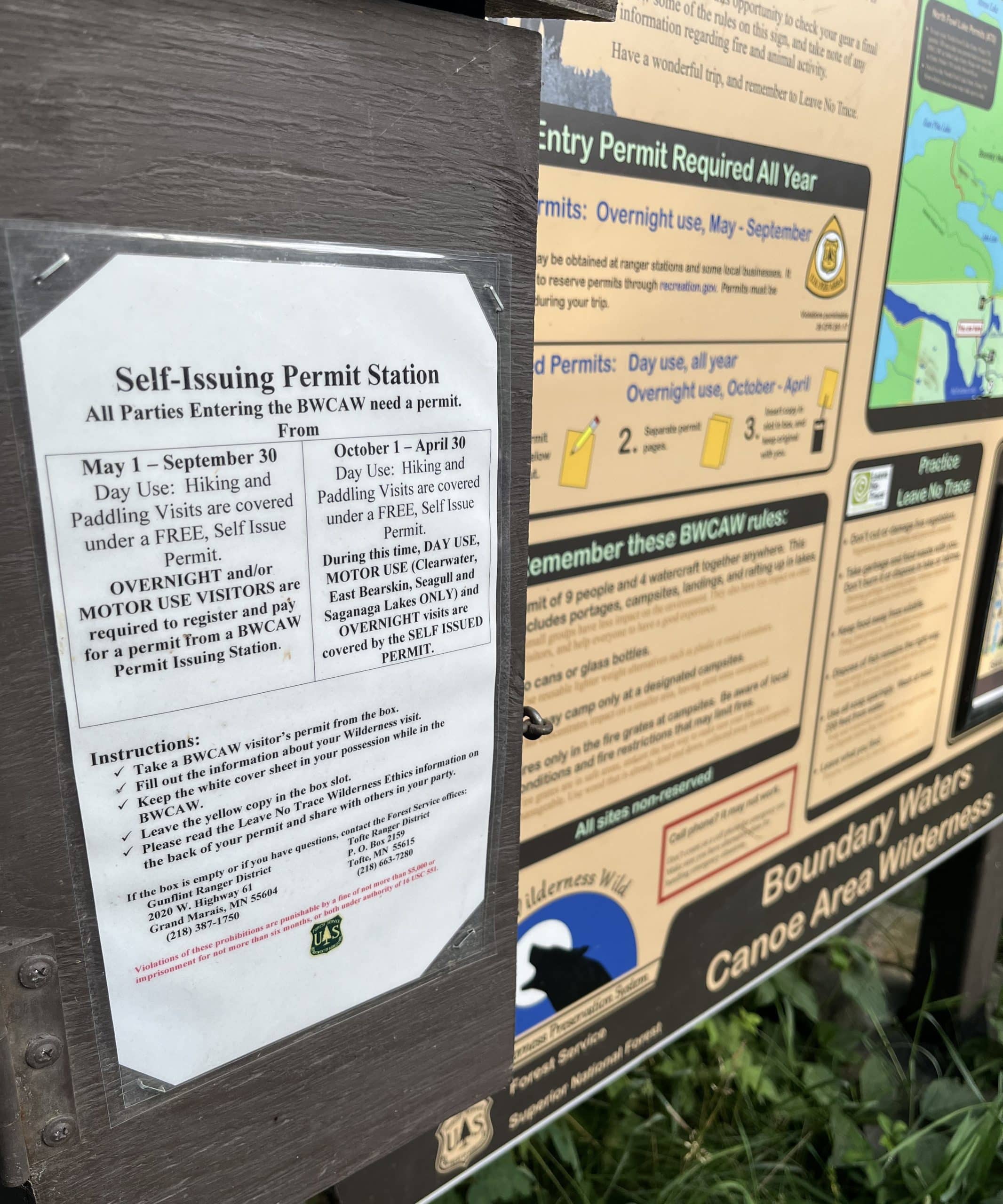
Reserved permits for overnight trips are required from May 1 – Sept. 30. Photo by Joe Friedrichs
Record Number of Canceled Permits Highlights Ongoing Frustrations with BWCAW Reservation System

By Joe Friedrichs
More people canceled a permit to the Boundary Waters Canoe Area Wilderness last year than ever before, according to a new report from the U.S. Forest Service.
“Cancellations reached an all-time high at 10,245,” the Forest Service announced in sharing the report, which includes data from 2023. “Cancellations have more than doubled in five years, suggesting that BWCAW visitors continue to reserve more permits than they can use.”
Some outfitters and paddlers say the process the Forest Service uses for people to book permits is to blame, at least in part, for the record number of cancellations in 2023.
The quota permit season runs from May 1 to Sept. 30. The permits are required for overnight trips only. Day-use permits do not need to be booked in advance.
The permits are available in late January each year for the quota season ahead. Permits went live Jan. 31 this year, for example, and the quota season started May 1. Most visitors to the BWCA Wilderness book their early reservations online.
However, making all the permits available on the same day, at the same time, creates a narrative that people need to “book now and figure out the details later,” according to several outfitters Paddle and Portage spoke with earlier this year. This “come and get them now” approach leads to people booking permits that they might not use. For example, if a group of four friends from Minneapolis know they want to take a canoe trip to the Boundary Waters during the paddling season, but they’re not sure what weekend will work, they could legally book a permit on opening day for every weekend in July, with all four members of the group each booking a permit for one weekend throughout the month. Once the group narrows down what weekend will work, they can cancel the other permits they reserved for July.
The Forest Service charges a minimum deposit of $32 (equal to two adult recreation fees) when people make an advance reservation for a quota permit. Groups may cancel online anytime up to two days before the entry date for overnight permits. If someone cancels a reservation two or more days prior to entry date, all recreation fees paid will be refunded. A $6 non-refundable reservation fee is not returned regardless of when the permit is canceled. In other words, a group of paddlers can book any number of permits under different names and only risk losing $6 per permit if they cancel within 48 hours of the entry date.
At least one outfitter on the Gunflint Trail said the permit system the Forest Service has in place is “a broken government system.”
“The permit fee needs to be increased,” Deb Mark from Seagull Outfitters told Paddle and Portage this spring. “I would like to see a non-refundable minimum permit fee of $100 for any overnight permit, plus $20 per adult and $10 per kid for the trip.”
Mark said such a plan would bring in more revenue for the Forest Service “to have additional rangers out in the woods.” In addition, she said, “It would also eliminate much of the double and triple booking of permits that now happens.”
Mark said she would like to see the Forest Service go to a permit system somewhat similar to the one used in Quetico Provincial Park. To enter Quetico, paddlers can book a permit five months in advance of the trip departure date. In order to take a canoe trip August 1, for example, people can book their permit March 1. To enter Sept. 1, paddlers can book a permit April 1, and so on. There is also a $100 deposit to book a permit that is later applied to overnight fees, or lost if the permit is cancelled.
“How about something similar on the U.S. side?” Mark suggested.
For their part, the Forest Service maintains that they are potentially open to changing or reformatting how the permit rollout system functions.
Joy VanDrie is a public affairs officer for the Forest Service. She told Paddle and Portage earlier this year that reformatting the permitting system is something the newly formed BWCA Wilderness Collaborative might discuss this year. In other words, it’s possible the system could change in the future, though it likely will take time to build a new system, or modify the existing one, according to the Forest Service.
Meanwhile, nearly 1,500 more people ventured into the Boundary Waters Canoe Area Wilderness during the spring, late fall, and winter months in 2023 than the year before, according to the new report from the Forest Service.
“Day and overnight use during the non-quota season increased by 13 percent,” the Forest Service announced. “Shifting use to the off-season is beneficial for wilderness restoration efforts following the surge in visitors and associated resource damage seen during the pandemic.”
More than 11,150 people used a self-issued permit for day or overnight travel into the BWCA Wilderness outside of the quota season. This total includes winter campers and ice anglers. This is an increase from 2022, when 9,737 people entered the wilderness outside of the quota season.
Overall, the number of visitors who traveled across the Boundary Waters Canoe Area Wilderness dropped by about 3 percent last year, according to the recently released data. This marks a two-year decline in visitation to the BWCA Wilderness, following an uptick during the COVID-19 pandemic.
More than 146,200 people visited the 1.1-million-acre wilderness in 2023. The decline followed a nationwide trend with more people getting outside for recreation during the pandemic. Approximately 166,000 visitors traveled into the wilderness in both 2020 and 2021.
The Forest Service says the total quota permits issued for 2023 across the BWCA Wilderness dropped for most permit types, continuing the downward trend as visitor use slowly returns to pre-pandemic levels. The news of a decline in visitors did not prompt concern from the Forest Service.
“Returning to previous use levels is beneficial to protecting social and physical resources in the wilderness,” a statement from the Forest Service reads.
Other findings from the report include:
–In 2023, 92% of all the visitors who traveled to the BWCA Wilderness arrived from May 1 to Sept. 30 (the mandatory quota season.)
–From 2022 to 2023, day-use motorboat and overnight visitor use remained steady, while non-motor day use decreased by 19% during the mandatory quota season.
Support this type of journalism from and about the Boundary Waters by becoming a member of Paddle and Portage.
Other Recent Articles

No RABC Permit, No Problem: Telephone Reporting Sites Go Live in Quetico in June
Quetico entrance at Cache Bay. Photo by Joe Friedrichs Paddlers will be able to enter Quetico Provincial Park at the Prairie Portage and Cache Bay ranger stations using the new telephone reporting sites starting next month. Paddle & Portage media spoke to...

Helium Exploration Rolls Along Near the Boundary Waters
Looking for helium near the Boundary Waters. Photo courtesy of Pulsar Helium Deposits of helium found near the Boundary Waters remain a quiet talking point amongst industry insiders, state and federal regulators, politicians, and others interested in the future of how...

Wildfire Shuts Down Highway 61 Near Two Harbors
Wildfire burning May 15 near Lake Superior alongside Highway 61 A wildfire is burning along Highway 61 near Two Harbors. The fire is torching in the trees with 50 to 60 ft. flame lengths, according to the manager of operations for what is being called the Stewart...