
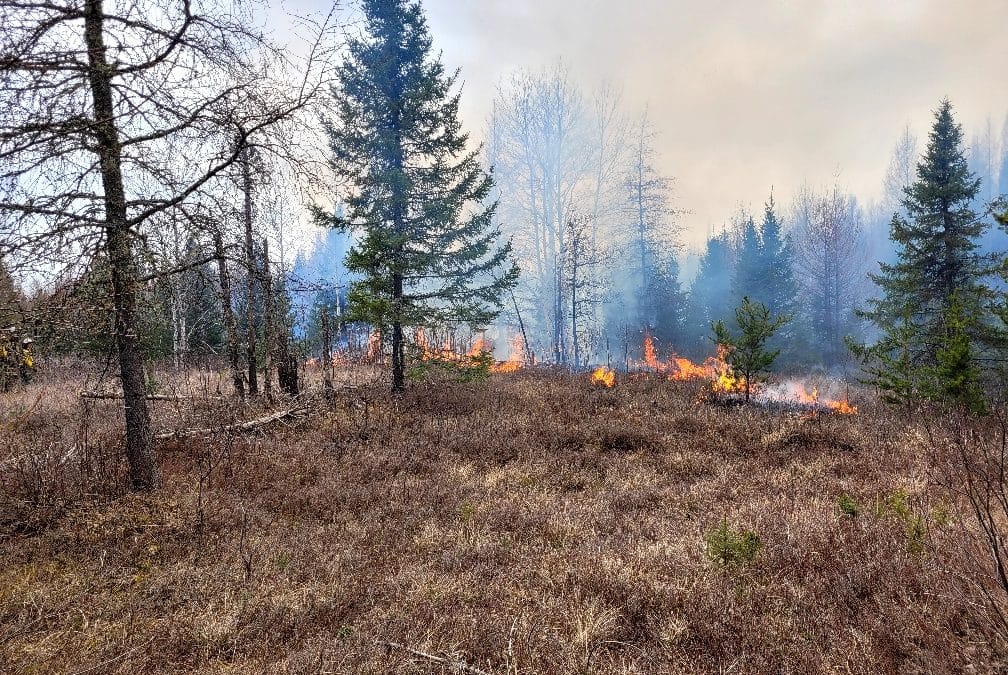

In 1854, the Chippewa of Lake Superior entered into a treaty with the United States whereby the Chippewa ceded to the United States ownership of their lands in northeastern Minnesota. These lands are called “1854 ceded territory.” Photo by Joe Friedrichs
History of Fire Near the Boundary Waters Allows Opportunity to Reflect on Indigenous History

By Joe Friedrichs
There’s been a lot of news about wildfires in and around the Boundary Waters Canoe Area Wilderness during the past two months.
And while wildfires are viewed by some simply as destructive forces of nature, they played a significant role in shaping what today are considered the most stunning landscapes across the Boundary Waters. The reality is this is a place where wildfire is common—even necessary.
Historically, some of the most important fires the Boundary Waters landscape experienced were those started intentionally by the Indigenous people who have lived here for centuries and who used these fires as a tool of sorts. Other times the fires started naturally, from a lightning strike, for example. Across the 1854 Ceded Territory, a vast area of land in northeastern Minnesota that includes all of Superior National Forest and the BWCA Wilderness, Indigenous people have for generations engaged in the practice of intentionally lighting smaller, controlled fires with specific outcomes in mind, including acquiring food and materials for clothing, making canoes, and following other means of living with the land known as “cultural burning.”
This type of engagement with the land is being recognized, and utilized, by organizations across Minnesota and beyond. This was shared during a recent event in Ely hosted by the U.S. Forest Service and the Aldo Leopold Foundation. And today, on Indigenous Peoples Day, it is an example of celebrating Native American history and culture, while acknowledging the ongoing challenges they face.
Regardless of how alarming a wildfire might be, even in a remote setting, a team of researchers from the Upper Midwest is currently asking if select fires should be allowed to burn in order to create healthy forests in certain pockets of Minnesota, particularly in and around the Boundary Waters. Furthermore, the researchers are exploring the notion that perhaps humans should be the ones starting some of these fires in the forest, as was done historically.
Evan Larson, a dendrochronologist and professor at the University of Wisconsin–Platteville, said fire is a “fundamental factor of northern forests.” In simpler terms, this means the species that grow in the Boundary Waters and elsewhere, including red pine, jack pine, and other trees and plants, have evolutionarily adapted to fire. As have animals such as moose.
Over the past decade, Larson, along with Professor Kurt Kipfmueller and Research Specialist Lane Johnson from the University of Minnesota, has been leading the research analyzing the historical use of fire in the Boundary Waters. Their explorations focus on what it would mean if landscapes we now consider wilderness were, at least in part, the legacies of human activity.
Johnson shared a nearly hour-long presentation on this research at the recent event in Ely. He said that though it is now frequented year-round by visitors from all over the world, the area referred to as the Boundary Waters along the Minnesota and Ontario border is a land long inhabited by Minnesota’s first resident and Indigenous communities. This history dates back some 10,000 years to when Paleo-Indians hunted and gathered here. Over the course of thousands of years, other Native populations moved in and out of the region, including most recently the Ojibwe people. Despite the comings and goings of various human inhabitants, the one constant in the history of the area that is the Boundary Waters is fire.
“We know that Anishinaabe groups in this region have used fire and engaged with the landscape through the process of fire for a host of reasons, whether it’s opening travel corridors or maintenance of blueberry patches,” Johnson said. “And so, we know that there are relationships here.”
The patterns illustrated by the team’s data show that fires were most common along the northern border of the Boundary Waters. In some places, the iconic stands of red pine BWCA Wilderness paddlers see today experienced fires every five to six years during the 1700s and 1800s—the period when fur-trade networks were expanding across the region. While the driving narrative behind the research is the history of fire in the Boundary Waters, Johnson says that along the way, the closer they looked at the forest, the more they learned about how this land has been embraced by humans for centuries.
The U.S. Forest Service on Superior National Forest signed a Memorandum of Understanding with the Grand Portage, Fond du Lac and Bois Forte bands in 2023. Prior to that, Juan Martinez was appointed as the first ever tribal liaison in the history of Superior National Forest, which includes the BWCA Wilderness.
Martinez was hired in 2022 to work on Superior National Forest.
During his two years working in and around the Boundary Waters, there has been meaningful change in how the Forest Service engages in dialogue and talks about important topics with the three Chippewa Bands located in northeastern Minnesota, Martinez told Paddle and Portage.
The second Monday of October is officially recognized as Indigenous Peoples Day in Minnesota. It is one of 17 states to recognize the holiday, with some of those, including Minnesota, replacing Christopher Columbus Day with the new holiday.
Other Recent Articles

No RABC Permit, No Problem: Telephone Reporting Sites Go Live in Quetico in June
Quetico entrance at Cache Bay. Photo by Joe Friedrichs Paddlers will be able to enter Quetico Provincial Park at the Prairie Portage and Cache Bay ranger stations using the new telephone reporting sites starting next month. Paddle & Portage media spoke to...

Helium Exploration Rolls Along Near the Boundary Waters
Looking for helium near the Boundary Waters. Photo courtesy of Pulsar Helium Deposits of helium found near the Boundary Waters remain a quiet talking point amongst industry insiders, state and federal regulators, politicians, and others interested in the future of how...

Wildfire Shuts Down Highway 61 Near Two Harbors
Wildfire burning May 15 near Lake Superior alongside Highway 61 A wildfire is burning along Highway 61 near Two Harbors. The fire is torching in the trees with 50 to 60 ft. flame lengths, according to the manager of operations for what is being called the Stewart...