
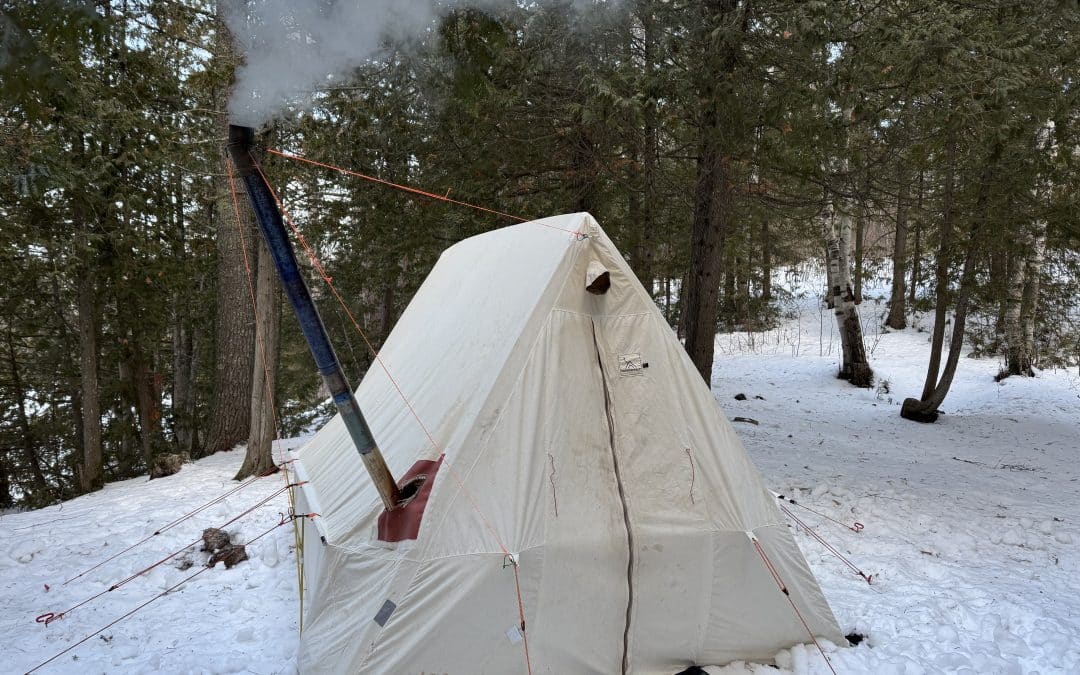
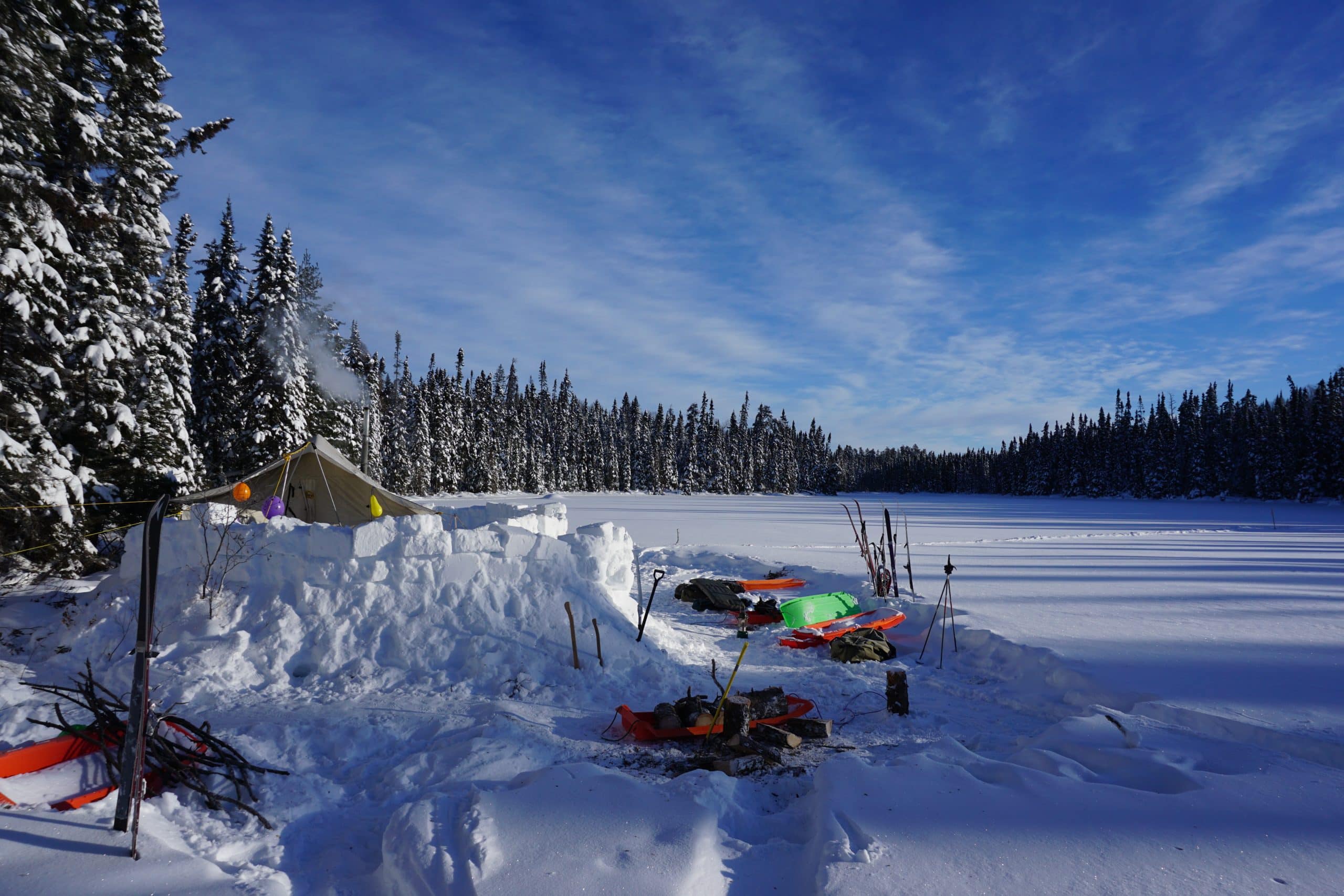
Winter campers need to hang food or store it in a certified bear-resistant container starting March 1. Photo by Bear Paulsen
BWCA Winter Campers Must Follow New Food Storage Order Starting March 1

By Joe Friedrichs
ARROWHEAD TRAIL – If you arrive to Little John Lake and prepare to enter the Boundary Waters Canoe Area Wilderness on a winter camping trip, you’ll find a sign posted on the large kiosk that informs you about how to store your food to prevent bear encounters.
The sign reads: “In the Boundary Waters Canoe Area Wilderness you are required to properly store food, garbage, and scented items by either correctly hanging packs or using a certified bear-resistant container.”
Emblazoned in large red letters on the sign is the following: “Non-compliance can result in a fine of not more than $5,000 or six months imprisonment.”

Photo by Joe Friedrichs
What the sign does not tell you is that the food storage order goes back into effect March 1.
This means that winter campers who visit the BWCA Wilderness during March – which happens to be one of the best and most popular times to go winter camping due to warmer weather and longer days – need to comply with the new food storage order. The order was issued last April by the U.S. Forest Service.
According to the order, “In effect March 1-November 30 each year, except while being prepared, consumed, or under on-site visual observance, all food, food containers, scented items (such as soap, lip balm, toothpaste) and refuse shall be suspended at least 12 feet above the surface of the ground and not less than 6 feet horizontally from the trunk of a tree, or stored in an Interagency Grizzly Bear Committee certified bear resistant container.”
There was much hullaballoo last spring about the fine for violating the food storage order being only $50, though the sign at the BWCA kiosk at the end of the Arrowhead Trail and the order itself clearly state a fine of $5,000 and mention the word imprisonment. Nonetheless, the Forest Service insists the fine is $50 for any violation of the order. There was also the running narrative from the Forest Service in 2024 that year one of the food storage was more an “educational” rollout of the order. In other words, fines weren’t likely to occur if someone did not comply with the order last year, unless the violation was so egregious a law enforcement officer or wilderness ranger deemed a ticket was necessary. Subjective interpretation of the law, in other words.
The Forest Service has been quiet about the food storage order in the lead-up to the second year of its implementation, which starts March 1. Most visitors to the BWCA Wilderness won’t be arriving until May, when the quota season starts. It’s likely the agency will issue public reminders about the food storage order when the quota season starts for overnight permits May 1. The order applies to the entire BWCA Wilderness. Other land across Superior National Forest is not included in the order.
Last May, when Paddle and Portage asked the Forest Service why the food storage order starts March 1 rather than May 1, they responded with a public statement: “There is significant variation from year to year in seasonal weather transitions. Since bears have been known to come out of hibernation as early as March, the Superior Wilderness and Wildlife Staff set March 1 as the effective date for the order.”
Paddle and Portage sent questions to the Forest Service on Superior National Forest Feb. 25 on this topic. Joy VanDrie, a spokesperson for the federal agency, responded Feb. 25 with this statement: “We will need at least 7-10 business days to respond. We’ve submitted your request and appropriate responses for review. This will be the process going forward.”
UPDATED as of March 3, when Forest Service responded:
1. Is there a general statement you can provide regarding the food storage order kicking back in this weekend on March 1?
March 1st through November 30th was identified as the effective period for the 09-09-24-02 Food Storage Order in the Boundary Waters Canoe Area Wilderness (BWCAW) to ensure visitors use best food storage practices while wildlife, particularly bears, are out of hibernation. Under typical conditions, bears are still hibernating in March. However, short and mild winters can reduce the length of time bears hibernate. The expanded window of implementation of the Food Storage Order compensates for potential late season hibernation and early season emergence.
2. Should BWCA winter campers in March (and perhaps April) be hanging their food in accordance with the order? (assuming they don’t have a certified container)
BWCAW visitors are required to follow proper food storage procedures March 1st through November 30th. The best way to prevent human/bear interactions is to follow the guidelines outlined in Forest Order 09-09-24-02: BWCAW Food Storage Order.
3. Last year the narrative from the Forest Service was (paraphrasing): “Year one is an education year, unless there is an egregious violation of the order.” Should BWCAW visitors expect less leniency in 2025, year two of the order?
Forest Protection and Law Enforcement Officers have discretion to address all violations within the BWCAW on a case-by-case basis. Educating the public and ensuring everyone’s safety is always the goal.
4. Any other information folks should be aware of regarding the food storage order?
The purpose of the Food Storage Order is ultimately to preserve wilderness character by preventing food-conditioning of wildlife, particularly bears. We appreciate the BWCAW visitors and outfitters that have adapted their behavior to help keep our wildlife wild.
Meanwhile, the Paddle and Portage team regularly camp in March and have never seen or heard of a bear coming into a winter campsite. That said, when we posted a similar sentiment last spring, a P&P reader reached out and said he’d experienced a bear in the BWCA Wilderness in February. Charles Ek, a longtime visitor to the canoe country, said he wrote in his journal that back in the early 1980s he encountered a bear on the Kekekabic Hiking Trail in the BWCA.
“From my journal on a failed Kek traverse, mid-February in the early ’80s (a notoriously warm winter). For the only time in a lifetime of BWCA, Alaska and Washington backcountry camping, I brought food into the tent,” Ek wrote to Paddle and Portage. “Hey, it was February – what could happen? Did I mention it was canned sardines and kipper snacks?”

Charles Ek journal entry from early 1980s
Black bears typically hibernate from October through March, according to the University of Minnesota. Even with a mild winter such as the one Minnesota experienced in 2024, many bear researchers across the state still expected bears to emerge when “true spring” arrived in late March or April. The winter of 2024-25 has been much more of a traditional Minnesota winter, with nearly 3 feet of ice on many BWCA lakes, and a snowpack that is satisfactory, yet dwindling.
The Forest Service highlighted the fact there were fewer bear-human conflicts in the BWCA Wilderness in 2024 than in recent years. Black bear complaints were more abundant than any time in the past decade across Minnesota last year, except for one particular area: The BWCA Wilderness. State and federal officials are attributing the low number of bear-human conflicts in the BWCA Wilderness last year to the food storage order the U.S. Forest Service enacted at the start of the paddling season.
“The proactive enaction of this order likely circumvented a summer of problems for (Boundary Waters) campers and reduced available attractants across a wide area,” said Andrew Tri, bear researcher with the Minnesota Department of Natural Resources.
The Forest Service says that, on average, there were approximately 40 conflicts between bears and people in the BWCA Wilderness during each of the past three years before 2024. Last paddling season, there were about 10, according to the agency.
Tri from the DNR suggests that the rollout of the food storage order and the large amount of media coverage and online buzz it garnered, likely played a role in BWCA Wilderness visitors being more “bear aware” last year.
“The strong and regular messaging that the (Forest Service) has been pushing and being proactive with local alerts when bear issues do crop up are the major reasons there were so few complaints (last) year,” Tri said, adding that the food storage order is included on that list.
The Forest Service agrees, with Joy Vandrie, a spokesperson for the federal agency, telling Paddle and Portage in October that they “are encouraged that forest and wilderness visitors understood the importance of proper food storage in reducing conflict and preventing the habituation of bears” in the Boundary Waters region.
“Our wilderness rangers heard a lot of support relating to the food storage order,” VanDrie said. “These types of food storage orders are common requirements in most national parks and many other national forests across the U.S.”
The Forest Service says it did not issue any tickets for violating the food storage order last year.
In recent years, there have been several areas with recurring bear sightings and interactions in the BWCA, including reports from Rose Lake, Duncan Lake and Daniels Lake in the Middle Gunflint Trail area. Other areas with abundant bear activity and interactions include the Moose Lake Chain near Ely, as well as areas at the end of the Gunflint Trail, including Seagull, Jasper, and Red Rock lakes.
In addition to proper food storage, there are other actions that visitors can take in bear country that help keep bears wild, alive, and healthy, including by making sure anything with a scent is properly stored, the Forest Service emphasizes. This includes, but is not limited to, toothpaste, wrappers, lip balm, soap, petroleum products and lotion.
Disposing of fish remains at least 200 feet from any campsite, portage, trail and shoreline is a requirement in the BWCA Wilderness and can help reduce bear interactions as well, according to the Forest Service. Burying fish remains in winter is nearly impossible, and it’s illegal to leave fish guts and remains on the lake, according to the DNR. If longtime Quetico Park Ranger Janice Matichuk had her way, visitors to the BWCA would return their fish remains to the lake they came from.
“It’s crazy to put fish guts in the woods,” the late ranger often said.
Other Recent Articles

No RABC Permit, No Problem: Telephone Reporting Sites Go Live in Quetico in June
Quetico entrance at Cache Bay. Photo by Joe Friedrichs Paddlers will be able to enter Quetico Provincial Park at the Prairie Portage and Cache Bay ranger stations using the new telephone reporting sites starting next month. Paddle & Portage media spoke to...

Helium Exploration Rolls Along Near the Boundary Waters
Looking for helium near the Boundary Waters. Photo courtesy of Pulsar Helium Deposits of helium found near the Boundary Waters remain a quiet talking point amongst industry insiders, state and federal regulators, politicians, and others interested in the future of how...

Wildfire Shuts Down Highway 61 Near Two Harbors
Wildfire burning May 15 near Lake Superior alongside Highway 61 A wildfire is burning along Highway 61 near Two Harbors. The fire is torching in the trees with 50 to 60 ft. flame lengths, according to the manager of operations for what is being called the Stewart...