
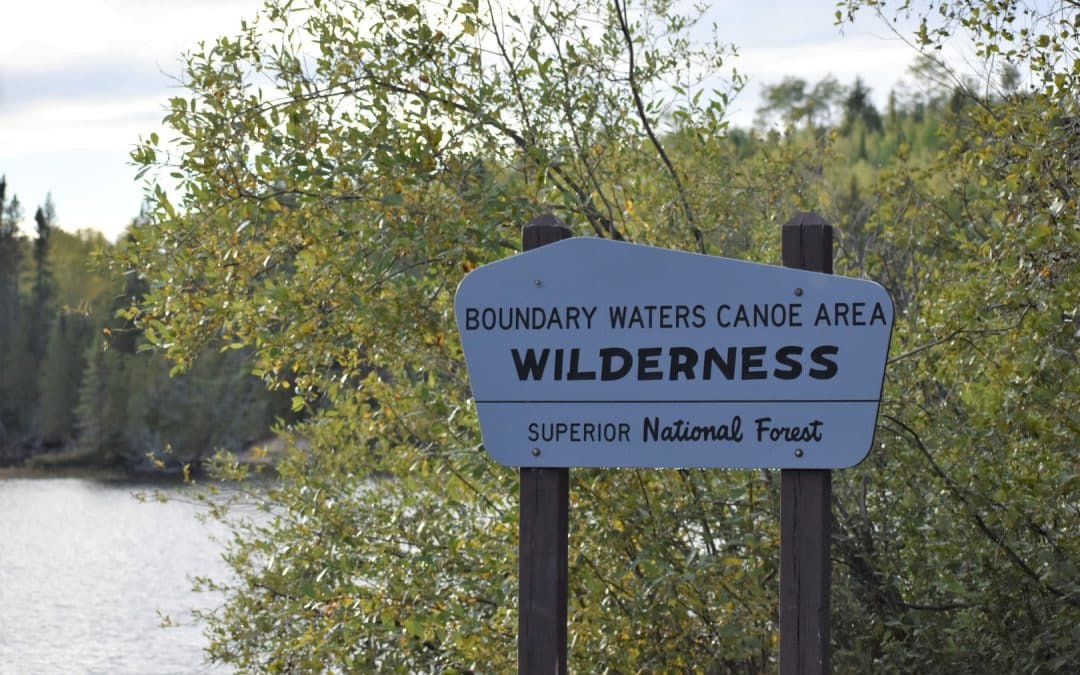

The BWCA Wilderness shares the border with Canada. P&P file photo
A New Era for Wilderness as Congress Eyes ‘Border Security’

By Joe Friedrichs
ELY – Adventurers Dave and Amy Freeman were wrapping up their Year in the Wilderness when Lukas Leaf presented what at the time seemed a most peculiar question.
“Do you think Trump could remove the wilderness designation from the Boundary Waters?” he asked me in 2016.
Leaf, who is now the executive director for the Sportsmen for the Boundary Waters, asked this inside a room we’d secured at River Point & Outfitting on the shores of Birch Lake. Across the lake is where the proposed Twin Metals mine could take form. The Freemans had come off the water of the lake an hour before, completing an entire year inside the most visited wilderness area in the nation, the Boundary Waters Canoe Area Wilderness.
“It’s possible,” I responded.

Lukas Leaf (left), with Dave and Amy Freeman. Photo by Joe Friedrichs
Leaf and I were young and full of ideals in 2016. About a decade later, we’ve both seen what happens when administrations change and, perhaps as importantly, control of Congress. We’ve seen the proposed Twins Metals mine inch forward during the first Trump term, get dragged back during the Biden era, and then leap from the box of conservative ideology with renewed energy in 2025. Despite the thrust, any such mine on the edge of the Boundary Waters is still many years from becoming a reality.
Nonetheless, news this month from the U.S. Senate that a proposed bill could lead to significant changes in how the federal government manages wilderness areas is the latest example of how fragile the concept of “wilderness” is in the United States. At the same time, it’s important to stay grounded in reality. The Boundary Waters remains a place where we can paddle canoes and go winter camping. It’s there, and it’s open for us to use. And how people utilize wilderness areas near international borders will continue to become more complex as elected officials continue to hammer the message of “border security.” Anyone who has seen the helicopters flying along the U.S.-Canada border this year understands this in a real, tangible way.
The aforementioned bill highlighting this comes from Utah Sen. Mike Lee, a Republican who repeatedly proposes changes to public-land policy in the U.S. His latest bill could open all federal land within 100 miles of both the Canadian and Mexico borders to roads, bridges, and increased surveillance in the name of homeland security. Sportsmen’s groups, including a handful in Minnesota, are livid with Lee’s proposal to open wilderness areas to what they consider varying levels of madness.
“Minnesota’s million-acre Boundary Waters Canoe Area Wilderness could be damaged almost beyond recognition if Lee’s bill passes,” said Kevin Proescholdt, Wilderness Watch’s conservation director and a former Boundary Waters Wilderness guide.

Helicopter over Cache Bay from March 2025. P&P photo
Proescholdt said Lee’s bill could overturn more than a century of conservation work to protect “the wild character of the Boundary Waters” by landing aircraft and deploying remote video surveillance systems and motion sensors throughout the canoe-country wilderness.
“You only have to look at the devastation the Department of Homeland Security has wreaked on wildlands on the southern border to appreciate the devastating impacts Senator Lee’s bill could have on the Boundary Waters,” he added.
According to a previous analysis prepared by Wilderness Watch, loosening the restrictions of the Wilderness Act along just the U.S. borders with Canada could damage 73 Wilderness areas across 12 states, affecting more than 32 million acres of the National Wilderness Preservation System. The U.S. border with Canada is 5,525 miles long, including a 1,538 mile-long border between Alaska and Canada. There’s a lot of timber along that border. There’s also an abundance of fresh water. There’s moose. Lake trout. And there’s not many people who call these spaces home, at least in part, because these lands are designated wilderness areas.
Lee, who chairs the Senate Committee on Energy and Natural Resources, first shared the details of the bill Thursday, Oct. 2. The bill also appears to open wilderness to logging, chainsaw use, brushing, and similar efforts to prioritize “fuels management” and create fuel breaks along the border and the new “navigable roads” that could be constructed in these areas.
Earlier this year, Lee was all over the news when he proposed selling some 3 million acres of America’s public lands to spur economic growth and to create more “housing” in the United States. Before that, Sen. Lee introduced legislation that would allow mountain bikes, strollers, and game carts on every piece of land protected by the National Wilderness Preservation System. His latest effort to adjust how public lands are managed in this nation is anchored in “border safety,” advocates of wilderness claim.
“Senator Lee is using the excuse of homeland security to wage his own war against America’s most treasured public lands, including wilderness (areas),” said George Nickas, Wilderness Watch’s executive director.

Calm morning in the BWCA on the border lakes. Photo by Pam Wright
Earlier this summer we spoke with Minnesota author Joe Whitson about his book “Marketing the Wilderness.” The premise of the book is that wilderness is a social construct that helps people make money. This notion runs contrary to the romanticized idea that wilderness is how the earth would be if only there weren’t so many pesky humans around. Whitson’s book made a splash in some circles this year, while others dismissed his reasoning for returning wilderness areas to Indigenous nations as either “woke” or “unrealistic.” Whatever the case, if you read Whitson’s book, or if you grasp the basic themes it conveys, you’re (hopefully) bound to form an opinion about it. And when we’re talking about public lands, including the BWCA, those opinions are often very passionate.
Similar passions stem from the halls of Congress when a bill like Lee’s emerges. Those who want stronger borders are likely to argue for it to pass. If we don’t tighten our borders, the reasoning goes, we’ll allow undocumented immigrants and drugs to enter the country. Others, like the team from Wilderness Watch, decry adjustments to wilderness laws as detrimental to the very soul of America. We need wilderness – places where we can disconnect from technology and the modern world – to be complete humans, some might argue.
Any wilderness area that shares an international border like the BWCA is ground zero for complicated policy on occasion. And it’s not just from the U.S. side where policy can stir frustration. The current situation with the Remote Area Border Crossing Program for example, continues to baffle permit holders who rely on these to cross from the Boundary Waters into Canada. Paddle and Portage heard from Canadian officials Oct. 21 with an update on RABC permits. The update was this: There is no update.
“We have no additional information to provide at this time,” Rebecca Purdy from Canada Border Services Agency wrote to P&P this week about RABC permits.
Leaf and the Sportsmen for the Boundary Waters made a statement on the Lee bill this week. They describe Lee’s bill as an “attempt to sow chaos amongst public land advocates across the United States.” Editor’s note: The Sportsmen had not released the statement at the time this article was published. P&P updated this article to reflect this.
I can recall Leaf standing there in the room at River Point Resort about 10 years ago, wondering if a gameshow host turned presidential candidate would consider loosening protections for the BWCA Wilderness. It’s possible, even likely, that a decade later, Lee’s bill is just the beginning.
Subscribe to Paddle and Portage to support this type of journalism from and about the Boundary Waters.
Other Recent Articles
Canceled BWCA Permits Likely to Follow in Wake of Go Live Day
Outfitters are a key source for BWCA permit information. Photo by Joe FriedrichsA member of Congress from New Mexico said late last month in the nation’s capital that she wasn’t able to take a family vacation to the Boundary Waters Canoe Area Wilderness last summer...

Canadian Officials Seek Input For ‘Telephone Reporting Sites’ to Replace RABC Program
The RABC Program ends Sept. 14, 2026. P&P file photoBOUNDARY WATERS – Officials from the Canadian government are seeking input from various stakeholders on where telephone reporting sites should be located once the Remote Area Border Crossing Program ends later...
Update on Boundary Waters News with Forest Supervisor Tom Hall
Tom Hall (right) with Cathy Quinn at a Forest Service event in Ely. Photo by Joe FriedrichsTom Hall is the forest supervisor on Superior National Forest. He arrived to the Boundary Waters region in 2022. In his first public interview with any media outlets in more...