

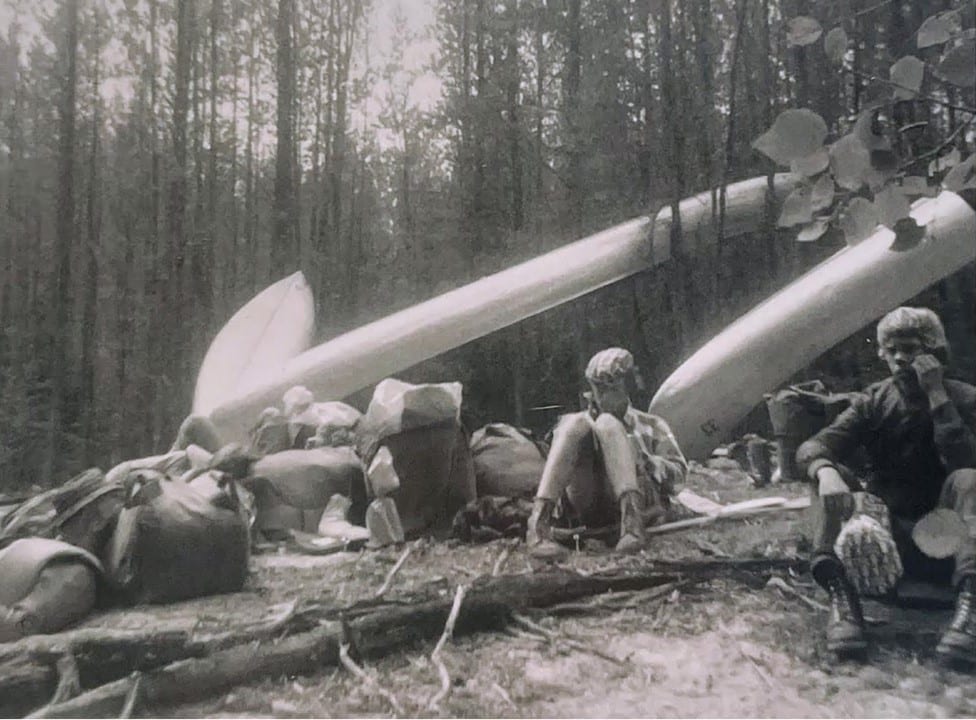
Northern Tier: Bissett is a history of Boy Scout’s wilderness canoeing program in eastern Manitoba and beyond. Submitted image
Northern Tier – Bissett: Tales From 50 Years of Scouting’s Most Extreme High Adventure Program

By Don Richard and Chuck Rose
Editor’s Note: “Northern Tier: Bissett” is a history of Boy Scout’s wilderness canoeing program in eastern Manitoba and beyond. They were drawn to the area by the illustrated canoe route maps of artist Réal Bérard. Operating in a small gold mining town, the program eventually used floatplanes to quickly go deep into the rugged Canadian Shield and reach its outstanding fishing areas. Over five decades, almost 16,000 Scouts have experienced adventures of a lifetime in what became the Atikaki Provincial Wilderness Park. A new book highlights this journey. The book’s authors have shared Chapter 1 of the book with Paddle and Portage and our readers. The complete book can be purchased here.
Chapter 1: New World
Lost.
Or the portage trail was, anyway. Ten Explorer Scouts and their four adult leaders found themselves confused and confounded, at least temporarily, along the shore of an unnamed pothole lake within the vast boreal forest of the rocky Canadian Shield. Their canoe camping adventure through eastern Manitoba began one day earlier. They had been traveling on a minimally maintained gravel road, Provincial Road 304 (PR 304) to Wallace Lake, near the Ontario border. This crew had set off paddling east in six canoes loaded with food and equipment for a 12-day trek. The goal was the Bloodvein River and Family Lake. This was a lightly traveled wilderness where residents of the First Nations of Little Grand Rapids and Bloodvein River village on Lake Winnipeg hunt moose and gather wild rice. It seemed like a perfect destination for this group of Scouts to explore. However, their initial excitement quickly faded as they trudged through a nearly mile-long, soggy portage, the excursion leaving them with aching backs. After a quick paddle, they reached another portage, this one drier, but longer and hillier. The next lake took barely 15 minutes to paddle across, but where was the next portage? The crew searched in vain. As frustration mounted, they pitched their tents on a big rock near the shore, one of the few dry spots available.
The crew was navigating with hand-drawn canoe route maps issued by the Manitoba government. The maps showed details important for canoe travel including portages and rapids, and their margins were filled with artwork depicting scenes from earlier trips making them potentially more valuable than the poorly detailed topographical maps available at that time. The illustrated maps had lured them and others to embark on similar adventures.
The maps were inspired by a decade-old journey by local artist and paddler Réal Bérard. A descendant of hardy French Voyageurs—and a few pirates— Bérard had always been interested in art. His fine arts training began in Manitoba’s capital, Winnipeg, where he studied in English, then continued in Montreal in French, and Mexico City in Spanish. Réal noted that an artist’s life is often challenging.

Katunigan route map. Submitted image
Many people went into the clergy and took a vow of poverty. I thought going into painting was taking a vow of poverty. I was on the same wavelength. Except for the obedience. Painting was my only option. Maybe a shepherd or trapper. But I decided to keep on painting.
Returning home, Bérard found work with natural resources, opening doors to new adventures. In 1962, he and a companion were sent on a fire patrol trip by canoe, and they wound through the roadless landscape east of Lake Winnipeg. Réal kept a journal, where he sketched the rivers and lakes to create maps filled with images and notes from his trip. In 1968 the province’s Parks Branch printed his Sasaginnigak Canoe Country and Katunigan Route maps. Initially distributed for free (and later sold) they served to promote Manitoba’s canoe trails and copies soon spread across the globe.
Catholic priest Father Paul Folsom discovered Bérard’s maps in a St. Cloud, Minnesota library. Described as hardworking, clean shaven, and a bit regimented, Father Paul was serving as a National Guard chaplain and as a Boy Scouts of America (BSA) volunteer. His 1971 book on Christian ecology aligned with his interest in Scouting. Working with youth ignited his enthusiasm wilderness paddling and he had led earlier trips through the Charles L. Sommers Wilderness Canoe Base, located on the edge of the Boundary Waters Canoe Area (BWCA) near the US–Canada border. The program had been named after supporter and St. Paul, Minnesota businessman Charles L. Sommers in 1942. Inspired by the illustrated maps, Father Paul “thought it would be a good idea” to take Scouts to explore Bérard’s routes. But knowing that outfitting and leading such a large group was a daunting task, in June 1972 he approached Sandy Bridges, the newly appointed Director of the Sommers Base.

Father Paul on the first morning of a paddle trip to the Far North. Submitted image
Growing up in Arkansas in the 1950s, Clyde Sanders (Sandy) Bridges had heard tales from older boys–The Northern Woodsmen–who had been canoe camping in Minnesota and even Canada (a magical word to a southerner). As a sturdy 17-year-old with thick glasses, he joined a local contingent to Sommers. Despite losing those glasses in one of the first lakes he visited, Sandy fell in love with the region. After earning his Eagle Scout rank, he applied to join the Charles L. Sommers staff as a “Charlie Guide” in 1959, returning the next several summers. For three years he attended forestry school, while also serving in the National Guard—and helping integrate Little Rock High School—from which he had recently graduated. Beginning in 1963, Sandy spent the rest of his life “Up North.” He briefly worked for an outfitter in Ely, then returned to Sommers as a trail staff manager, as “winter ranger,” and eventually as Base Director.
In the early 1970s, just as Sandy took over, Sommers was folded into the BSA’s National High Adventure program, which was designed to provide exciting outdoor-focused challenges for older Scouts. By that time, the BSA had been sending crews into the canoe country around Ely for about 50 years. And while the Boundary Waters Canoe Area Wilderness (BWCAW, “Wilderness” was added to the name in 1978) along with the adjacent Quetico Provincial Park provided great opportunities and countless routes for wilderness canoe travel, the areas were becoming more popular and crowded with restrictive regulations on the horizon. The BSA’s youth membership would peak at nearly 5 million in 1972. To provide more Scouts with wilderness experiences, the program needed to expand. Of course, Sandy’s first thought was Canada, specifically to add a base near the town of Atikokan, Ontario, about 50 miles (80 km) north of the Canoe Base. A few ambitious Sommers groups had even paddled there and back. Then came the request from Father Paul, who also showed Sandy the Sasaginnigak and Katunigan maps. Would the Canoe Base outfit Father Paul and his Explorer Scouts for an expedition into this unfamiliar wilderness, so far northwest of its existing program area?
Although it was an exciting opportunity, Sandy was cautious. After all, he was dealing with other people’s children. So, he tracked down Réal Bérard in Winnipeg, Manitoba, for his input on whether the BSA could safely send kids into this new and isolated area. They talked about canoe tripping and the vast Canadian bush. Sandy also visited the town of Bissett, Manitoba, on Rice Lake, best known for the San Antonio gold mine. The mine was the reason that the minimally maintained gravel Provincial Road 304 (PR 304) had been built so far into the backcountry. The town’s population had been about 1,200 before the mine closed in 1968 and was fewer than 200 just four years later.

Swiftwater on the Bloodvein River. Submitted image
Finally, Sandy checked out Wallace Lake, a resort area sixteen miles (26 km) to the east. Wallace was a better place to launch canoe trips but had even fewer services. Sandy came away confident that the wilderness around Bissett offered the potential to expand the geography of the Sommers program, providing for an extreme high adventure experience as well as unparalleled opportunities for fishing. Within a month, Father Paul recruited a group of late-teen boys and registered them for the Explorer Scout program for this expedition.
Back on the pothole, the lost crew faced two navigational challenges. First, nearly all maps have north at the top. Bérard, more artist than cartographer, drew routes of his Sas map to fit onto rectangular paper, placing north on the right-hand side. The map’s only hint of this is the inclusion of the Ontario-Manitoba border, which runs north/south in that area. Second, few had used the portages in the decade since Bérard’s trek, leaving the trails overgrown and hard to follow. Father Paul and one of the Charlie Guides finally found the faint trail around dusk. One Scout wrote in his trip journal, “Everyone was overjoyed (ha, ha). To tell the truth, we were tired.”
Up with the birds on a lovely, foggy morning, the crew quickly broke camp. They trudged–brush crashing in places–through the next two portages. Despite the challenge, spruce bog and rock can seem majestic in their own way. When the crew unexpectedly found themselves on a cliff edge, they were able to finally see the beautiful Obukowin Lake. Now on bigger water, the pace of travel picked up despite prevailing headwinds. They camped at what one Scout thought was “the prettiest waterfalls I have ever seen,” and “slept that night on a rock with the softest moss beneath my sleeping bag.”
Moving from Obukowin Lake, they followed the Gammon River to Aikens. From there, paddling north and then taking two rough portages led to the Bloodvein River, with its shallow rapids (it was a low-water year) and abundant walleye. Ten pounds (4.5 kg) of fillets were eaten at one meal. Hard-fighting channel catfish were filling, but not tasty. The crew decided they’d have more fishing time if they went to Sasaginnigak Lake (Sas) instead of Little Grand Rapids on Family Lake farther north. In doing so, they missed an opportunity to meet the chief of the Saulteaux Anishinaabe tribe at the Little Grand Rapids First Nations community and explore an active Hudson’s Bay Company trading post, activities Father Paul had arranged. Along the way, they made friends with “ten billion mosquitoes.” It rained when the Scouts took off their coats and it was sunny when they left them on. Some swift water was run and some was lined, but not always with the best technique. Thirty-five miles were covered that day. A bald eagle (rare in the 1970s because of the effects of the insecticide DDT) soared overhead. Bannock (frying pan bread common in the Canadian bush) baked the previous evening, and high-energy oatmeal bars (which Sandy had named “Hudson Bay Bread”) were gulped down at lunches.
Leaving the Bloodvein River, the crew paddled upstream (east) on Sasaginnigak River towards Sasaginnigak Lake. Bérard’s tripping partner–Émile Péloquin–described the area on the Katunigan map:
This, as the last swamp, is really a new world. The river is wide, shallow, and easy flowing. Absolute silence hangs over the miles of empty wilderness. What a change for the violent tumultuous roar of rapids and falls! The horizon is unobstructed except for a few clusters of poplars standing out alone along the banks of the river. Once in a while a brood of ducks will be heard quacking away in the reeds.
In the last glows of the sunset or quiet moonlight beavers can be seen rippling their way to and from a low hut at the mouth of a creek.
Early in the morning the fog, tinted with a somewhat savage odor, rises slowly as an incense to its creator.
As the crew paddled through this swamp, they spotted a moose and her calf. The guides cautioned them to keep their distance.
Upon arriving at Sas, the crew reveled in a much-needed layover day. Many slept under the stars and the Northern Lights until early morning rain chased them into their tents, where they then slept until noon. Later, nine pelicans flew by, skimming the water’s surface in formation. One boy caught his first fish ever—a three-pound northern; but before it was landed, it was nearly swallowed by a 15- pound northern that almost jumped into the canoe. Two beavers swam by the camp as if nobody was there. Some boys jousted with their canoes. Most climbed a nearby fire tower, viewing “the most magnificent horizon you would ever want to see. You haven’t seen Canada until you’ve seen it from up in a ranger tower.” Supper consisted of ham, beans, and apple sauce, highlighted by cheesecake for dessert.

View of Sasaginnigak Lake. Submitted image
The next morning, they were on the move again. The layover on Sas marked the high point of the trip and now they would be turning south, hoping for a successful return and a chance to share stories of their adventures with friends and family. But this portion of the trip, by a different route, would prove equally challenging.
During the return leg, they encountered another neglected portage between the Sasaginnigak flowage and the Bloodvein River. A quarter mile (just under half a kilometer) in, the faint trail disappeared. Due to wind, heavy snow, and rocky soils leading to shallow root systems, it seems that at any given time about a quarter of the trees in the boreal forest are uprooted and lying on or near the ground, a proportion that seemed even higher in this area. The group ate Hudson Bay Bread and tried to find humor in the situation.
They slept, talked, and watched chickadees while waiting for four and a half hours as Father Paul and the two guides searched for the rest of the portage. Ultimately, the group agreed to retreat to an island campsite. Early the next morning, the guides went ahead to find and clear the trail. The Scouts plowed through tangled brush, stopping five or six times while the guides cut holes in the forest for them to get through. At last, they found their way back to the Bloodvein. In their journals, the scouts mention losing a fishing rod, map and compass, as well as a “self-winding, waterproof, shock-resistant, stainless steel calendar watch, just lying there waiting for the next person who uses our self-made portage.” All in all, the trail (labeled “Long Portage Route” on the Sas map) took a day and a half to complete!
Eager to get home, the crew began paddling upstream, tracing their course back to their parked vehicles near Wallace Lake. Calm weather and even an occasional tailwind helped them maintain a good pace. The crew picked juicy blueberries on the portages between the Bloodvein and Gammon Rivers, sharing handfuls with Father Paul. Three miles of wild rice beds near Aikens Lake followed. They navigated some upstream swifts that required hard paddling. That evening, they took a refreshing swim and enjoyed the reflections off the water. The next day was not as productive as the hot sun forced them to take many breaks in the shade. However, they were rewarded with another eagle sighting. Finally, there was only one day left. Up early, they fortified themselves with cream of wheat and apple sauce for breakfast. With empty food packs, a better sense of direction, and hard won experience from their journey, the Obukowin to Wallace portages went much, much faster. Using a tent fly to catch an unusual east tailwind allowed them to sail the final miles. After nearly two weeks of eating fish every night and only seeing three small groups of campers (even the trapper cabins and fly-fishing camps they found were empty), the crew was very eager to get back to civilization. But before embarking on the 13-hour drive home, they stopped at the Hotel San Antonio in Bissett for much needed showers.
Later, the boys reflected…
I can still smell the Hudson Bay Bread, fifty years later.
The trips that aren’t perfect are the best.
The trip was over, but in my mind, it will go on forever.

Bissett is about 500 road miles (800 km) northwest of Ely, 146 miles (235 km) northeast of Winnipeg. Submitted map
Thanks to Réal, Father Paul, and Sandy, that first trip was a great success and a learning experience. Tales from this trip sparked interest in other nearby routes to explore and potential journeys even further north. Similarly, this trip’s planning and logistics showed that even at 500 miles (800 km) from headquarters near Ely, Scouts (with dedicated adults and trained staff) could successfully accomplish an extreme wilderness adventure. In the following years, additional tests of different routes led to the formation of Northern Expeditions, which was officially marketed for the first time in 1975. From this beginning, a 50-year program with nearly 16,000 participants (so far) has logged 100,000 camper days of some of Scouting’s highest adventures.
Learn more about Northern Tier, America’s oldest national high adventure program for Scouts, here.
Order the full book by Don Richard and Chuck Rose here.
Subscribe to Paddle and Portage to support the platform for being able to share stories like this from and about the Boundary Waters and other paddling destinations across North America.
Other Recent Articles

Forest Service Prepares for Significant Announcements on BWCA Policy & Usage
BWCA Wilderness entry point sign. Photo by Joe Friedrichs The U.S. Forest Service continues to consider changes to a trio of policies that would impact people and businesses that interact with the Boundary Waters Canoe Area Wilderness. Of the potential changes, this...

Missing Hiker Found Alive & Alert at Isle Royale National Park
Isle Royale National Park. P&P file photo A hiker missing at Isle Royale National Park for a week has been found on the remote Lake Superior island. Craig Berg, 70, has been found alive and alert, the National Park Service announced Sept. 12. Berg, missing since...
A Tour of Areas Burned in 2026 BWCA Wildfires
The Sioux River North Entry Point in September 2026. Photo by Joe Friedrichs The fires that shut down the Boundary Waters Canoe Area Wilderness this summer made national news. Paddle & Portage media was invited Sept. 9, along with other members of the press, to...