
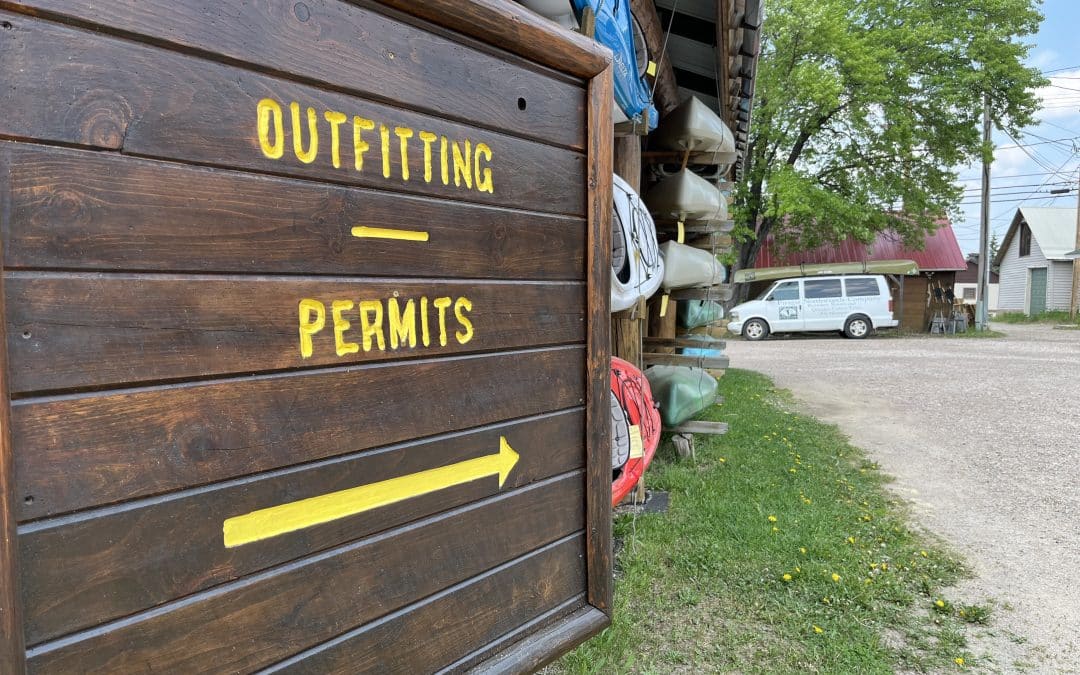
Sign at an outfitter in Ely. Photo by Joe Friedrichs
Forest Service Aims to Increase BWCA Permit Cancellation Costs

By Joe Friedrichs
BOUNDARY WATERS – It’s a start.
That’s been the general sentiment from outfitters and some members of the public regarding the U.S. Forest Service’s plan to increase the cost of cancelling a permit to the Boundary Waters Canoe Area Wilderness. The basic premise of the plan is to make people pay more money if they don’t use or cancel a permit they book for the most-visited wilderness in the nation.
Though outfitters and most members of the paddling community agree any change to the permitting cancellation process is a step in the right direction, the current proposal does nothing to change the chaos of “Go Live Day,” where most BWCA permits are gobbled up for the quota season in the span of a few hours. Instead, the new plan lumps on bigger fines and a three-step tier system in an attempt to resolve the problem.
“Our aim is simple: Cancel early so others can go,” said Drew Stroberg, the temporary supervisor for Superior National Forest. (Tom Hall, the forest supervisor, is working in another position for the Forest Service for a region that covers 13 states across the South.)
If the Forest Service moves forward with its proposed plan, it would work like this:
-Cancel the BWCA permit prior to 28 days of entry: Refund of 50 percent of the deposit (typically the cost of two adults and the reservation fee, which is currently a total of $38).
-Cancel from 28 to three days before entry: Retain 25 percent of the deposit.
-Cancel within two days of entry: No refund.
Keep in mind the Forest Service is also aiming to increase the cost of a BWCA permit. The current cost for an adult to enter the BWCA on an overnight permit is $16. Last year, the Forest Service announced it was considering raising the cost of that permit to $40. The agency says this would be the first permit fee increase for the BWCA in nearly two decades. The fee increase is necessary, the Forest Service says, as it needs money to help maintain portages and campsite amenities.
What this means is that cancellations next year could cost nearly $90 for groups who forget or neglect to cancel their permit. Or, if a lake is frozen for the fishing opener next year and you have a permit for that lake, you won’t get a refund unless you cancel nearly a month beforehand. It’s essentially impossible to know in mid-April if a BWCA lake is going to be open in mid-May.

Permits for the BWCA. Photo by Joe Friedrichs
If the Forest Service moves forward with this cancellation fee structure for BWCA permits, it has not said where the money would go or what it would be used for.
A public comment period on any changes to the permit cancellation policy is open until July 22. You have to email your comments to the Forest Service. There is not a direct way to submit comments online other than email. Here is the email address: sm.fs.bwcawsurvey@usda.gov
The Forest Service said this week that members of the BWCA Collaborative, a group of people interested in Boundary Waters news, policy, and other happenings in the wilderness, helped shape the proposed tier-system for cancelled permits. If nothing else, it shows the Forest Service is listening to the group, including outfitters and other stakeholders. It also shows the Forest Service is listening to the average paddler as well about a lack of permits or the issue of permit hoarding. There’s still work to be done, but indeed, this is a start.
That said, the proposed cancellation policy for BWCA permits operates under the premise that any permit not used by a potential paddler is wasted under either a nefarious or unconcerned manner. This is not true. When lakes are frozen early in the season, some paddlers are forced to cancel a permit days before their scheduled entry date. Similarly, people get sick and sometimes must cancel a permit at the last minute. Also, life happens: vehicles break down, situations change with jobs, and unexpected things surface with some degree of frequency for most people. When they do, plans and schedules have to change, often times without much warning. To what degree people have “credible” cancellations vs. simply not showing because they didn’t bother to or intentionally hoarded the permit is more or less impossible to know.
As we reported earlier this year, the number of people cancelling a permit to the Boundary Waters Canoe Area Wilderness continues to climb, according to a 2026 report from the U.S. Forest Service. This is the fifth consecutive year the number of canceled permits has increased.
Cancellations of BWCA Wilderness permits reached an all-time high of 12,096, the Forest Service announced in the report, which was released in April.
“Analysis indicates excessive reservations during the permit on sale, with rising last-minute cancellations and no-shows,” a report summary from the Forest Service reads. “In 2025, over 40 percent of on-sale reservations were never used, and cancellations and no-shows increased while the number of quota permits issued remained constant.”
A canceled permit for the BWCA Wilderness is one that is booked and then released back into the system. The majority, nearly 70 percent, of cancellations in 2025 occurred less than 30 days before the entry date for the permit. The previous high for cancellations, 11,244, was set in 2024, meaning that over 850 more permits were canceled last year than the previous record high.
A “no-show” means a permit is booked but never issued or utilized. Sometimes people book a permit and forget to cancel it. There’s also the notion of “permit hoarding,” where some BWCA paddlers and outfitters believe people intentionally book a permit and never intend to use it. There were 3,674 no-shows last year specific to BWCA Wilderness permits.

A group watches the Forest Service BWCA video at Sawtooth Outfitters before picking up their permit for Pine Lake in the BWCA. Photo by Joe Friedrichs
As we’ve previously reported, some outfitters and paddlers say the process the Forest Service uses for people to book permits is to blame, at least in part, for the high number of cancellations.
The quota permit season runs from May 1 to Sept. 30. The permits are required for overnight trips only. Day-use permits do not need to be booked in advance. The Forest Service reports that “most permit holders reserve their own permits online well in advance.” Permit reservations made on the last Wednesday in January have more than doubled in five years, a Forest Service report states. In 2024, 57% of cancellations and 59% of no-shows were from reservations made on the first day permits were available, commonly known as ‘go live day,’ suggesting visitors continue to reserve more permits than they can use, according to the Forest Service. Last year, nearly 40 percent of the permits booked on go live day were never used. Returning unused permits earlier improves trip certainty for visitors and for the businesses that support them, the Forest Service said this week.
The sentiment from outfitters and the public that increasing the cancellation fee “is a step in the right direction” is a polite way of saying the plan is decent. It takes action, albeit by penalizing people who presumably want to visit the BWCA. The proposed plan, however, does nothing to address a core issue regarding BWCA permitting: ‘go live day.’
Making all the permits available on the same day, at the same time, creates a narrative that people need to “book now and figure out the details later,” according to several outfitters Paddle and Portage spoke with last year. This “come and get them now” approach leads to people booking permits that they might not use. Until that situation is addressed, the Forest Service will continue to use people’s money as a key ingredient to fix the problem.
We spoke with Ginny Nelson from Spirit of the Wilderness Outfitters in Ely about this topic.
Other Recent Articles
Local Governments Keep Asking: How Much is the BWCA Wilderness Worth?
The Cook County Courthouse in Grand Marais. Photo by Joe Friedrichs Local governments near the Boundary Waters Canoe Area Wilderness have asked this question before, and they’re still wondering: How much money is the BWCA worth? The root of the question stems from...
Wildfire Evacuation Stands Out in Otherwise Quiet Year for BWCA Search & Rescue Operations
Towboat evacuation July 14 in the BWCA Wilderness. Photo courtesy of Vosburgh's Custom Cabins BOUNDARY WATERS – A stretch of three days in July where thousands of paddlers were evacuated from the Boundary Waters Canoe Area Wilderness was the peak of an otherwise quiet...

Forest Service Prepares for Significant Announcements on BWCA Policy & Usage
BWCA Wilderness entry point sign. Photo by Joe Friedrichs The U.S. Forest Service continues to consider changes to a trio of policies that would impact people and businesses that interact with the Boundary Waters Canoe Area Wilderness. Of the potential changes, this...