

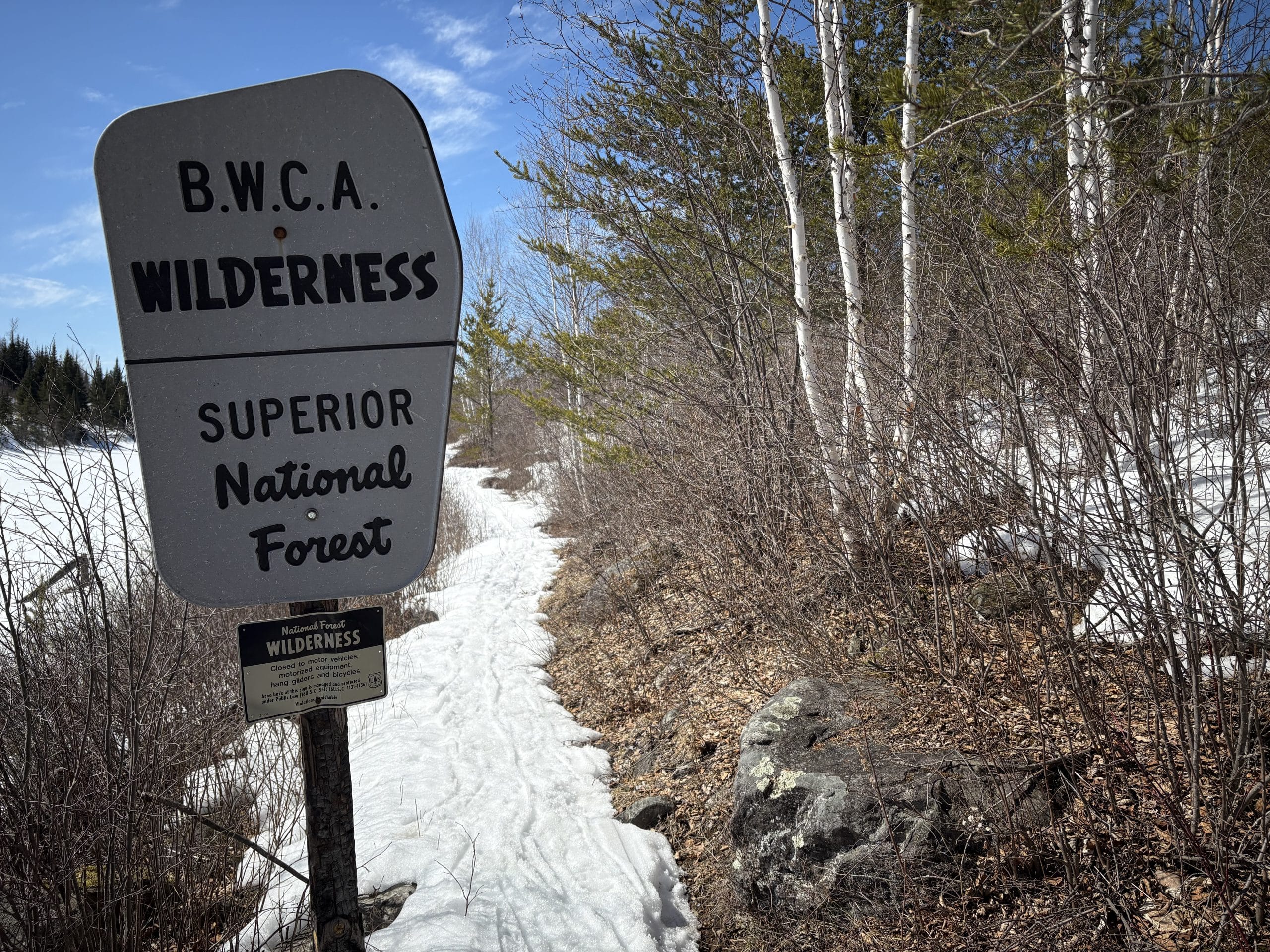
A land of legislation (and wilderness?). Photo by Joe Friedrichs
The Political Theater of the Boundary Waters

By Joe Friedrichs
ST. PAUL – State Senator Grant Hauschild went fishing for the votes of some Boundary Waters enthusiasts this month.
Most regional media took the bait.
In a move that some media outlets say will “protect the BWCA,” Hauschild introduced a resolution last week in opposition to a federal bill that could alter the landscape of the canoe-country wilderness. The image accompanying the press release announcing his resolution shows Hauschild in a canoe with a group of children, presumably in a setting like the Boundary Waters.
In reality, Hauschild is using his resolution to “stand up for” the Boundary Waters during a time in which he faces criticism from the political left (including his own constituents in northeastern Minnesota) for not opposing proposed copper-nickel mines near the Boundary Waters. His bill, which has no authority on federal policy, creates a positive narrative for Hauschild when someone Googles his name and the Boundary Waters together. The resolution has no authority as it is challenging a federal bill that is currently stalled in Congress.

Photo courtesy of Hauschild office (press release)
Hauschild’s resolution, which passed through a state Senate rules committee last week, is a symbolic way of opposing something known as the Border Lands Conversation Act. As we’ve reported, the Border Lands Conservation Act, proposed by Utah Sen. Mike Lee, would allow the Department of Homeland Security to increase its activities on federal lands, including national parks and wilderness areas, within 100 miles of both the northern and southern borders. If passed, the bill would make an amendment to the 1964 Wilderness Act to allow increased surveillance, tactical infrastructure like roads and fences to be built, and allow motorized equipment for surveillance purposes, including aircraft. It’s worth noting that the Border Patrol already has a modest presence in and above the BWCA Wilderness, with officers occasionally (albeit rarely) paddling canoes in the wilderness, and more often flying drones over the Boundary Waters.
Nonetheless, Lee’s bill represents the latest move in a national trend challenging public lands. The Trump administration has pushed to expand resource extraction and roll back environmental protections since first taking office, all while carving up public land management agencies with layoffs and budget cuts. The administration cites a need for critical minerals when it comes to why they support a copper-nickel mine near the BWCA. Border security is the main selling point when it comes to the bill proposed in the U.S. Senate.
Hauschild, in his resolution, states that Lee’s bill “amends the Wilderness Act to allow the federal government to operate motor vehicles, motorboats, and other motorized equipment; use aircraft, including aircraft approach, landing, and takeoff; and deploy infrastructure and technology for detecting illegal border crossings, including observation points, remote video surveillance systems, motion sensors, vehicle barriers, fences, roads, bridges, drainage, and detection devices.” It further states that Lee’s bill “requires installing roads and technological infrastructure in the wilderness to control the northern border.” Lee’s bill hasn’t been in the news or made any progress in Congress since it was introduced last October. It’s more or less vanished into the ether of political wrangling in Washington, making Hauschild’s timing all the more suspect. (Note: Paddle and Portage reached out for comment for this article and did not immediately hear back.)
Meanwhile, many are waiting for news about a vote in the U.S. Senate regarding H.R. Bill 140, which would lift a mining ban currently in place on a large swath of Superior National Forest. That vote needs to happen in the Senate before the end of April, and it remains unknown if or when that vote will take place. No other bill associated with the Boundary Waters region has garnered as much public interest during the past decade than H.R. 140, which was first introduced by Minnesota Congressman Pete Stauber.
The political theater surrounding public lands, including the BWCA, will increase in the months ahead. It’s an election year, after all. Hauschild, a Democrat, is running for re-election this year. His challenger, once again, is Babbitt Mayor Andrea Zupancich, a Republican. Zupancich is more likely to side with Stauber on many issues that concern voters in northeastern Minnesota, and Hauschild knows he needs the support of Boundary Waters enthusiasts in order to hold his seat in the state Senate. His resolution aims to do just that. But in terms of actual outcomes, it does little more.
Subscribe to Paddle and Portage to support journalism from and about the Boundary Waters.
Other Recent Articles

Scope Narrows For Telephone Reporting Sites Across the Boundary Waters Region
The border lakes of the Boundary Waters. P&P photo BOUNDARY WATERS – The end of the Remote Area Border Crossing Program and permits that allow people to cross many of Minnesota’s border lakes is approaching. The RABC Program as it currently operates will close...

Forest Service Returns Camping Gear to BWCA Paddlers Who Narrowly Escaped Wildfires
Photo courtesy of Bailey Shinn A Texas family was camping in the Boundary Waters Canoe Area Wilderness earlier this month when a wildfire took off not far from where they were staying. While camping on Pipestone Bay (Basswood Lake) Bailey Shinn, her three young...

Firefighters Talk of ‘Protecting Structures’ Near BWCA, She Helps In Advance
Teresa Floberg at a property managed to reduce wildfire risk near Ely. Photo by Joe Friedrichs Protective measures done in advance, that’s the key, she says. “We try to encourage homeowners to think in advance about the risks of wildfires,” says Teresa Floberg, the...