
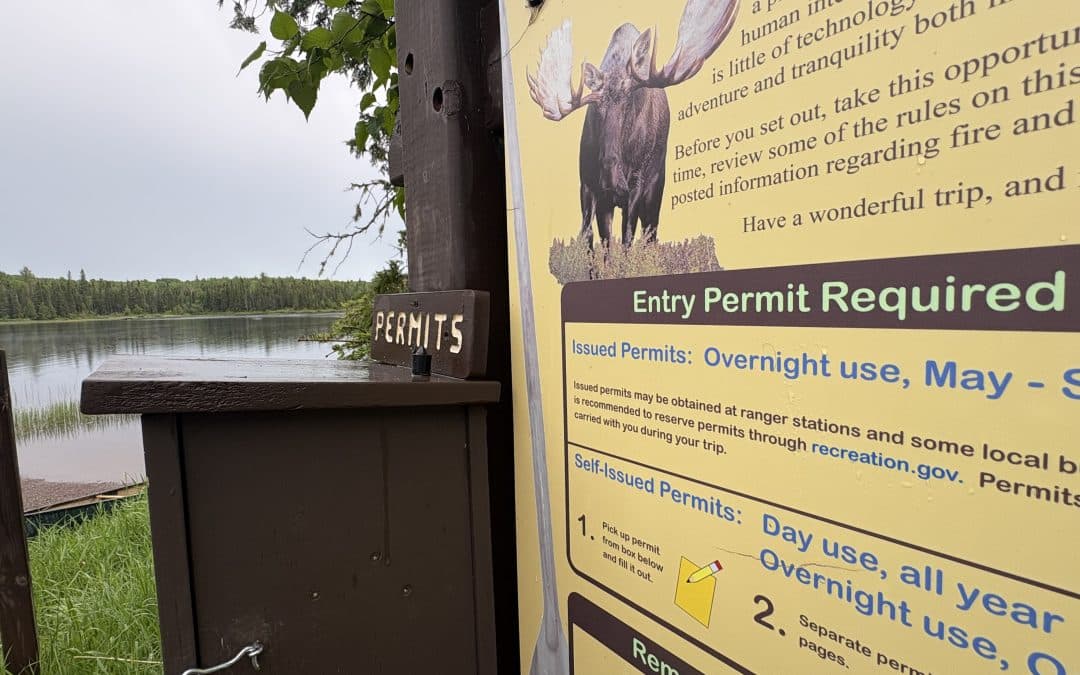

BWCA Wilderness entry point sign. Photo by Joe Friedrichs
Forest Service Prepares for Significant Announcements on BWCA Policy & Usage

By Joe Friedrichs
The U.S. Forest Service continues to consider changes to a trio of policies that would impact people and businesses that interact with the Boundary Waters Canoe Area Wilderness.
Of the potential changes, this report from Paddle & Portage media will focus on three key areas:
1) Changing (increasing) the cost for overnight permits to the BWCA Wilderness during the quota season, which runs from May 1 to Sept. 30 annually.
2) A plan to increase the cost of cancelling a permit to the BWCA Wilderness during the quota season. The basic premise of the plan is to make people pay more money if they don’t use or cancel a permit they book for the most-visited wilderness in the nation.
3) A revision of what’s known as the “forest plan,” a document that guides management of the BWCA Wilderness. Revising the plan could change the number of permits the Forest Service issues each quota season, where campsites are located, towboat usage in the wilderness, fisheries management, and numerous other policies for management in the BWCA.
We’ll break these down and share updates on where each of these potential changes sits as we head deeper into fall and the end of 2026.
1) The BWCA Wilderness permit deposit policy revision is still in process and is expected to be implemented starting in January 2027, Superior National Forest spokesperson Joy VanDrie told Paddle & Portage media Sept. 21.
If the Forest Service moves forward with its proposed plan, it would work like this:
-Cancel a BWCA permit prior to 28 days of entry: Refund of 50 percent of the deposit (typically the cost of two adults and the reservation fee, which is currently a total of $38).
-Cancel from 28 to three days before entry: Retain 25 percent of the deposit.
-Cancel within two days of entry: No refund.
Though outfitters and most members of the paddling community agree any change to the permitting cancellation process is a step in the right direction, the current proposal does nothing to change the chaos of “Go Live Day,” where most BWCA permits are gobbled up for the quota season in the span of a few hours. Instead, the new plan lumps on bigger fines and a three-step tier system in an attempt to resolve the problem.
“Our aim is simple: Cancel early so others can go,” said Drew Stroberg, the temporary supervisor for Superior National Forest. (Tom Hall, the forest supervisor, is working in another Forest Service position for a region that covers 13 states across the South.)
As we reported earlier this year, the number of people cancelling a permit to the Boundary Waters Canoe Area Wilderness continues to climb, according to a 2026 report from the U.S. Forest Service. This is the fifth consecutive year the number of canceled permits has increased.
Cancellations of BWCA Wilderness permits reached an all-time high of 12,096, the Forest Service announced in the report, which was released in April.
The general sentiment from outfitters and the public that increasing the cancellation fee “is a step in the right direction” is a polite way of saying the plan is decent. It takes action, albeit by penalizing people who presumably want to visit the BWCA. The proposed plan, however, does nothing to address a core issue regarding BWCA permitting: ‘go live day.’ Click here for the full story on this and more background information.
2) VanDrie, a spokesperson for Superior National Forest, told Paddle & Portage Sept. 21 that permit fee changes are still on hold as the agency is “waiting on a recreation fee advisory board to be stood up at the national level.”
This means any proposed fees for the cost of an overnight trip are less likely to increase in 2027, which was the original target for the Forest Service when it made the announcement last year. In June 2025, the Forest Service proposed increasing fees for BWCA Wilderness trips for adults from $16 to $40.
The Forest Service said it would be the first fee increase since 2008, sharing in numerous town halls that Paddle & Portage attended that the added revenue is needed to maintain portages, entry points and the wilderness area’s nearly 1,900 campsites, including “improvements to degraded amenities such as fire rings, latrines and many other improvements.”
Hall told Paddle & Portage earlier this year that the Forest Service received about 2,300 comments on the proposal to increase the price of a permit to enter the BWCA Wilderness on an overnight permit during the quota season.
“About 2,000 of those were a form letter from Wilderness Watch, and so they all said the same thing,” Hall said. “We had about 300 unique comments, and they kind of split in three different buckets.”
Hall said a third of the comments were against any sort of fee increases, a third were supportive, and a third were supportive of fee increases, but not one that more than doubles the price of a BWCA permit.
The trajectory for the change to BWCA permit fees was to be implemented in 2027, Hall said, so long as the federal fee board had time to evaluate the proposal. Given that VanDrie said this week the fee board has not been established by late September, the likelihood of the fee increases being in place for 2027 appears low. That said, if the federal “fee advisory board” is established before the end of the year, it remains possible BWCA permits will cost more next paddling season.
3) VanDrie said there was little to report regarding a revision of what’s known as the “forest plan,” a document that guides management of the BWCA Wilderness. Revising the plan could change the number of permits the Forest Service issues each quota season, where campsites are located, towboat usage in the wilderness, fisheries management, and numerous other policies for management in the BWCA.
Hall told us earlier this year that following two public comment periods in 2024, one related to the Forest Plan in general and one related to towboats operating in the wilderness, the Forest Service is now talking with its partners, including (Tribal) bands, the DNR, and the general public.
“We’re having direct conversation with our partners, and we’re doing a survey with the public on how their experiences are in the wilderness,” Hall said.
Hall said the Forest Service anticipated that sometime this fall it will come out to the public with a proposed action for the Boundary Waters forest plan amendment. VanDrie would not comment specifically this week if that is still the target timeline.
We asked Hall earlier this year if quota reduction for the BWCA Wilderness was being discussed as part of the amendments to the Forest Plan.
“We’ve talked about congestion and overuse, degradation of natural resources and degradation of the wilderness experience,” Hall said. “Those are all things that will be a part of the Forest Plan amendment.”
The last time the Forest Service reduced the permit quota was in 2022. That year, the Forest Service said it would issue 248 permits each day during the quota season, a 13 percent reduction from the 285 permits it was issuing.
At the time, the Forest Service said the move was necessary to reduce natural resource damage, crowding, congestion and the “overall degradation of the wilderness.”
To say the move didn’t sit well with some outfitters who rent canoes and other gear to BWCA paddlers would be an understatement. The quota reduction garnered mixed reviews from the paddling community and BWCA enthusiasts.
VanDrie told Paddle & Portage media this week that the Forest Service expects to publish updates by the end of the year regarding the topics discussed above. Paddle & Portage media will share updates on this website, on the Paddle & Portage Podcast, and on our YouTube channel.
Subscribe to Paddle and Portage to support journalism and updates from and about the Boundary Waters. Use the promo code ‘Summer25’ this week to get 25 percent off an annual membership.
Other Recent Articles
Local Governments Keep Asking: How Much is the BWCA Wilderness Worth?
The Cook County Courthouse in Grand Marais. Photo by Joe Friedrichs Local governments near the Boundary Waters Canoe Area Wilderness have asked this question before, and they’re still wondering: How much money is the BWCA worth? The root of the question stems from...
Wildfire Evacuation Stands Out in Otherwise Quiet Year for BWCA Search & Rescue Operations
Towboat evacuation July 14 in the BWCA Wilderness. Photo courtesy of Vosburgh's Custom Cabins BOUNDARY WATERS – A stretch of three days in July where thousands of paddlers were evacuated from the Boundary Waters Canoe Area Wilderness was the peak of an otherwise quiet...

Missing Hiker Found Alive & Alert at Isle Royale National Park
Isle Royale National Park. P&P file photo A hiker missing at Isle Royale National Park for a week has been found on the remote Lake Superior island. Craig Berg, 70, has been found alive and alert, the National Park Service announced Sept. 12. Berg, missing since...