
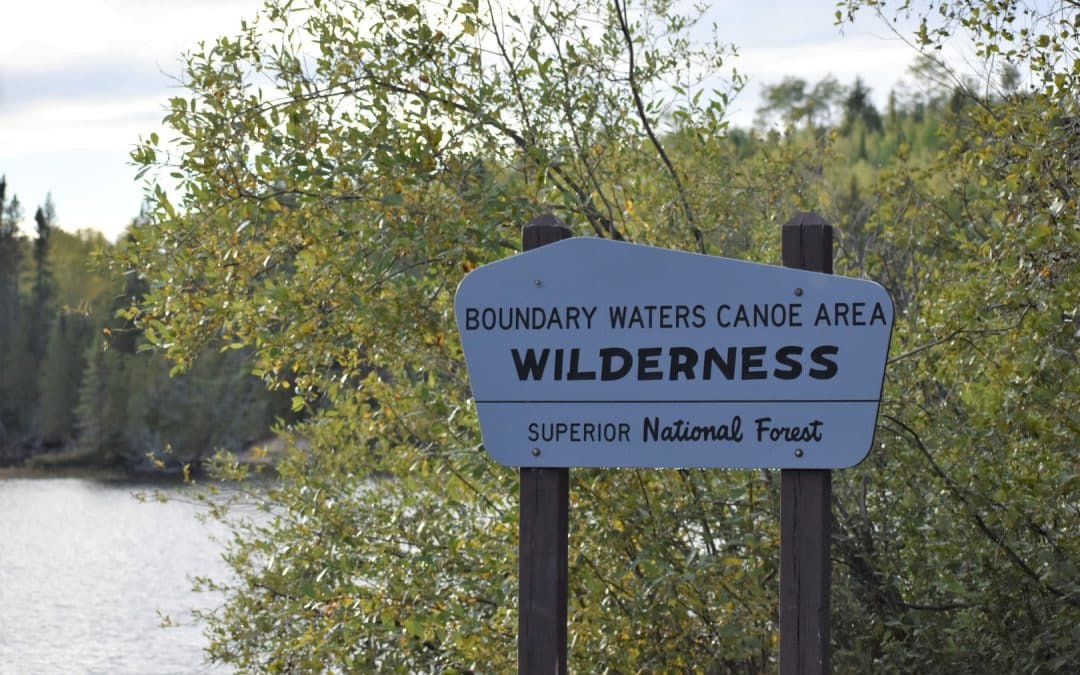

BWCA Wilderness sign at Seagull Lake. Photo by Joe Friedrichs
Walz’s Executive Order to Protect the BWCA Only the Latest Move in the Wilderness Chess Match

By Joe Friedrichs
A Paddle & Portage subscriber who lives out of state reached out late in the day Aug. 18 after seeing social media light up with news of Minnesota’s governor “saving the Boundary Waters.”
In her missive, she wrote: “I almost fainted with relief when I saw the news about Governor Walz’s executive order. Seriously, I had to sit down.”
It’s understandable that people would assume Gov. Tim Walz single-handedly stopped a potential copper-nickel mine from opening when he signed an executive order Tuesday. On the surface it seems like the news environmentalists and BWCA enthusiasts have long dreamed of: An end to the decades-long debate over a proposed mine near the edge of the wilderness.
It isn’t.
In an era when anyone with a smartphone can post a video or photo that shares the news of the day, social media pages for BWCA enthusiasts become saturated on days when news from the wilderness makes national headlines. It happened during the wildfires and the recent BWCA closure. It happened when Congress repealed a mining ban earlier this year. And it happened again yesterday. Outfitters, advocacy groups, mining companies, and disgruntled people who live near places like Ely and the Iron Range came out en masse to share their take on Walz’s order. It’s the current state of media we’re in; one where everyone has a platform, even if it’s just on Instagram or Facebook.
What I told the above-mentioned P&P subscriber is that Walz signed the order Tuesday largely to make a statement that he stands for protecting the watershed of the Boundary Waters. He’s not running for reelection, so there’s no risk to his legacy in signing the order he did Tuesday. It shows the governor cares about the BWCA, and that he’s listening to the many hundreds of thousands of people who encouraged him to protect the Boundary Waters. The executive order Walz signed temporarily stops state environmental review and permitting by the Minnesota Department of Natural Resources and the Minnesota Pollution Control Agency for any new mining proposals in the watershed of the Boundary Waters. The order also directs the DNR to draft legislation that would permanently ban copper mining in the watershed of the BWCA. Any legislation of this sort would need to pass the Minnesota House and Senate, and be approved by the next governor, something that would be challenging to accomplish given the current political climate in Minnesota, though the upcoming elections could shift that scale one way or the other.
What’s certain is that Walz’s executive order puts pressure on the next governor of Minnesota to sort out what happens next. Because what he signed this week is an executive order and not a law, any of his executive orders that are not extended by the next governor simply expire 90 days after Walz leaves office. That would be early April 2027 for this matter.
Minnesota’s next governor is likely to be either Republican Lisa Demuth, the current state House Speaker, or Democratic U.S. Sen. Amy Klobuchar. Demuth is clear she would terminate Walz’s executive order. Klobuchar is on the fence, roaming the gray area many Democrats wander in northern Minnesota when it comes to taking a stance on copper-nickel mining near the Boundary Waters.
The Democrats running for the Minnesota Senate and House seats this year, Grant Hauschild and Aaron Kania, respectively, both disagree with Walz’s action to circumvent what they refer to as “the process” to permit or deny any mining projects in Minnesota, including those near the Boundary Waters. In a statement sent to Paddle & Portage Aug. 18, Kania said, “I know we can both maintain Minnesota’s strong environmental standards and build a resilient economy for everyone. Today’s executive order on Rainy River eliminates a deliberative process where communities and businesses could carefully consider how to protect our wilderness and encourage responsible mining.”
Walz hit the national stage in 2024 when he was selected by the Democratic presidential candidate at the time, Kamala Harris, to be her running mate in a bid for the White House.
In terms of controversial mining projects proposed near the BWCA, Walz had been largely middle of the road until this week. Similar to U.S. Sen. Tina Smith, Walz is largely taking a bolder stance on BWCA issues in the final chapter of his political storyline. Moving forward, there will be plenty of debate about proposed mines near the Boundary Waters ahead of the November midterms. And indeed, it’s just getting started.
Support this type of reporting from and about the Boundary Waters by subscribing to Paddle and Portage today.
Other Recent Articles

RABC Permits Extended Until the End of November
RABC permit sign. P&P file photo BOUNDARY WATERS – The Remote Area Border Crossing Program has a new end date. The RABC Program as it currently operates is now scheduled to close Nov. 30. The program was set to end in mid-September. No official reason for the...
Cabin Owners, Forest Service Split on Benefits and Timing of Prescribed Fire Near the BWCA
A sign posted by the Forest Service at the Greenwood Lake public landing showing a map of prescribed fire activity in 2026. Photo by Joe Friedrichs The first wildfire of the year near the Boundary Waters started May 15 near Betty’s Pies and Highway 61, not far from...
Nearly 75 Percent of BWCA Wilderness Campsites to be Reopened by August 13
A BWCA update kiosk as seen Aug. 10 in Ely's Whiteside Park. Photo by Joe Friedrichs The U.S. Forest Service and its partners continue to make progress containing a series of wildfires that led to the complete closure of the Boundary Waters Canoe Area Wilderness in...