

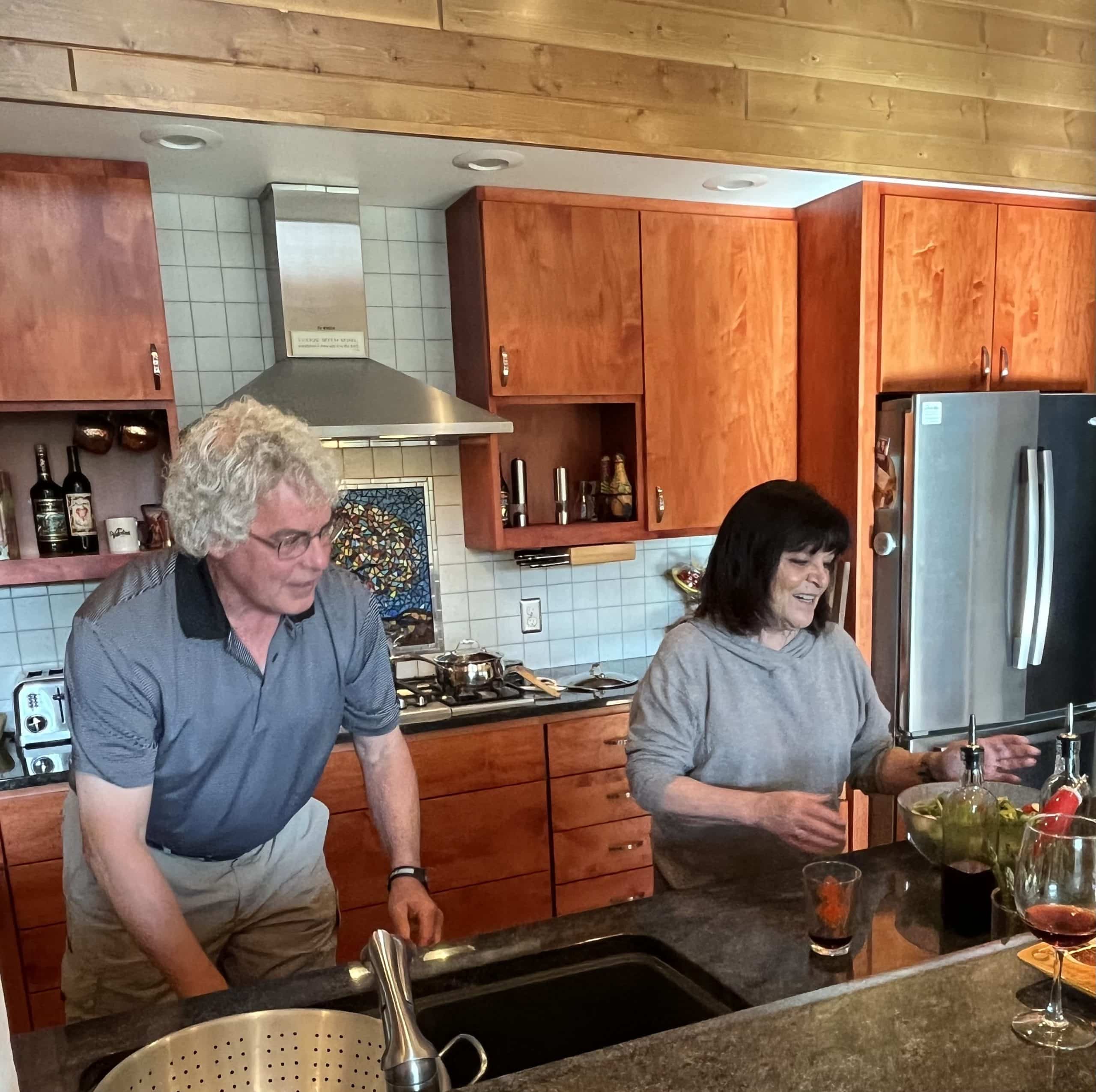
Michael and Sally Valentini at their home on the Seagull River at the end of the Gunflint Trail. Photo by Joe Friedrichs
Valentinis’ Move Symbolic of Generational Shift on Gunflint Trail

By Joe Friedrichs
“While something may come to an ending on the surface of time, its presence, meaning and effect continue to be held and integrated into the eternal. This is how spirit unfolds and deepens. In this sense, eternal time is intimate, it is where the unfolding narrative of individual life is gathered and woven. Eternal life is eternal memory; there, it becomes possible to imagine a realm beyond endings where all that has unfolded is not canceled or lost, but where the spirit-depths of it are already arriving home.”
– John O’Donohue “To Bless the Space Between Us”
GUNFLINT TRAIL – The road ends down near the big water. Saganaga. Seagull. The waterways that flow in between. It’s down here, at the end of this winding 57-mile roadway, that change is coming.
Change is always coming, he’ll tell you. It’s inevitable.
The person speaking of change is Michael Valentini. After more than two decades living at the end of the Gunflint Trail, Michael is putting his house up for sale and moving back near his hometown on the Iron Range. It’s the end of an era, and yet another example of the changing of the guard on the Gunflint Trail. Time changes everything, he’ll say.
Michael and his wife, Sally, first arrived to the Gunflint Trail in May 1999. They finalized the purchase of their property May 29, Sally’s birthday. It was five weeks before a storm with 90 mile-per-hour winds downed hundreds of thousands of trees across the Boundary Waters, including a large swath of the Gunflint Trail.
In the 25 years that have followed, Michael and Sally have impacted the Gunflint Trail in the way people who leave a mark here do: By embracing it. They’re both dedicated volunteers, serving for many years on things like the Gunflint Trail Historical Society and the Gunflint Trail Volunteer Fire Department. They organize events. They host dinners at their home. Sally started the fire department’s annual shrimp boil. Well-known by her peers, she was named the “Volunteer of the Year” at one point for the work she does for the Gunflint Trail.
For his part, Michael became what current residents of the Trail described as “the go-to person” for anything that needs to get accomplished up the Gunflint. He installs docks for home and cabin owners with lakeshore property. He builds structures. He repairs water lines. For Valentini, there’s no task too small, and seemingly few too large.
“He’s a guy who wears many hats,” said John Schloot, the former owner of Cross River Lodge (now called Borderland Lodge) on the shores of Gunflint Lake.
Schloot, like many others who are retired from their careers, remains active in things like the Gunflint fire department and search and rescue. He’s also a longtime friend of the Valentinis.
“They’re going to be hard to replace,” Schloot said of Michael and Sally.
—
When pressed for a simple explanation on why they’re moving, it comes down to an inability to say “no,” Michael explains. Residents of the Gunflint Trail call for a service, be it a leaking pipe or to have a sprinkler system installed on their cabin, and Valentini springs to action.
“I respond to issues,” he says, when asked about what he does up the Gunflint Trail.
Valentini Property Services is the company Michael started not long after he arrived to the Gunflint. He received a list of names from Mike Prom at Voyageur Canoe Outfitters, which is next door to the Valentinis’ home. Using that list, Valentini sent a business card to a list of property owners on the Gunflint Trail for a general contractor and handyman service. Eventually word spread that Valentini could handle almost any job that needing doing. He could fix a water line. He could install a dock. He could open or close your cabin. In recent years, it’s been a struggle to find employees to help do the work that needs to be done to successfully run the business, Valentini said. In turn, much of the workload falls back on him. At 73, there’s only so much work he can do on any given day, he acknowledged.
Valentini bought the property on the Seagull River in 1999. Prior to that, he’d worked for 20 years as an emergency medical technician in the Twin Cities. The pace of the work engaged him, as riding in an ambulance with sick or injured people is fast, important work. From there, he returned home to Chisholm, Minn., where he ran the family business for 20 years, Valentini’s Supper Club. The Italian eatery is famous in certain pockets of Minnesota. The business was open for 24 hours a day during the peak of the mining boom in northern Minnesota, feeding hungry miners as they collected ore that was used for steel to build a nation and fight in World War II. Everyone knows the name Valentini on the Iron Range, Michael says, both through the restaurant and because of his large family. Michael is the oldest of eight children.
After two decades running the family restaurant, Valentini wanted to live on the edge of the wilderness. He’d been fishing in the Boundary Waters many times, though always on the Ely side. It was a longtime friend, Tony Faras, who told him about the Gunflint Trail. A visit to the Trail in 1996 changed everything. Michael and Sally needed to live here. It was time for a change.

Michael Valentini preps a sprinkler system for testing. Photo by Joe Friedrichs

Sally Valentini serves an Italian dinner at their home at the end of the Gunflint Trail. Photo by Joe Friedrichs
The Gunflint Trail is more than a road. It’s a destination. People come from all over the world to explore the many lakes, river, cabins, and businesses that dot the Trail. It’s more than a tourist destination, however. It’s a community. The people who live here, particularly the year-round residents, are sturdy souls who don’t get too caught up in the happenings in places like Grand Marais, Lutsen, or other towns beyond the Gunflint corridor. On the Trail, the news of the day tends to be how the woodstove is burning, where the fish are biting, and what’s for supper. Larger events, like the 2007 Ham Lake Fire, bring people together. Community centers, built in large part due to the fundraising efforts of Michael Valentini, helped unify the Gunflint Trail. There was a time when the Gunflint Trail had three separate communities: Mid-Trail, Gunflint, Seagull-Sag. Valentini, along with wildfires, improved communication, and social media, helped bring these groups together. It became the Gunflint Trail community, singular.
The road starts in Grand Marais. A construction zone that will soon be an apartment complex below the water tower above town greets visitors this summer. From here, the Trail stretches for 57 miles northwest to Trail’s End Campground. The Minnesota Historical Society chronicles that, “Indigenous peoples have inhabited the northeastern area of Minnesota for thousands of years. By the mid-1700s, Ojibwe people were living in the region, and French fur traders from Montreal had begun to trade with them. Lakes and streams provided transport routes for them to traverse by canoe. Travelling by foot, snowshoe, or sled was possible, but less ideal.”
They go on to say that “the Ojibwe had developed a footpath—the forerunner of the trail—beginning at Biiwaanag Zaaga’igan (Gunflint Lake) and extending at least to Gichi Biitoobig (Grand Marais) by 1800. Around this time, the area got its name from the flint, or chips of chert, that French traders would gather for their flintlock firearms at the lakeshore where the path began.”
Characters, who are now legends, came to the Trail as it became more accessible. Benny Ambrose. Justine Kerfoot. Billy Needham. Others were born here, like Dicky Powell, raised in the wilds of what is now the end of the Gunflint Trail.
In the late 1990s and early 2000s, another generation followed, many of them seeking solitude and simpler ways of life. Barb and John Bottger. Fred and Fran Smith. Michael and Sally Valentini. There are others. Many others. The common thread among many who come to the Trail seeking solitude is that they end up getting involved in what’s happening.
“The strength of the community is based on the people and their involvement,” Barb Bottger said. “Just look at what they’ve (Michael and Sally) done up there since they arrived. It touches about every facet of life on the Gunflint.”
—
Michael Valentini is a boisterous human being. Easily recognizable with curly white hair and a booming laugh, you can usually spot or hear him long before he “arrives.” He’s also a tireless worker. It’s not unusual for Valentini to work a 12-hour day, arrive home to the house on the Seagull River, and then immediately turn around and walk back out the door to respond to an emergency search and rescue call. That happened May 31, for example, when a BWCA camper said they needed help after a strange experience using psilocybin mushrooms at a campsite on Alpine Lake.
“Those types of calls happen sometimes,” Valentini said. “We have to respond. We don’t know some of the time until we get out there how bad it is.”
During the 25 years he’s spent living on the Gunflint Trail, Valentini has responded to numerous emergencies in the BWCA through search and rescue and the fire department. He turned 65 in the wilderness while responding to a search and rescue operation on Clove Lake. That night, a severe thunderstorm ripped across the canoe-country wilderness, killing the brother of Gov. Tim Walz on Duncan Lake. Valentini said he remembers paddling to Clove Lake that night, a remote border lake, and watching as the skies cleared after midnight. The storm was gone, and the lake was so calm that it was almost eerie. It was then that Valentini had an epiphany.
“It was my birthday that next day, so after it turned midnight and we were out there paddling, I realized I was now old enough for Medicare,” he said.
Valentini has the ability to bounce back and forth between being completely serious and full of sarcasm during the course of the same conversation. Schloot, his longtime friend from the Gunflint Trail, said that he was quick to let people know where they stood, too. After an exhaustive search and rescue operation one time, Schloot attempted to lighten the mood by telling what could best be described as a “dad joke.” With a straight face, Valentini looked Schloot square in the eyes and said, “I’m in charge of humor on the Gunflint Trail.” Valentini then burst into a deep, roaring laugh.
Pivoting from that story, Schloot said Valentini is a deeply compassionate and caring individual. He referenced a story from June 2023 where an 18-year-old Wisconsin man drowned on Gillis Lake in the BWCA. In that incident, Lester Hochstetler, of Clear Lake, Wis., fell from his rented canoe and never resurfaced. After searching the lake for more than 24 hours, Cook County had to request assistance from the St. Louis County Rescue Squad, an advanced search and rescue unit headquartered near Duluth, though they also cover the Ely area and a large section of the BWCA. Shortly after arriving to Gillis Lake, the crew from the St. Louis County Rescue Squad located Hochstetler. He was found in an area where Cook County searchers had been looking.
In terms of operations and equipment, it was obvious something needed to change. Recently, Cook County Search and Rescue and the Gunflint Trail Fire Department purchased an underwater camera with sonar and recovery arm, along with an assortment of other search and rescue items. The total expense for the new equipment was approximately $100,000.
The underwater camera unit Cook County purchased is the same device that was used on Gillis Lake last summer to recover Hochstetler. After consulting with the Hochstetler family and receiving their permission, the same unit that found his body from the bottom of Gillis Lake is now named Lester in his honor. Schloot credits Valentini for raising the funds and for communicating with Lester’s family in Wisconsin to get their blessing to name the device for him.
“These types of things are irreplaceable,” Schloot said. “The extra mile he goes on almost everything he does.”
—
The reality is, no one lives forever.
Andy McDonnell, a co-owner of Tuscarora Lodge & Canoe Outfitters, shares this sentiment rather matter-of-factly on a recent sunny afternoon up the Gunflint Trail. It’s in the context of change happening on the Gunflint Trail. Changes to the people who live there. People coming. People moving away from the Trail. People, in some instances, dying here.
No matter who calls the place home, the Gunflint community will continue to thrive, McDonnell, 39, believes. There’s a new generation stepping up. Matt and Cassidy Ritter from Voyageur Canoe Outfitters, along with Maddy Frawley and Clay Warburton. Megan Meyer at Wilderness Canoe Base. Jessica Berg-Collman at Seagull Creek Fishing Camp. Ben Seaton at Hungry Jack Outfitters. Zach and Ruth Baumann at Golden Eagle Lodge. Change is happening.
Dicky and Sherry Powell are gone from Saganaga. Bruce and Sue Kerfoot left Gunflint Lake and, more recently, sold their home on Tucker Lake. Fred and Fran Smith moved south, back to Iowa, where things are somehow simpler these days for people who came to the Gunflint seeking that very thing: The simple life.
And now, Michael and Sally Valentini are preparing to move on. They’ve met with a local realtor and soon their house on Sag Trail will be listed. The property looks much different than when they bought it in 1999. The little cabin where they used to eat dinner on TV trays is rarely used. The big house they built overlooking the Seagull River will be home to someone else. Its fate is unknown.
One of the reasons Michael Valentini became so well-known on the Gunflint Trail is due to his tireless dedication to it. Barb Bottger said Valentini would “drop whatever he was doing in order to come help people.”
That very reason, his inability to say “no” to such requests, is ultimately a reason he has to leave. If the phone rings, Valentini said, he would respond. He says a quote on the gravestone of Muhammad Ali captures how he feels about helping people who are in need. It reads, “Service to others is the rent you pay for your room in heaven.”
And so it goes. Change.
Bottger said that when legends leave the Gunflint Trail, they’re not really gone. There is magic in the woods here, she said. Just like moose in the woods, we don’t always see the people from the past, but we know they’re there, Bottger explained.
“This is a place where spirits linger,” she said of the Gunflint Trail. “The woods just hold it.”
Support this type of reporting from the Boundary Waters by subscribing to Paddle and Portage.
Other Recent Articles

What Forest Service Headquarters Moving to Utah Means for the Boundary Waters
Information kiosk near the Tofte Ranger Station. April 2026 photo by Joe Friedrichs The federal government announced this week it is moving the headquarters for the U.S. Forest Service from Washington, D.C. to Salt Lake City. As part of the move, the Forest Service...

Forest Service Uses Dog Sled Teams in First Steps to Improve Monument Portage
Monument Portage in summer 2025. Photo by Mark Zimmer (the Barefoot Paddler) It became known as the portage where boots and socks vanish for parts unknown. The Monument Portage. Straddling the U.S.-Canada border, this well-traveled portage between Ottertrack and Swamp...

The Political Theater of the Boundary Waters
A land of legislation (and wilderness?). Photo by Joe Friedrichs ST. PAUL – State Senator Grant Hauschild went fishing for the votes of some Boundary Waters enthusiasts this month. Most regional media took the bait. In a move that some media outlets say will “protect...