


Border sign near the Boundary Waters. Photo by Lisa Sorlie
Economic Concerns Mount as Canadian Government Stays Silent on Future of RABC Program

By Joe Friedrichs
SAGANAGA LAKE – It’s a failure to communicate.
Echoing the sentiments from the Paul Newman film “Cool Hand Luke,” there’s ongoing concern from business owners and other property owners on the Canadian side of this lake regarding the future of the Remote Area Border Crossing (RABC) Program.
“We feel as though we’ve been left in the dark,” said Donny Sorlie, the co-owner of Chippewa Inn on the Canadian side of Saganaga Lake near the end of the Gunflint Trail. “Totally, 100 percent, left in the dark with no rhyme or reason.”
After more than a month of questioning from members of the press, Congressional staff, business owners, and people who are feeling left hanging, Canadian officials are still being vague when it comes to the future of the RABC program.
“While RABC permit applications can still be submitted, as of Sept. 25, the Canada Border Services Agency (CBSA) has paused the processing of new and renewal applications as we work on reviewing and updating our procedures,” said Luke Reimer, a spokesperson for CBSA.
Reimer confirmed with Paddle and Portage Dec. 10 that the Canadian border agency “regularly assesses its programs to respond to current service needs and evolving trends.”
Part of assessing the current status of RABC permits includes dynamics focused on “ensuring the safety, security, and prosperity of Canada.”
With nothing in the way of a public announcement, the Canadian government in late September “paused the processing of new and renewal applications” for the RABC program that allows travelers to cross into certain remote parts of the Boundary Waters region.
Donny and his wife, Lisa, met with this reporter at the Paddle and Portage headquarters in Grand Marais Dec. 10 to discuss how the “pause” on the RABC program is impacting their plans for the upcoming winter and the 2025 open-water season. The Sorlies bought Chippewa Inn in 2023 from the Powell family. Lisa said that guests have already reserved cabins for 2025, and they are very concerned about how they’ll be able to access the small resort if RABCs are not an option.

Donny and Lisa Sorlie cut ice near Chippewa Inn. Submitted photo
“I have stopped talking about being open in the winter since we heard of this six weeks ago,” she said. “Our bigger concern is that if it’s not open by summer, we’re going to cancel all of the reservations made, most likely, unless people are willing to do the long drive around. And if that’s the case, we may have to look at different work options to still pay our bills.”
Unless the pause on RABC permits is changed in the months ahead, snowmobilers, anglers, canoeists, and property owners on lakes at the end of the Gunflint Trail won’t be able to access Canadian border waters if their permit expires without first entering Canada through the Pigeon River crossing, or another official port of entry. In addition, canoe outfitters, fishing guides, and other businesses that operate on the border lakes in and around the Boundary Waters won’t be able to provide some of the services their clients have come to depend on. This includes towboat transfers to Quetico, and guided fishing trips on the Canadian side of lakes such as Saganaga.
The RABC permits allow U.S. citizens to cross into Canada on some border lakes, from Lake Superior over to Rainy Lake, without stopping at a customs checkpoint such as the Pigeon River entry point in Grand Portage. These permits cost about $35 to process and must be renewed annually. Canadian officials issued approximately 9,000 RABC permits in fiscal year 2023-2024. As of Dec. 10, they’ve issued approximately 7,300 permits in fiscal year 2024-2025, according to Reimer.
If RABC permits are not renewed or available, Donny said people hoping to access the Canadian side of Saganaga Lake will need to enter from Northern Light Lake or Trout Bay Road. For context, Donny said that turns what would be a two-hour trip from Grand Marais to Chippewa Inn on the Canadian side of Sag into a 10-hour trip.
“Those are rough roads back in there,” he said. “That access is tough any time of the year.”
Joining the Sorlies at the Paddle and Portage headquarters in Grand Marais Dec. 10 was longtime Cook County resident Darin Fagerman. A retired conservation officer for the Minnesota Department of Natural Resources, Fagerman spent many years checking anglers and hunters in the woods and waters near the Gunflint Trail and other parts of the county. Fagerman said he built a cabin on the Canadian side of Sag, his favorite lake in the Boundary Waters region, in hopes of spending significant amounts of time there, including with his 4-year-old grandson and other family members. Without an RABC permit, accessing the cabin is an entirely different process.
“I built a cabin, and I invested most of my retirement savings in it,” Fagerman said. “And my grandson likes to fish, and this is the time to make memories with the kids. And it’d be devastating for our family if we’re not able to go up there.”

Winter recreation on Sag is common, with many using an RABC permit. Photo by Darin Fagerman
At this time, active RABC permits are valid until they expire, according to Canadian officials, though they won’t be renewed if the “pause” of the program continues. Permits are valid for one year from the time they were issued. All previously issued RABC permits that have expired will still be considered for renewal, and U.S. citizens can still apply for a new permit at this time, according to CBSA officials. That said, any renewal or new applications are likely, at best, to be sitting in a queue or holding phase until the “pause” of the program ends or some other factor intervenes.
The Sorlies’ RABC permits will expire Jan. 1 if the pause is not lifted. Fagerman’s permit expires later in January. Donny acknowledged that the RABC is a unique policy that allows people to cross an international border without checking in at customs. However, the communication, or lack thereof, is adding to the frustration regarding this situation.
“The least they could do is talk,” Donny said of the Canadian government. “I’ve said this before: An RABC is a privilege. It’s not a right, but it’s a privilege.”
Paddle and Portage asked CBSA officials in November if changes made in 2023 by Canada and the U.S. regarding the Safe Third Country Agreement (STCA) were a factor in the current RABC pause. Reimer said the agreement is not a factor in the current pause on RABC permits. In short, the STCA makes it difficult for people of any nationality entering Canada from the U.S. to claim asylum if they cross the border. The update from last year expands the STCA’s terms to cover the entire land border rather than just formal crossings. There’s been speculation by some Canadian officials following the U.S. elections earlier this month that Canada is preparing for a rise in border crossings with the threat of mass deportations under President-elect Donald Trump. When asked specifically if the third country agreement is impacting RABC permits, Reimer said, “No. As mentioned, the CBSA regularly assesses its programs to respond to current service needs and evolving trends, while ensuring the safety, security, and prosperity of Canada.”
Another program used to allow people to cross the U.S. – Canada border in a more streamlined fashion, known as NEXUS, is not currently being reviewed, while the RABC program is, Reimer said.
Additionally, U.S. officials Paddle and Portage spoke with for this story have not attributed the pause on RABC permits to anything related to background checks for people entering Canada.
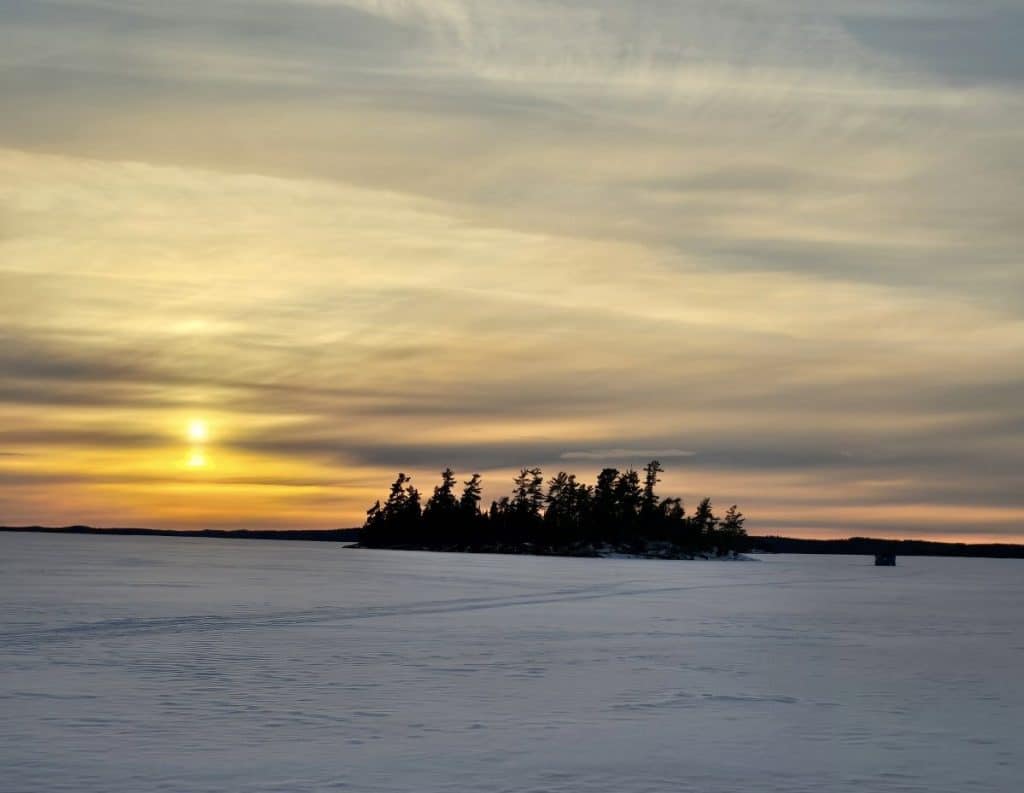
Winter on the Canadian side of Sag. Photo by Darin Fagerman
This is the second time in recent years that RABC permits have been either suspended or paused. During the COVID-19 pandemic, all travel between the U.S. and Canada was suspended, with the RABC permits being suspended until 2022. Recently re-elected Minnesota Congressman Pete Stauber sent a letter to Canadian Prime Minister Justin Trudeau requesting that RABCs be available in 2022, telling this reporter at that time, “Minnesota and Canada both benefit from a healthy, reciprocal border crossing relationship,” Stauber said. “Especially during the summer months, our shared border area is a hub of economic vitality as tourists from around the world look forward to visiting our shared wilderness and lake areas.”
Paddle and Portage reached out to officials from Stauber’s office for comment on the current pause of RABC permits. Representatives from Stauber’s office told Paddle and Portage Dec. 10 that Stauber’s office submitted a letter to Canadian officials regarding the RABC program.
“Congressman Stauber recently sent the attached letter to the Canadian government,” Nicky Hazelbaker, a staff person from Stauber’s office told Paddle and Portage. “Since then, we have received communications from the Canadian Embassy regarding the letter’s delivery. However, we have not received an official response from the Canadian government.”
Stauber raises numerous questions in his letter to Canadian officials, asking:
- How long will the RABC program be undergoing review? When can my constituents expect their applications to be processed?
- Is it anticipated that the review will cause delays and disrupt the routine activities of my constituents?
- If so, how will you communicate with my constituents to let them know of the delays and disruptions?
- Further, how will my constituents receive access to Canada in remote locations during this delay?
- During this review, is the RABC program at risk of being terminated?
- If so, what alternatives is the CBSA considering for its replacement?
- Does the CBSA plan to collaborate with the Department of Homeland Security on these alternatives?
- Would you commit to releasing a public statement clarifying the recent confusion regarding the status of the RABC?
“I understand the RABC program regularly undergoes review, which may delay the renewal process,” Stauber said in the letter dated Nov. 25. “However, unnecessary delays in the application renewal would be counterproductive to the prosperity of both of our nations.”
The RABC system has been in place for decades and has been effective in facilitating border crossings for individuals who live in remote areas and are unable to check in at an official point of entry, Stauber said previously. It is also utilized by paddlers who enter Quetico Provincial Park through Cache Bay from the end of the Gunflint Trail.
Paddle and Portage contacted Quetico Superintendent Trevor Gibb to ask if the Cache Bay Ranger Station would be open in 2025 if the RABC program remains paused or is officially suspended. In an emailed statement, Gibb said he was still unaware of the reasons behind the pause on RABC permits.
“I’ll let you know if I learn anything new so we can get the word out to Quetico park paddlers,” Gibb told Paddle and Portage.
Meanwhile, the Sorlies are heading into the peak of the holiday season with uncertainty about how their business will operate this winter, and in the year ahead.
“I’ve just been waiting for it with bated breath, truthfully, hoping there would be an answer by now,” Lisa said. “And again, we’re so grateful for the opportunity to use the RABC when we can. And I think we’ve all gotten so used to it that it caught us off guard to have it stop for whatever the reason may be. I think that’s the thing, is that there’s almost just a dumbfounded shock reaction from people ‘What do you mean it’s paused?’”
Subscribe to Paddle and Portage to support this type of journalism from and about the Boundary Waters.
Other Recent Articles

Helium Exploration Rolls Along Near the Boundary Waters
Looking for helium near the Boundary Waters. Photo courtesy of Pulsar Helium Deposits of helium found near the Boundary Waters remain a quiet talking point amongst industry insiders, state and federal regulators, politicians, and others interested in the future of how...

Wildfire Shuts Down Highway 61 Near Two Harbors
Wildfire burning May 15 near Lake Superior alongside Highway 61 A wildfire is burning along Highway 61 near Two Harbors. The fire is torching in the trees with 50 to 60 ft. flame lengths, according to the manager of operations for what is being called the Stewart...

More Details Emerge As RABC Program Enters Final Months
The RABC Program ends Sept. 14. P&P file photo BOUNDARY WATERS – People who cross the border lakes this fall who are enrolled in the NEXUS Program may have an easier time traveling into Canada. In a statement sent May 8 to Paddle & Portage media, officials...